- Animals
- ›Arthropods
- ›Hexapods
- ›Insects
- ›Winged and Once-winged Insects
- ›Antlions, Lacewings, and Allies
- ›Lacewings and Allies
- ›Green Lacewings
- ›Typical Green Lacewings
- ›Chrysopini
- ›Chrysoperla
- ›Chrysoperla carnea
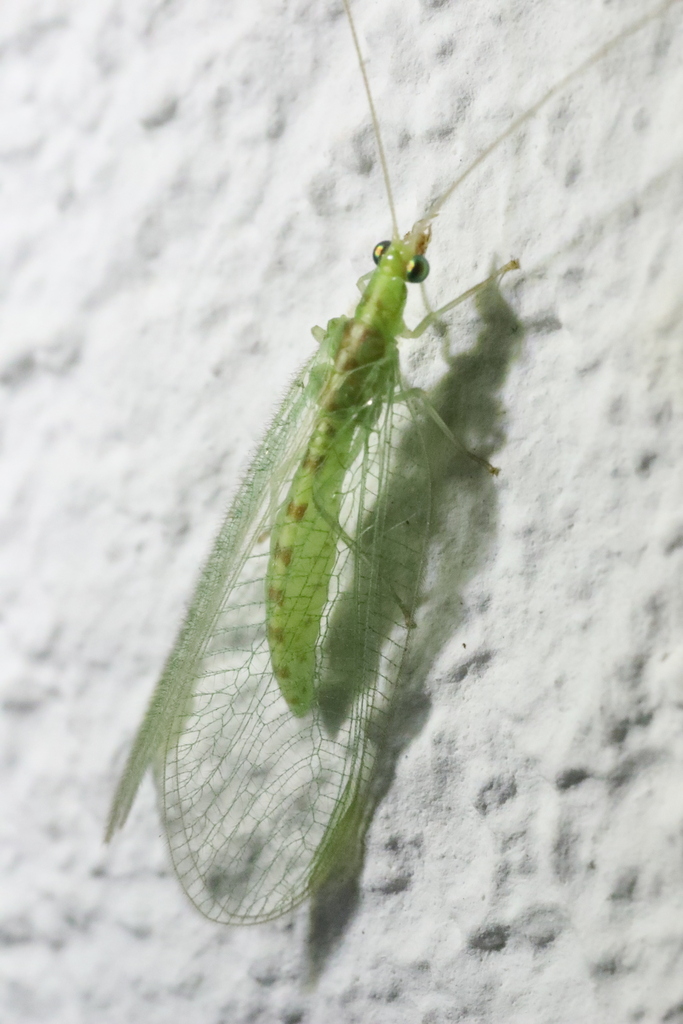
Chrysoperla carnea
Chrysoperla carnea, one of the species of common green lacewing, is an insect in the Chrysopidae family. Although the adults feed on nectar, pollen and aphid honeydew, the larvae are active predators and feed on aphids and other small insects. It has been used in the biological control of insect pests on crops.
Chrysoperla carnea was originally considered to be a single species with a holarctic distribution but it has now been shown to be a complex of many cryptic, sibling subspecies. These are indistinguishable from each other morphologically but can be recognised by variations in the vibrational songs the insects use to communicate with each other, which they especially do during courtship.
From the article Chrysoperla carnea on Wikipedia (CC BY-SA), quoted section by section
Description
The green lacewing eggs are oval and secured to the plant by long slender stalks. They are pale green when first laid but become gray later. The larvae are about one millimetre long when they first hatch. They are light brown to cream coloured, often with markings, and have been compared in appearance to small alligators, crawling actively around in search of prey. They have a pair of pincer-like mandibles on their head with which they grasp their prey, sometimes lifting the victim off the leaf surface to prevent its escape. The larvae inject enzymes into the bodies of their victims which digest the internal organs, after which they suck out the liquidated body fluids. The larvae grow to about eight millimetres long before they spin circular cocoons and pupate. Adult green lacewings, with a main body length of around 11-12 mm, are a pale green colour with long, threadlike antennae. They have four wings, and golden coloured compound eyes. They are weak fliers and have a fluttery form of flight. They are often seen during the evenings and at night when they are attracted by lights. The high green sensitivity of the superposition eyes allows the green lacewings to recognize fresh green leaves that they use to find honey dew produced by aphids, a site for egglaying and a resting place.
Range & habitat
Chrysoperla carnea is a widespread European species. They are often found in hedgerows and woodland. Due to taxonomic revisions to the genus, in particular the Chrysoperla carnea species group, the exact geographic bounds of the species remain in question. As of 2009, two of the primary candidates for the true C. carnea are designated as Cc2 ("slow motorboat") and Cc4 ("motorboat"). Cc2 is the more restricted of the two candidates, only extending from central Spain north to England and east to Greece and Hungary. Cc4 is more widespread, ranging from the Southern Alps to the north through the United Kingdom and into the southern portion Fennoscandia and to the east to western or central Russia. Both candidates also differ in terms of habitat, with Cc2 being restricted to warmer elevations of below 1,000 meters whereas Cc4 is more tolerant of the cold and ranges into elevations above 1,000 meters.
Wikipedia: “Distribution and habitat”
What it does
The green lacewing adults overwinter buried in leaf litter at the edge of fields or other rough places, emerging when the weather warms up in spring. Each female lacewing lays several hundred small eggs at the rate of two to five per day, choosing concealed spots underneath leaves or on shoots near potential prey. The eggs are normally laid during the hours of darkness. The larvae hatch in three to six days, eat voraciously and moult three times as they grow. They feed not only on aphids but also on many other types of insects such as thrips, mites, whiteflies, and lepidopteran eggs. After two to three weeks, the mature larvae secrete silk and build round, parchment-like cocoons in concealed positions on plants. From these, the adults emerge eleven to thirteen days later. The length of the life cycle (under 4 weeks in summer conditions) is greatly influenced by the temperature and there may be several generations each year under favourable conditions.
Wikipedia: “Life cycle”
Listen
Looking for field recordings…
Where it lives
Recorded sightings
—
geo-referenced records in GBIF, from museums, herbaria and field observers.
Drag the globe to turn it. Dots are where records exist, not a range map; darker means more records.
In the stacks
Searching the stacks…
Every page naming Chrysoperla carnea in the Biodiversity Heritage Library →
This page is assembled live from iNaturalist, GBIF, Wikipedia, the Source Library and the Internet Archive. It is not yet part of the hand-edited codex. iNaturalist taxon 311581.