On eBird ↗
Ruddy Pigeon
Live sightings near you, the range map, bar charts of when it is seen, and Macaulay Library photos and recordings.
Ruddy Pigeon
Patagioenas subvinacea
The ruddy pigeon (Patagioenas subvinacea) is a largish pigeon which breeds from Costa Rica south to western Ecuador, Bolivia, and central Brazil. It belongs to a clade of small and rather plain species of Patagioenas with characteristic calls that constitute the subgenus Oenoenas. Like the other New World pigeons, it was formerly united with their Old World relatives in Columba, but today the New World genus Patagioenas is recognized as distinct again.
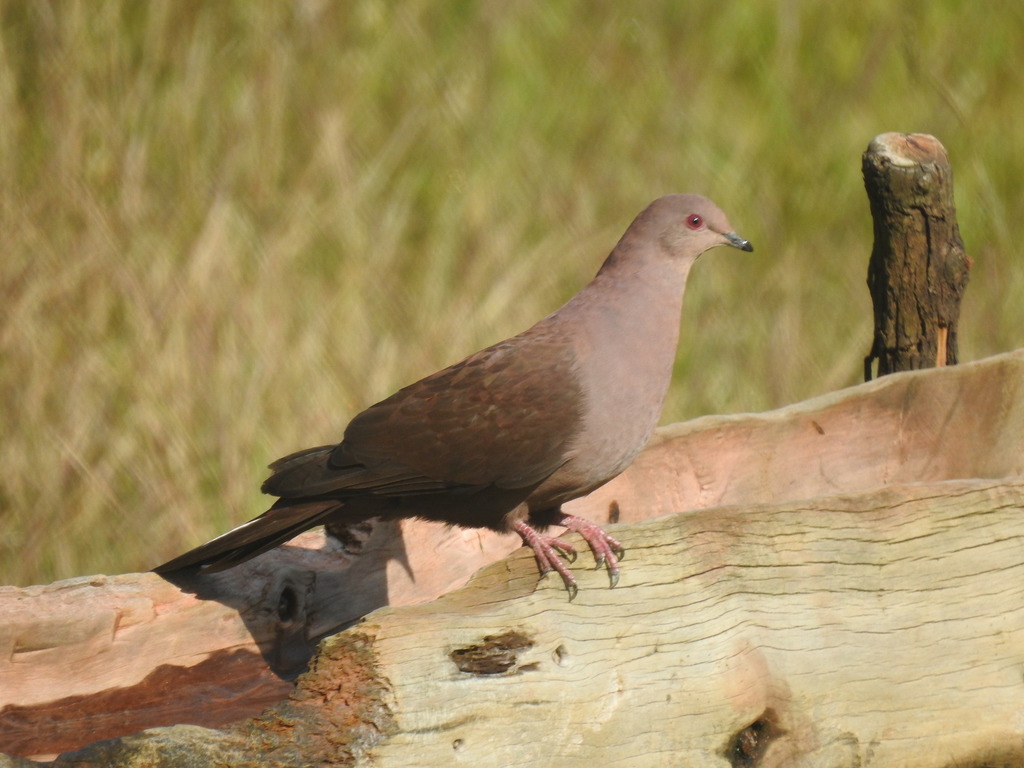
The ruddy pigeon is 28 cm (11 in) long and weighs 170 g. It is unpatterned and mainly wine-purple in colour, becoming more rufous on the back. The tail and primary flight feathers are dark brown, the bill is black, and the legs are purple-red. The iris is typically red, but can, at least in the Amazon basin, sometimes be dull yellow (however, due to the red eye-ring, the iris never appears as conspicuously white as in adults of the sympatric subspecies of the plumbeous pigeon, P. plumbea). The female is slightly duller and browner than the male, and the juvenile bird has a greyish brown head, neck and breast, with cinnamon or rufous scaling on the head and upperparts.
Listen
Looking for field recordings…
Where it lives
Recorded sightings
—
geo-referenced records in GBIF, from museums, herbaria and field observers.
Drag the globe to turn it. Dots are where records exist, not a range map; darker means more records.
In the stacks
Searching the stacks…
Every page naming Patagioenas subvinacea in the Biodiversity Heritage Library →
This page is assembled live from iNaturalist, GBIF, Wikipedia, the Source Library and the Internet Archive. It is not yet part of the hand-edited codex. iNaturalist taxon 3095.