On eBird ↗
Bolle's Pigeon
Live sightings near you, the range map, bar charts of when it is seen, and Macaulay Library photos and recordings.
Bolle's Pigeon
Columba bollii
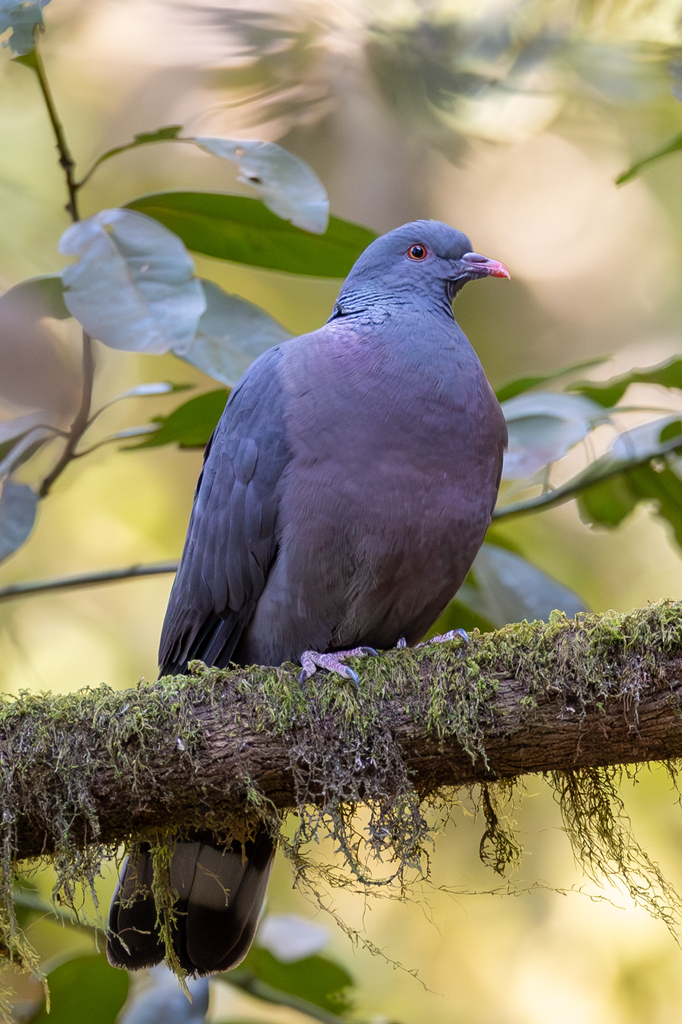
Bolle's pigeon, Bolle's laurel pigeon or dark-tailed laurel pigeon (Columba bollii) is a species of pigeon in the genus Columba that is endemic to the Canary Islands, Spain. This bird is named after the German naturalist Carl Bolle, who was the first to distinguish it from the laurel pigeon. This wood pigeon is endemic to the laurel forest habitat.
From the article Bolle's pigeon on Wikipedia (CC BY-SA), quoted section by section
Description
Larger than the common pigeon, a length of 36 cm to 38 cm. It is a large dark grey pigeon. At 37–40 cm, it looks like a very dark wood pigeon. Its dark grey, rather than brown, plumage and the dark bands on the grey tail distinguish it from the other pigeon endemic to the Canary Islands, the laurel pigeon. It is a basically dark grey bird, with a pinkish breast. It lacks any white markings, which together with its darker plumage distinguishes it from the other species. With red beak, most intense at the tip. Head relatively large, slate grey, in males, with bluish or greenish metallic side of the neck and back of neck. Eyes rounded, yellow to orange with black pupil and lightly framed by a thin, flesh-coloured eye ring. Back, rump and wings brownish grey, which in adult males with metallic blue shoulders. The primary and secondary remiges are blackish brown. The chest, blue-dark grey, stained purple in males. Belly is pale grey pastel. Females, less conspicuous, do not hold the highlights, reflections and metallic hues, and even the colours are more 'grey' and off. Mainly dark grey with blacker flight feathers and paler grey tail with dark terminal band, hindneck with green and pink gloss and reddish tinge to breast. Only likely to be confused with white-tailed laurel pigeon Columba junoniae or dark feral pigeon. The voice is a guttural mournful cooing. …
Range & habitat
It is a resident breeder in the mountain laurisilva forest zone. Bolle's pigeon builds a stick nest in a tree, laying one white egg. Columba bollii occurs on Tenerife particularly at Anaga and Teno, La Palma in a restricted area of the north-east), La Gomera in Garajonay National Park with some birds outside the park, and El Hierro where it occurs in Golfo and Sabinosa in the Canary Islands, Spain. It may formerly have occurred on Gran Canaria, as bones similar to those of a laurel pigeon have been found and there is a possible sight record from the late 19th century. It was common in the past, but disappeared from many areas owing to clearance of laurel forest in the islands. More recently the rate of laurel forest clearance has been slowed or stopped. Population estimates for the species are 1,160-1,315 birds in 1980, 6,000 individuals in 2001, and 5,000-20,000 most recently. …
Wikipedia: “Distribution and population”
What it does
Breeding occurs in trees especially in February–June. The nest, somewhat more elaborate than those of other pigeons, is built on the upper branches of a tree, with pieces of sticks and twigs, forming the classic platform, which is usually lined with mosses and lichens briefly. It lays one or two eggs. The egg hatch after a shared incubation of eighteen days. Frugivore which eat drupes or fruits of Azores laurel (Laurus azorica), Viñátigo (Persea indica), Til (Ocotea foetens) and fruit of faya (Myrica faya) but can consume alternately diverse sweet acorns, hazelnuts, other nuts, and berries.
Wikipedia: “Ecology”
Listen
Looking for field recordings…
Where it lives
Recorded sightings
—
geo-referenced records in GBIF, from museums, herbaria and field observers.
Drag the globe to turn it. Dots are where records exist, not a range map; darker means more records.
In the stacks
Searching the stacks…
Every page naming Columba bollii in the Biodiversity Heritage Library →
This page is assembled live from iNaturalist, GBIF, Wikipedia, the Source Library and the Internet Archive. It is not yet part of the hand-edited codex. iNaturalist taxon 3055.