On eBird ↗
Snow Pigeon
Live sightings near you, the range map, bar charts of when it is seen, and Macaulay Library photos and recordings.
Snow Pigeon
Columba leuconota
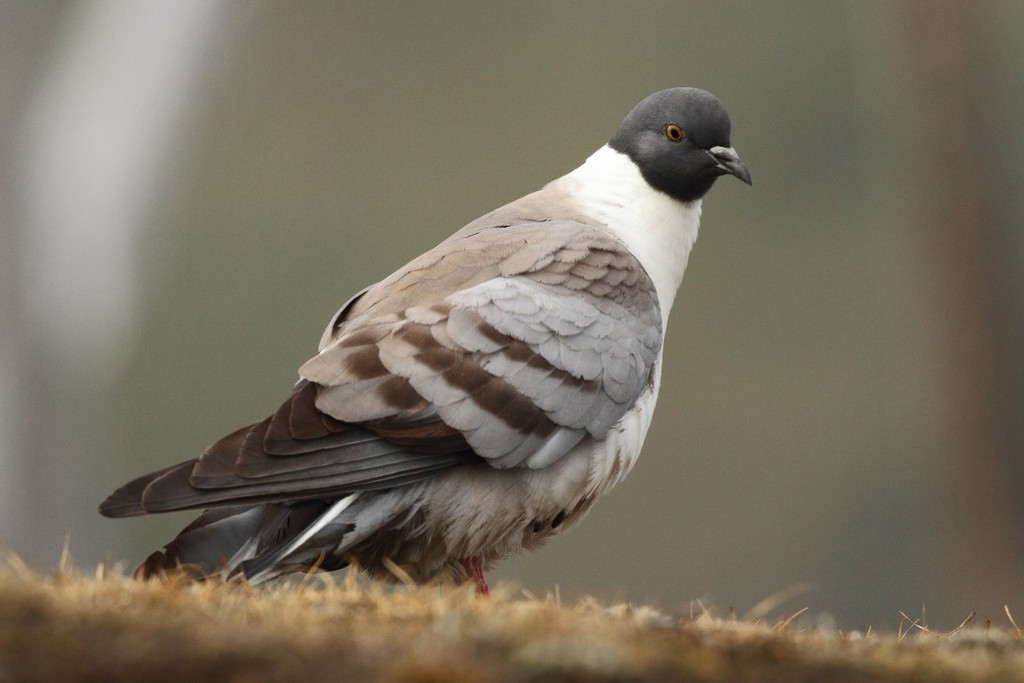
The snow pigeon (Columba leuconota) is a species of bird in the genus Columba in the family Columbidae from hilly regions of central Asia. They are grey, black, pale brown and white birds and two subspecies are recognised: C. l. leuconota occurs in the western Himalayas from western Afghanistan to Sikkim and C. l. gradaria occurs in the mountains of eastern Tibet and from eastern Nan Shan (Qinghai) to Yunnan and extreme northern Myanmar. The birds forage in open country in pairs or small groups, feeding on grain, buds, shoots, berries and seeds. They roost at night on cliffs, breeding in crevices where they build untidy stick nests and lay a clutch of usually two white eggs. The International Union for Conservation of Nature has rated the bird's conservation status as being of least concern.
From the article Snow pigeon on Wikipedia (CC BY-SA), quoted section by section
Description
Snow pigeons have a blackish head contrasting with a white neck collar and white underparts shading into ashy on the abdomen. Their backs are brownish-grey with a white patch on the lower back. Their wings are pale grey with three brown bands. Their black tails have a clear white band in the middle which narrows and curve forward to reach the tip of the outermost tail features. Young birds have narrow, pale buff margins to the feathers of the upper parts and wings. The white of the underparts is sullied with buff.
Range & habitat
They are resident birds in rocky hills of Afghanistan, Bhutan, China, India, Kazakhstan, Myanmar, Nepal, Pakistan, Tajikistan, and Turkmenistan. It is a common bird and has an extremely large range. The population is believed to be stable and for these reasons, the International Union for Conservation of Nature has assessed its conservation status as being of least concern.
Wikipedia: “Distribution and status”
What it does
They frequent rocky hill sides and sequestered valleys, seen up to the snow line. They frequently feed in the fields during the day, but roost in the cliffs. They are generally shy and wary. Gatherings of 150 or more occur in winter, often in the company of hill pigeons and in some areas with rock doves also.
In the summer, they descend to lower heights and are found in pairs or small flocks. They breed in colonies. The nests are placed in crevices or caves in the face of cliffs or ledges of rock. Their nests are untidy interlaced structures made of sticks, grass, straw, feathers, etc. The nests are generally reused every year with minor repairing. Generally, two eggs are laid. They feed on berries, grain, buds, bulbs, seeds, and shoots.
Wikipedia: “Behaviour and ecology”
Listen
Looking for field recordings…
Where it lives
Recorded sightings
—
geo-referenced records in GBIF, from museums, herbaria and field observers.
Drag the globe to turn it. Dots are where records exist, not a range map; darker means more records.
In the stacks
Searching the stacks…
Every page naming Columba leuconota in the Biodiversity Heritage Library →
This page is assembled live from iNaturalist, GBIF, Wikipedia, the Source Library and the Internet Archive. It is not yet part of the hand-edited codex. iNaturalist taxon 3045.