 NL·0370
Herbarium of the Nature Library
- Name
- Columba livia
- Family
- Columbidae
- Native to
- Europe, North Africa and Western and South Asia; feral populations worldwide
- Habitat
- Sea cliffs, Cities, Farmland
On eBird ↗
Rock Pigeon
Live sightings near you, the range map, bar charts of when it is seen, and Macaulay Library photos and recordings.
Rock dove (feral pigeon)
Columba livia
Also calledKabūtar (Hindi/Urdu/Persian) · Ḥamām (Arabic) · Gēzi (Chinese, 鸽子) · Paloma bravía (Spanish) · Njiwa (Swahili)
The wild ancestor of the domestic and city pigeon, probably the first bird tamed by humans. Homing pigeons can find their way back from hundreds of kilometres away, and carried messages for armies for millennia.
The rock dove, also known as the common pigeon or rock pigeon, is a member of the bird family Columbidae. In common usage, it is often simply referred to as the "pigeon", although the rock dove is the wild form of the bird; the pigeons familiar to most people are the domesticated forms of the wild rock dove. Wikipedia
What it can do
- iHomes over 1,000 km using sun compass, magnetic sense and landmarks
- iiPossibly uses low-frequency infrasound for navigation
- iiiBoth parents feed chicks 'crop milk'
- ivTrained to tell paintings by Monet from Picasso (Watanabe et al. 1995)
- vCan recognise individual human faces
In the field
Field marks
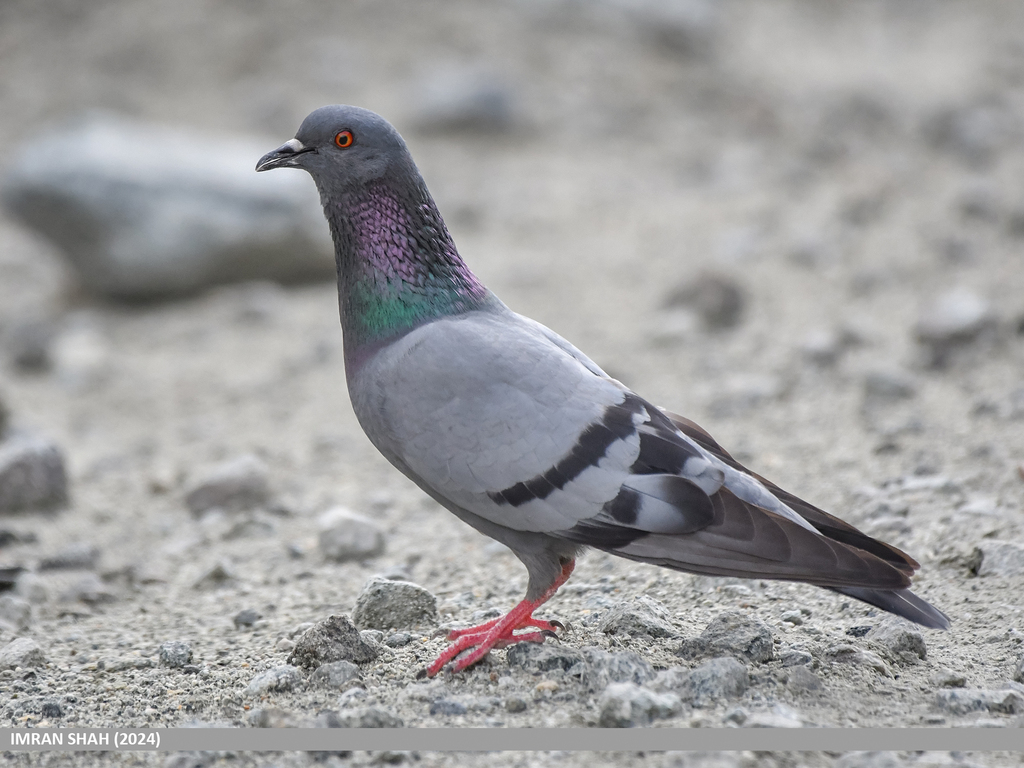
- aBlue-grey pigeon with an iridescent green-purple neck
- bTwo broad black bars on each wing
- cWhite rump (wild type)
- dFeral birds come in many colours
- Voice
- Soft, cooing 'oo-roo-coo'
- Not to be confused with
- Stock dove has no white rump and only short black wing bars. Woodpigeon is larger with a white neck patch and white wing bands.
- Where to see it
- Wild-type birds on sea cliffs of western Scotland and Ireland; feral flocks in almost every city
- When
- Resident
Listen
Looking for field recordings…
Life & habits
- Diet
- Seeds and grain; food scraps in cities
- Habitat
- Cliffs and ledges; buildings and bridges
- Size
- 29–37 cm
- Lifespan
- 3–5 years in cities; up to 15+ in captivity
Pairs raise up to six broods a year, breeding in almost any season.
Where it lives
Recorded sightings
—
geo-referenced records in GBIF, from museums, herbaria and field observers.
Native range
Europe, North Africa and Western and South Asia; feral populations worldwide
Drag the globe to turn it. Dots are where records exist, not a range map; darker means more records.
In the old herbals & bestiaries
Woodcuts and engravings matched from the Source Library’s scanned books by name. Plates marked “relative” show a close kin rather than this exact species. Click a plate to read the page it came from, with translation.


In the stacks
Searching the stacks…
Every page naming Columba livia in the Biodiversity Heritage Library →
Marginalia
Pigeon posts relayed news for the Persians, Romans and Mughals, and a pigeon named Cher Ami saved nearly 200 American soldiers in 1918. Darwin bred fancy pigeons to illustrate artificial selection in 'On the Origin of Species'.
Curiosity
Reuters began in 1850 using pigeons to carry stock prices between Aachen and Brussels.
Kinship

Photographs: iNaturalist contributors under the licences shown. Records: GBIF.org. Historical plates: Source Library (CC BY-SA 4.0; originals public domain). Summary text: Nature Library editors and Wikipedia (CC BY-SA). Medicinal and edibility notes are historical and educational, not advice. iNaturalist taxon 3017.