- Animals
- ›Arthropods
- ›Hexapods
- ›Insects
- ›Winged and Once-winged Insects
- ›Ants, Bees, Wasps, and Sawflies
- ›Narrow-waisted Wasps, Ants, and Bees
- ›Ants, Bees, and Stinging Wasps
- ›Vespoid Wasps
- ›Hornets, Paper Wasps, Potter Wasps, and Allies
- ›Paper Wasps
- ›Polistini
- ›Polistes
- ›Aphanilopterus
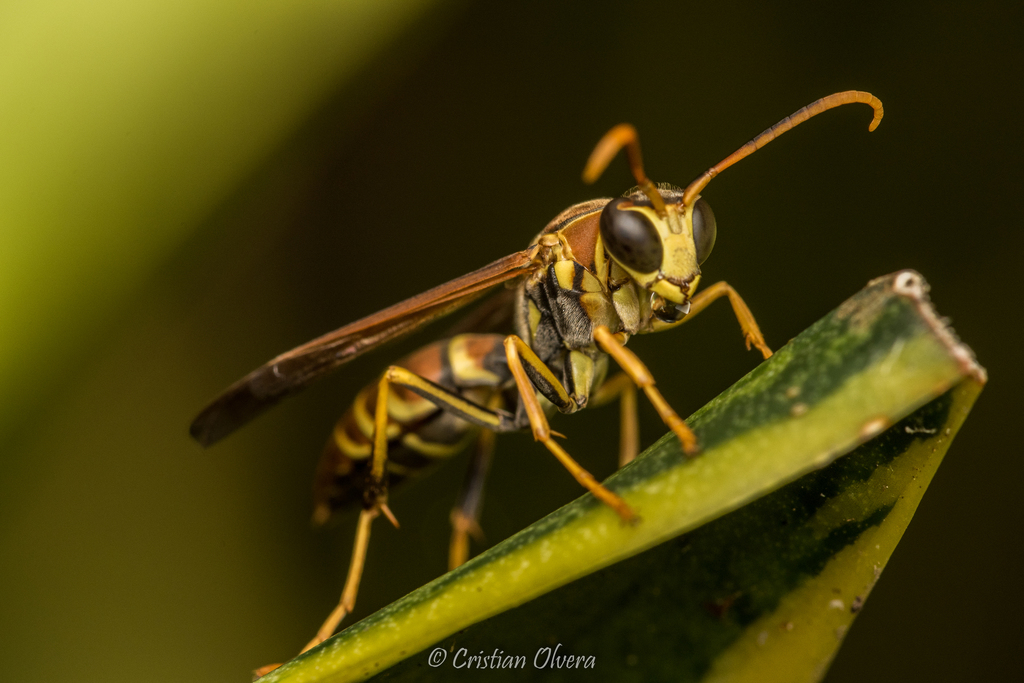
Unstable Paper Wasp
Polistes instabilis
Polistes instabilis, or Unstable paper wasp is a type of paper wasp, is a neotropical, eusocial wasp (family Vespidae) that can be found in tropical and subtropical areas such as Central America and South America. It can be easily identified with its characteristic yellow, brown, and reddish markings, and it builds nests made from chewing plant fibers and making them into paper.
Colonies are usually initiated in the spring after the foundresses have emerged from the winter. Either one or a few queens found each colony by laying eggs, which develop into workers. Although there are no morphological differences between queens and workers, queens can be identified easily by their dominant interactions with workers. While queens are responsible for laying eggs, workers are responsible for gathering materials for the nest, tending to the young, and foraging for food. This species tends to feed on nectar as well as arthropods such as caterpillars.
From the article Polistes instabilis on Wikipedia (CC BY-SA), quoted section by section
Description
Polistes wasps, including Polistes instabilis, are large social wasps with yellow, brown and reddish markings. Body size ranges between 0.51–0.98 in (13–25 mm) with wings that are about 0.55 in (14 mm), which are folded longitudinally against the body. Male Polistes are typically smaller than females, have a yellow face, and hold their antenna curled at the tips, while females hold their antenna straight at the tips and have more dark markings on their faces. Nests are constructed with paper substance made by chewing up plant fibers, and they are typically connected a surface by a stalk. The cells of the nest are not covered as they are in some other wasp species.
Wikipedia: “Description and identification”
Range & habitat
Polistes instabilis can be found in tropical and subtropical areas. These include Central and South America, specifically Mexico, Belize, Guatemala, Honduras, Nicaragua and Costa Rica. Those found in Costa Rica tend to live in the lowlands, in dry forested areas. Once the rainy season ends in December, individuals migrate to higher elevation to wait out the winter. In the Yucatán Peninsula (México), this species and Polistes stabilinus (with similar morphology and overlapping distributions in Mexico and Central America; might be a synonym of P. instabilis) are both called Xananch'ak (Poqomam Mayan, "red mosquito"), Nichak (Yucatec Mayan, "red nose") or Avispa papelera (Spanish, "paper wasp"). They can be spotted during the rainy season, mostly during August–September, in the Yucatecan sub-tropical forests. Sometimes in Yucatec Maya they can be referred as well as Xanabchak ("red shoes" or "lightning shoes"), possible due to the similar pronuntiation between both Poqomam and Yucatec Mayan lenguages and the geographical distribution of Polistes.
Wikipedia: “Distribution and habitat”
What it does
Polistes instabilis feeds on caterpillars as well as nectar. When hunting caterpillars, the workers chew up the caterpillars extensively before returning to the nest. They distribute the ingested liquid to larvae, and caterpillar remains to other workers. Foragers will take nectar from many different plants such as soapberry, sumacs, vauquelinia, and Apache plume.
Wikipedia: “Diet”
Listen
Looking for field recordings…
Where it lives
Recorded sightings
—
geo-referenced records in GBIF, from museums, herbaria and field observers.
Drag the globe to turn it. Dots are where records exist, not a range map; darker means more records.
In the stacks
Searching the stacks…
Every page naming Polistes instabilis in the Biodiversity Heritage Library →
This page is assembled live from iNaturalist, GBIF, Wikipedia, the Source Library and the Internet Archive. It is not yet part of the hand-edited codex. iNaturalist taxon 300637.