On eBird ↗
Metallic Pigeon
Live sightings near you, the range map, bar charts of when it is seen, and Macaulay Library photos and recordings.
Metallic Pigeon
Columba vitiensis
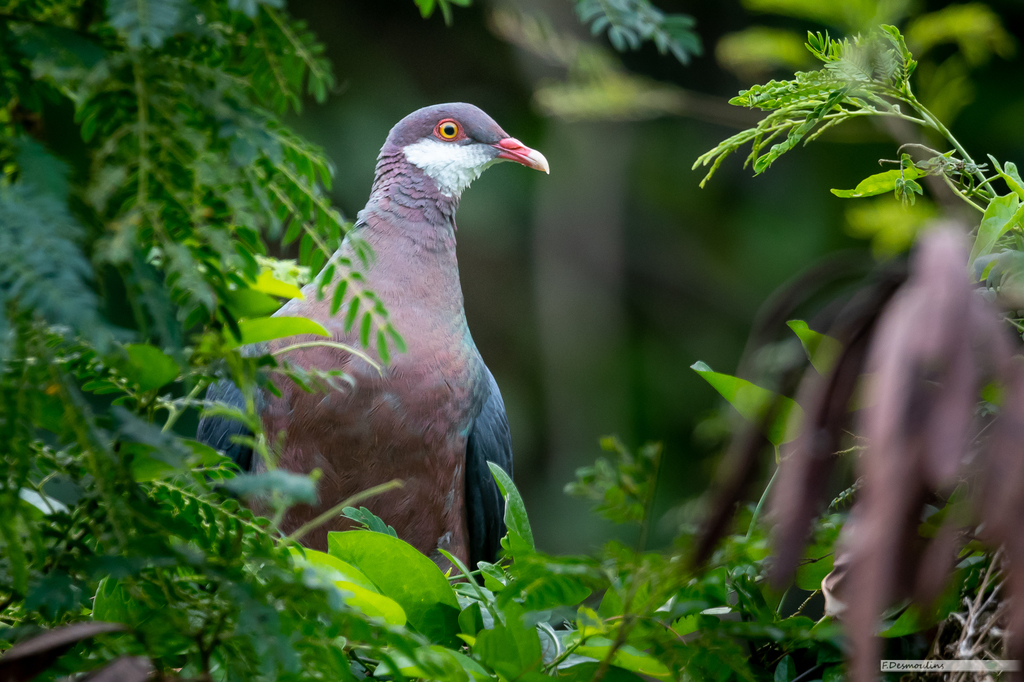
The metallic pigeon, (Columba vitiensis) also known as white-throated pigeon is a medium-sized, up to 37 cm long, bird in the family Columbidae.
From the article Metallic pigeon on Wikipedia (CC BY-SA), quoted section by section
Description
The adult has an iridescent purple and green crown, black wing and uppertail coverts, yellowish red iris, yellow bill, red orbital skin, white or grey chin and ear coverts, and purplish feet. It has a dull chestnut or glossed purple green below, depends on subspecies. The nominate form C. v. vitiensis from Fiji has dull underparts, while subspecies C. v. halmaheira has the most iridescent plumage. Both sexes are similar, though females are often duller. The young is duller than adult. Sexual dimorphism in throat colour is constant in several subspecies; for example, in C. v. vitiensis, males have white throats and cheeks, while females are washed with grey. This difference is noticeable even in juveniles. A pigmented malar spot and line beneath the eye is present in all subspecies except in C. v. castaneiceps.
Range & habitat
The metallic pigeon is distributed through the islands of Indomalaya, Australasia, and Oceania. It occurs in the Philippines, Indonesia after the Wallace Line (except Sulawesi), Papua New Guinea, the Solomon Islands, Vanuatu, New Caledonia, Fiji, and Samoa. It is also found on several small islands off the northwest coast of Borneo. The species likely reached Vanuatu from New Guinea and from where it spread to other Polynesian islands. While most subspecies are common within their respective ranges, C. v. halmaheira is considered uncommon on Bougainville and the Bismarck Islands. Similarly, C. v. metallica (Lesser Sundas metallic pigeon) is rare throughout its range, with the exception of Timor. The subspecies C. v. godmanae (Lord Howe pigeon), formerly endemic to Australia's Lord Howe Island, has been extinct since approximately 1853.
Wikipedia: “Distribution”
What it does
Rather than being long-distance migrants, these birds are nomadic, engaging in irregular, local movements between islands in search of food. They are typically found singly or in pairs. Their diet is diverse, consisting mainly of various fruits, grains, seeds, and berries. The average lifespan for this species is approximately 3 to 4 years.
Wikipedia: “Behaviour and diet”
Listen
Looking for field recordings…
Where it lives
Recorded sightings
—
geo-referenced records in GBIF, from museums, herbaria and field observers.
Drag the globe to turn it. Dots are where records exist, not a range map; darker means more records.
In the stacks
Searching the stacks…
Every page naming Columba vitiensis in the Biodiversity Heritage Library →
This page is assembled live from iNaturalist, GBIF, Wikipedia, the Source Library and the Internet Archive. It is not yet part of the hand-edited codex. iNaturalist taxon 3001.