On eBird ↗
Sunda Collared-Dove
Live sightings near you, the range map, bar charts of when it is seen, and Macaulay Library photos and recordings.
Sunda Collared-Dove
Streptopelia bitorquata
The Sunda collared dove (Streptopelia bitorquata), sometimes referred to as the island collared dove, Javanese turtle dove, Javanese collared dove, or Indonesian collared dove, is a species of bird in the family Columbidae. Sometimes confused with the Eurasian collared dove (Streptopelia decaocto) which is very similar in appearance, the Sunda collared dove is a small to medium-sized bird, native to the tropical and subtropical islands of Indonesia.
From the article Sunda collared dove on Wikipedia (CC BY-SA), quoted section by section
Description
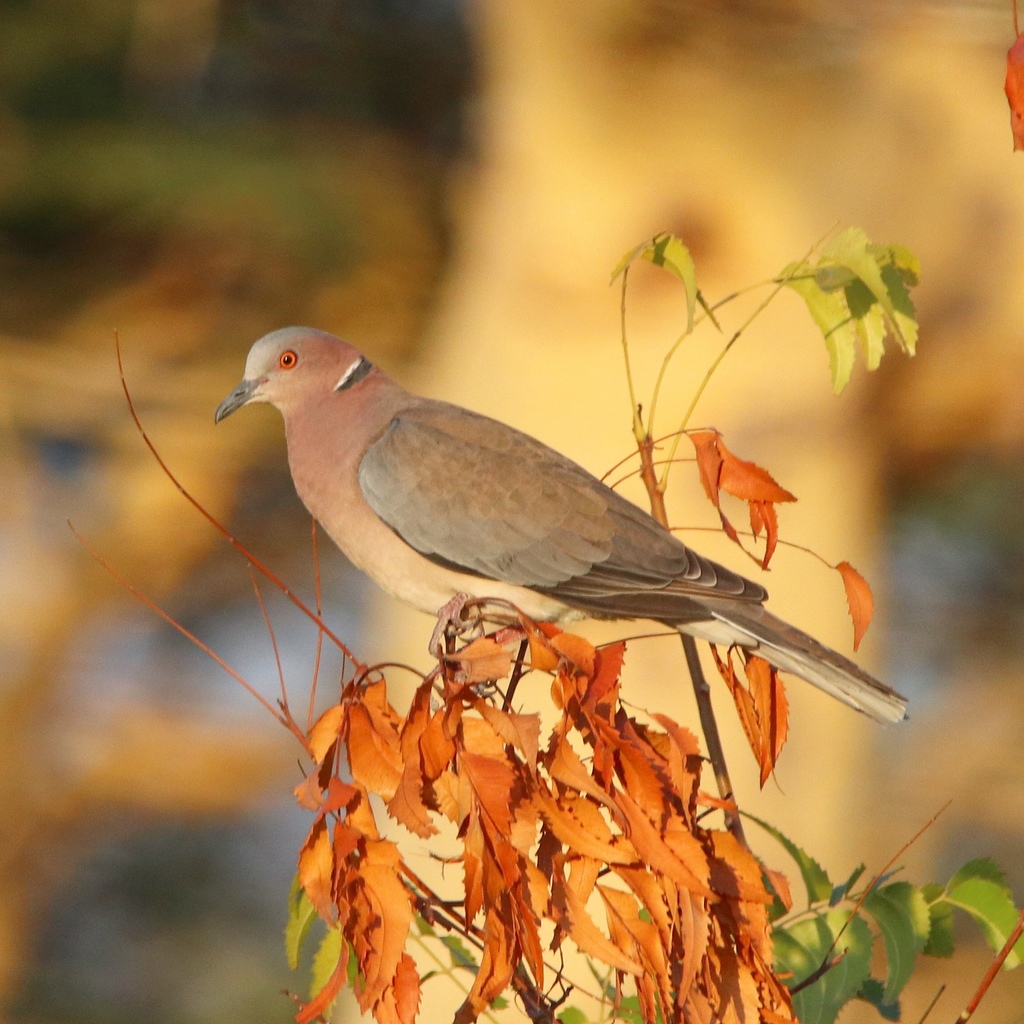
The Sunda collared dove is a small to medium-sized bird which has a light, rosy hue around the neck and chest area, fading into the underside of the bird which consists of a light caramel color, into a shade of cream at the base (start) of the tail. The start of the wings have a light grey tone, protruding to a steely grey hue near the end of the wing, all the way to the tip of the tail. The tail feathers under the bird are 'eggshell' white in colour. The birds tail consists of few layers from creamy colored to an ashen grey. The eye is quite rounded like that of most pigeons and doves. The eye color is a shade of orange caramel. The main distinguishing feature is a dusty black band that covers half the bird's neck. A white highlight can be seen above the band. The Philippine collared dove was once considered a subspecies, together known as the island collared dove.
Range & habitat
This species distribution occurs from Java and Bali, through to Komodo, Lombok, Sumbawa, Timor and Flores, Solor and, the Lesser Sunda Islands, Indonesia. Its natural habitats are subtropical or tropical moist lowland forest and subtropical or tropical mangrove forest.
Wikipedia: “Habitat”
What it does
The Sunda collared dove has a seasonal appetite like that of other collared doves, and mainly feeds on cereal grains, seeds found on the ground while scouring in low lying vegetation, they will also feed on berries in the autumn months. They have also been rarely spotted feasting on caterpillars, aphids, and other bugs at different times of the year or when their preferred prey is simply unavailable.
Wikipedia: “Diet”
Listen
Looking for field recordings…
Where it lives
Recorded sightings
—
geo-referenced records in GBIF, from museums, herbaria and field observers.
Drag the globe to turn it. Dots are where records exist, not a range map; darker means more records.
In the stacks
Searching the stacks…
Every page naming Streptopelia bitorquata in the Biodiversity Heritage Library →
This page is assembled live from iNaturalist, GBIF, Wikipedia, the Source Library and the Internet Archive. It is not yet part of the hand-edited codex. iNaturalist taxon 2972.