- Plants
- ›Vascular Plants
- ›flowering plants
- ›Dicots
- ›Sunflowers, Bellflowers, Fanflowers, and Allies
- ›Sunflowers, Daisies, Asters, and Allies
- ›Asteroideae
- ›bonesets, blazingstars, and allies
- ›Oxylobinae
- ›Ageratina
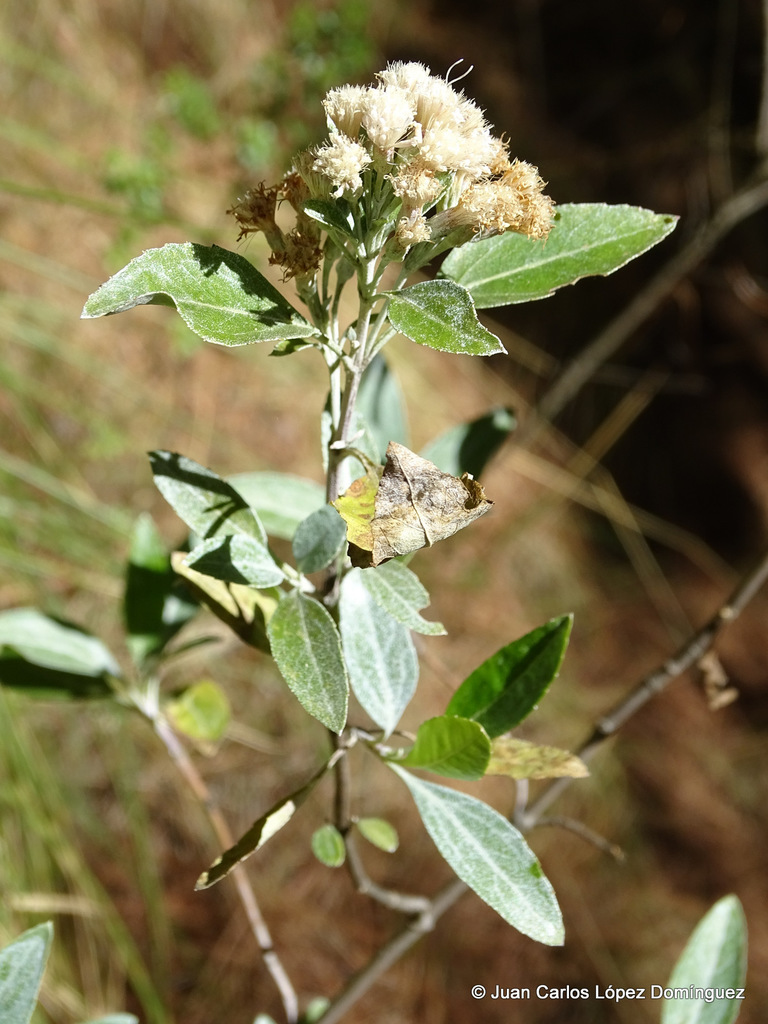
Ageratina glabrata
Ageratina glabrata is a flowering plant belonging to the huge Aster, Composite or Sunflower family, the Asteraceae.
From the article Ageratina glabrata on Wikipedia (CC BY-SA), quoted section by section
Description
Ageratina glabrata displays these main distinguishing features:
It is a woody shrub up to 2.4 meters tall (~8 feet). Its leaves, arising in pairs opposite one another, are longer than wide, with a pointed tip, and margins which are toothed to almost smooth. Blades are hairless and somewhat resiny-shiny, with the lower surface dotted with glands; leaf texture ranges from thin to somewhat leathery. Flowers are arranged in heads consisting only of 15-18 disk florets with cylindrical corollas; the heads are arranged in cyme-type inflorescences. Corollas are white, sometimes with pinkish lobes, and up to about 7 mm long (+3⁄16 inch). The fruit is a one-seeded, non-splitting, "cypsela" with a pappus almost as long as the corolla.
Range & habitat
Ageratina glabrata is endemic to Mexico, from the northern states of Sinaloa, Durango and Tamaulipas south to Oaxaca and Puebla.
Wikipedia: “Distribution”
What it does
Ageratina glabrata has a continuous flowering pattern throughout the year. Relative to closely related species, its greater height and cover suggest an adaptation to open environments.
Wikipedia: “Ecology”
In medicine
In Mexico, Ageratina glabrata is considered to have analgesic activity; one of its names is hierba del golpe, which can be translated loosely as 'plant for hits'. Preliminary results of controlled tests with rats using the "hot plate"and "tail flick tests" suggested that treatment with extracts of the plant provided analgesic effects for 5 hours after its administration. Another study, noting the shrub's traditional use for stomach pain and for postpartum baths, found that Ageratina glabrata contains antioxidants that might explain the usefulness.
Wikipedia: “In traditional medicine”
In human culture
The genus name Ageratina is based on another genus, Ageratum, plus the Latin diminutive suffix ina. Species in the two genera are very similar and dozens of species have been reassigned from Ageratum into Ageratina. The species epithet glabrata is based on the Latin glaber meaning 'smooth, bald', likely referring to the species' hairless leaves. In 1818, Kunth formally described the leaves of the type specimen as "... subcarosa, glabra...", suggesting the name glabratum.
Wikipedia: “Etymology”
Where it lives
Recorded sightings
—
geo-referenced records in GBIF, from museums, herbaria and field observers.
Drag the globe to turn it. Dots are where records exist, not a range map; darker means more records.
In the stacks
Searching the stacks…
Every page naming Ageratina glabrata in the Biodiversity Heritage Library →
This page is assembled live from iNaturalist, GBIF, Wikipedia, the Source Library and the Internet Archive. It is not yet part of the hand-edited codex. iNaturalist taxon 288759.