On eBird ↗
Rapa Fruit-Dove
Live sightings near you, the range map, bar charts of when it is seen, and Macaulay Library photos and recordings.
Rapa Fruit Dove
Ptilinopus huttoni
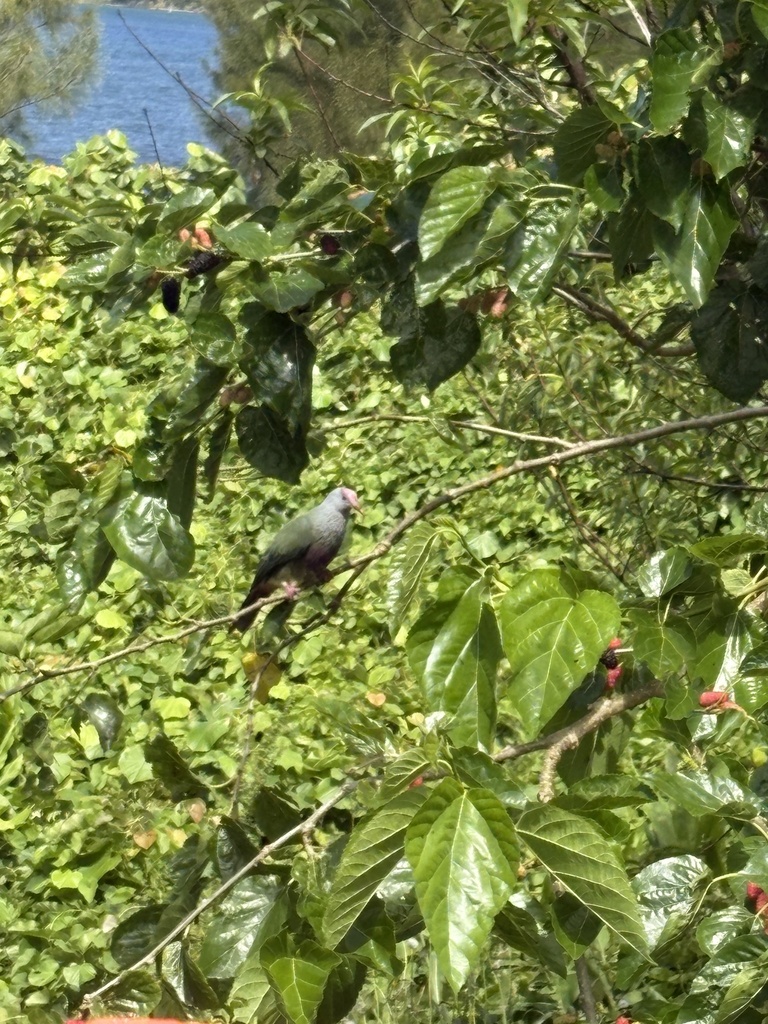
The Rapa fruit dove (Ptilinopus huttoni) is a species of bird in the family Columbidae, which includes pigeons and doves. It is endemic to the island of Rapa Iti in French Polynesia. The species was classified as Critically Endangered by the IUCN Red List in 2018 because of its small population and predicted continued decline. The Rapa fruit dove primarily feeds on fleshy fruit. Its natural habitat is subtropical or tropical moist lowland forests and it has an extent of 30 square kilometres (12 sq mi). It is threatened by habitat loss due to deforestation and invasive species. Effective land protection and management could increase the quality of habitat for the species. Additional research into population dynamics and the impact of threats to the species can give a better understanding of the conservation practices needed.
From the article Rapa fruit dove on Wikipedia (CC BY-SA), quoted section by section
Description
The Rapa fruit dove is approximately 31 centimetres (12 in) tall, making it a medium-sized dove. It is a colorful bird, with mostly green plumage, especially on its wings. Its foreparts (head, neck, chest, upper back) have blue-gray plumage. It has a yellow lower belly with a rose-purple band below its chest feathers. A distinguishing feature of the Rapa fruit dove is its bright pink crown, located on the face between the eyes. This species is endemic to the small island of Rapa Iti in the Austral Islands of French Polynesia and has an estimated extent of 30 square kilometres (12 sq mi). The population was estimated at 160 individuals in 2017, with all individuals in one subpopulation. Surveys carried out in 1989-1990 found a population of approximately 274, resulting in a 42% decline in population between the two surveys.
Wikipedia: “Description and range”
Range & habitat
The Rapa fruit dove's decreasing population size is caused by habitat loss. It lives in the forests of Rapa Iti, but very little of the island's original native forests remain. The destruction of the habitat was caused by logging, fires, and an increased need for grazing land for cattle and goats. The quality of the remaining habitat has diminished since the introduction of the invasive strawberry guava from South America. When left unchecked, the strawberry guava can grow uncontrollably in dense thickets and wreak havoc on ecosystems, choking out native species that the fruit dove relies on. Other invasive species, like feral cats, predate on the fruit doves and have been a factor in their decline.
Wikipedia: “Conservation threats to habitat”
What it does
The Rapa fruit dove lives in the remaining undisturbed forest fragments on the island and prefers an elevation between 40 – 450 meters. Rapa Iti has a tropical climate and the dove can be found in the moist lowland forests. They prefer the most wooded areas but can occasionally be found in the Caribbean pine plantations. As indicated by their name, the Rapa fruit dove primarily feeds on fleshy fruit from the various trees on the island, as well as nectar from some flowers. There are many productive native berry trees on Rapa Iti to sustain the dove. While the strawberry guava is an invasive species and a cause for habitat decline, it is possible that it is also a source of food for the dove. They eat while perched in the tree and pick or reach for the fruit. Since they are heavier than some other fruit doves, the Rapa fruit dove does not move out to the end of the branches, and instead must perform many contortions to reach the fruit.
Wikipedia: “Ecology”
Listen
Looking for field recordings…
Where it lives
Recorded sightings
—
geo-referenced records in GBIF, from museums, herbaria and field observers.
Drag the globe to turn it. Dots are where records exist, not a range map; darker means more records.
In the stacks
Searching the stacks…
Every page naming Ptilinopus huttoni in the Biodiversity Heritage Library →
This page is assembled live from iNaturalist, GBIF, Wikipedia, the Source Library and the Internet Archive. It is not yet part of the hand-edited codex. iNaturalist taxon 2836.