On eBird ↗
Superb Fruit-Dove
Live sightings near you, the range map, bar charts of when it is seen, and Macaulay Library photos and recordings.
Superb Fruit Dove
Ptilinopus superbus
The superb fruit dove (Ptilinopus superbus), also known as the purple-crowned fruit dove (leading to easy confusion with the purple-capped fruit dove), is a medium-sized (22–24 cm long), colourful fruit-dove in the family Columbidae.
From the article Superb fruit dove on Wikipedia (CC BY-SA), quoted section by section
Description
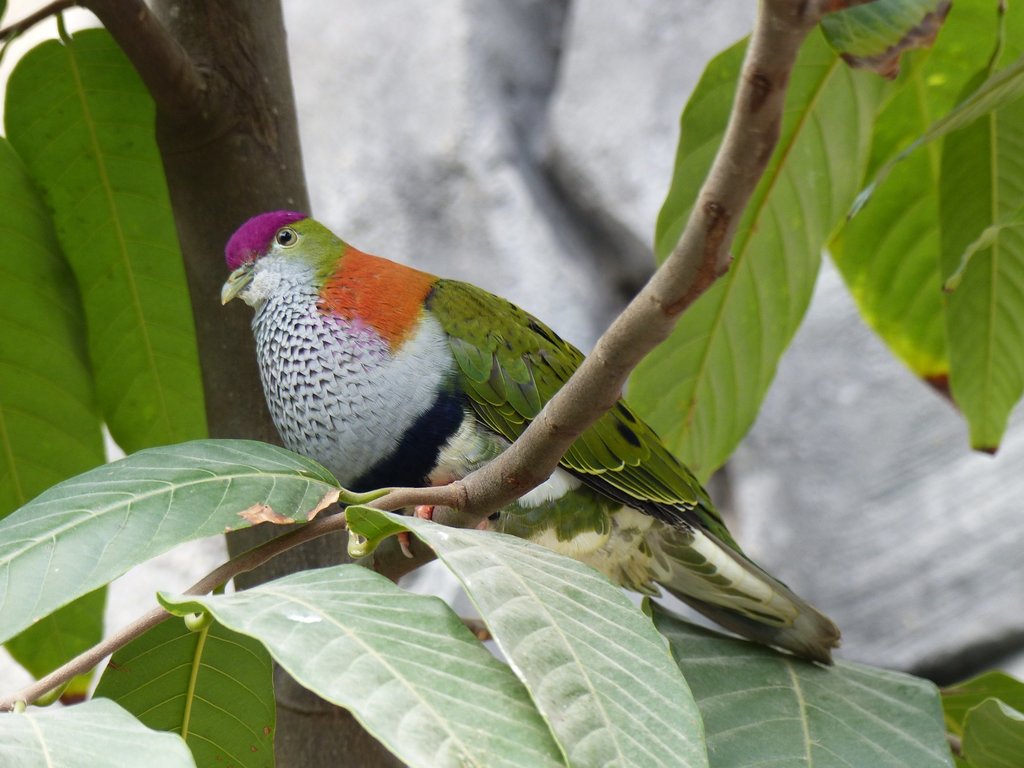
It is sexually dimorphic. Males are superbly coloured with a fiery orange nape, green ears, and a purple crown. The breast is grey, and divided from the abdomen by a wide, dark blue band. Their wings are olive green covered with dark spots, and the tail is tipped with white. Females are mostly green, with a white abdomen, blue wing tips, light blue breast, and a small, dark blue spot on the back of the head. Both sexes have yellow eyes and eye-rings. Despite its colourful plumage, the superb fruit dove is well-camouflaged amongst the rainforest foliage.
Range & habitat
Native to Australasia, the superb fruit dove lives in the rainforests of New Guinea, Australia, Solomon Islands, the Philippines and Sulawesi of Indonesia. In Australia, it is found from southern New South Wales around the town of Moruya and extends further north, where it becomes more common to Cape York in Queensland. In some areas of its range, such as the New Guinean rainforest, it is a resident bird; in more marginal or seasonal habitats such as those in Australia, flocks are known to move about according to the availability of food.
Wikipedia: “Range”
What it does
The superb fruit dove feeds primarily upon fruits and berries. In the Port Moresby area, the bulk of its diet was found to consist of figs, notably Ficus albipila and Ficus benjamina, Canarium australianum drupes, and Archontophoenix, Calamus and Livistona palm fruit. Also frequently eaten were the fruits of various cinnamon trees, Litsea, Neolitsea and Cryptocarya. Less important food were fruits of Ylang-ylang (Cananga odorata), Syzygium, and Vitex cofassus. They eat smaller fruit than some other fruit doves; the maximum recorded volume was 2.5 cm³; in a spherical fruit, a 1.7 cm diameter.
Wikipedia: “Diet”
Listen
Looking for field recordings…
Where it lives
Recorded sightings
—
geo-referenced records in GBIF, from museums, herbaria and field observers.
Drag the globe to turn it. Dots are where records exist, not a range map; darker means more records.
In the stacks
Searching the stacks…
Every page naming Ptilinopus superbus in the Biodiversity Heritage Library →
This page is assembled live from iNaturalist, GBIF, Wikipedia, the Source Library and the Internet Archive. It is not yet part of the hand-edited codex. iNaturalist taxon 2811.