- Plants
- ›Vascular Plants
- ›flowering plants
- ›Dicots
- ›Legumes, Milkworts, and Allies
- ›Legumes
- ›Faboideae
- ›Millettieae
- ›Tephrosia
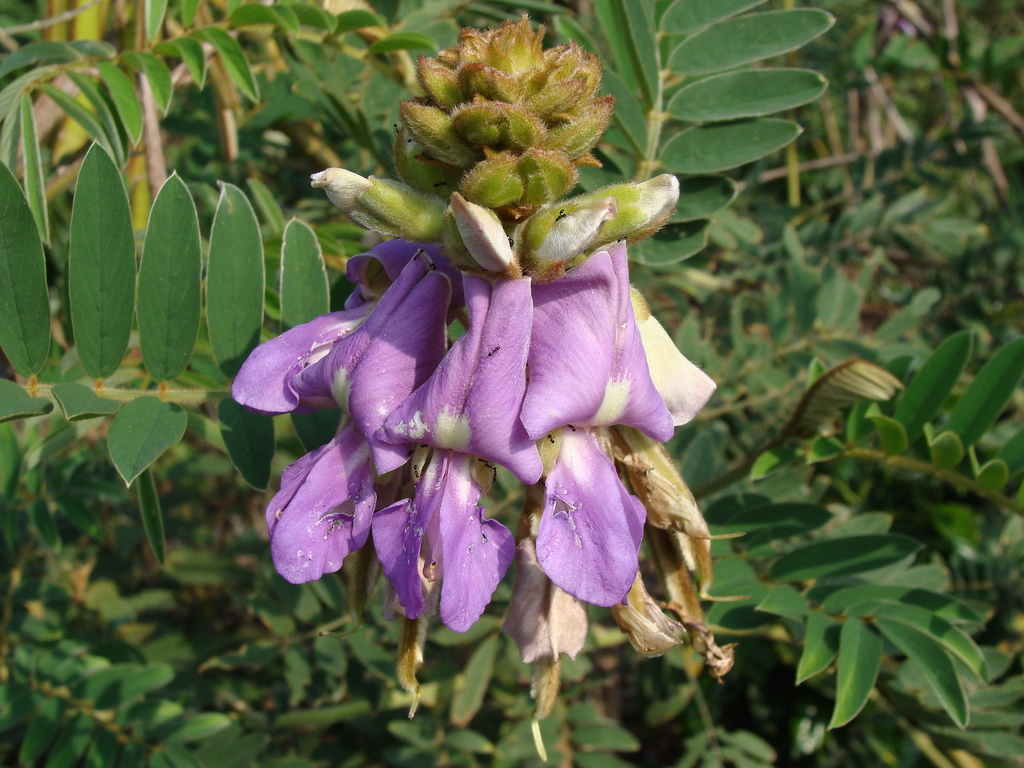
Fish-Poison Pea
Tephrosia vogelii
Tephrosia vogelii, the Vogel's tephrosia, fish-poison-bean or Vogel tephrosia (English), tefrósia (Portuguese) or barbasco guineano (Spanish), is a flowering plant species in the genus Tephrosia.
It is a herb or small tree that is native to tropical Africa and has also been used in tropical America as well as South and Southeast Asia. It is commonly used to deter pests and diseases, specifically fleas and ticks on animals. It is not suitable for livestock or human consumption because it is not highly nutritious and can be poisonous for fish and some other animals. Since it is a nitrogen-fixing plant, it can be intercropped with other plants and used as a source of green manure.
From the article Tephrosia vogelii on Wikipedia (CC BY-SA), quoted section by section
Description
Tephrosia vogelii is a soft, woody herb with dense foliage. It stands 0.5–4 m tall, and contains stems and branches with short and long white or rusty brown hairs. Long, narrow leaves branch out from stems, as well as sack like shapes that contain the seeds of the plant for reproduction.
At the table
Tephrosia can be used for various purposes besides human and livestock consumption which makes it a diverse and helpful plant. Its most common use is for organic tick control. First, leaves from the Tephrosia plant are ground up and a juice is extracted which is then used on the animal. The green liquid from the plant is mixed with water and is then applied to the animal's skin with a piece of cloth or a sponge. A little bit of soap can be added to the liquid to make it stick to the skin. Usually it is left on the animal for a week after which results appear. It is only effective against ticks that still have soft skin and are immature. This is a great practice for farmers that do not have access to veterinary medicine. Tephrosia can also be used as a fish poison, because chemicals in the plant react to chemicals in the fish and stupefy them so they can be easily caught. Tephrosia vogelii is not used for human or livestock consumption, although another great use is for a natural, organic pesticide on farmer's crops. Its leaves contain high amounts of nutrients, including nitrogen, which is important for good plant development 3. …
Wikipedia: “Uses of Tephrosia”
How it is grown
When it comes to its growing conditions, Tephrosia vogelii comes with many benefits. Firstly, it only takes three months to mature. It is also good as a shade or boundary crop and can be planted between rows of other plants or around the circumference. Planting of Tephrosia should be done at the beginning or middle of the rainy season in the region. It is found in various habitats and can adapt to many different climates and weather types. Tephrosia is grown in vegetations similar to the savannah, grassland areas, forest margina, shrubland, wasteland and fallow fields. Since it is highly adaptable, this plant a great option to grow in most areas. Tephrosia reproduces through seeds. Without pesticide and chemical treatment, the seedling survival rate is 60%. Germination is stimulated when it is soaked in warm water. Since it grows slowly, it does not compete with maize or other crops, though there may be some competition with weeds. Planting stations require weeding and care during the beginning of the growth period. It is tolerant to pruning, drought, strong wind, and grazing. However, drought often stops it from re-sprouting, so the more water it has, the more successful it will be for future use.
Wikipedia: “Growing conditions”
In human culture
Tephrosia vogelii is native to tropical Africa. It was introduced as a cover crop in tropical America as well as South and Southeast Asia. In 1908, it was introduced to Java and is now grown and found throughout regions of Malesia. In Sub-Saharan Africa, Tephrosia vogelii is a wild growing plant. Traditionally in Kenya, it has been used by Samburu and Maasai pastoralists to get rid of ticks on their livestock. Recently, it has been investigated for its use within smallscale dairy herds in Mashonaland Central Province in Zimbabwe. Striking similarities have been found between Tephrosia extract and Triatix dip, which is the most common conventional acaricide. Research has revealed that there is no difference between the two, and Tephrosia has been recommended for smallscale farmers in regions where veterinary drugs are not readily available.
Wikipedia: “History, geography and ethnography”
Where it lives
Recorded sightings
—
geo-referenced records in GBIF, from museums, herbaria and field observers.
Drag the globe to turn it. Dots are where records exist, not a range map; darker means more records.
In the stacks
Searching the stacks…
Every page naming Tephrosia vogelii in the Biodiversity Heritage Library →
This page is assembled live from iNaturalist, GBIF, Wikipedia, the Source Library and the Internet Archive. It is not yet part of the hand-edited codex. iNaturalist taxon 280795.