- Plants
- ›Vascular Plants
- ›flowering plants
- ›Dicots
- ›Sunflowers, Bellflowers, Fanflowers, and Allies
- ›Sunflowers, Daisies, Asters, and Allies
- ›Asteroideae
- ›asters and allies
- ›Machaerantherinae
- ›Hazardia
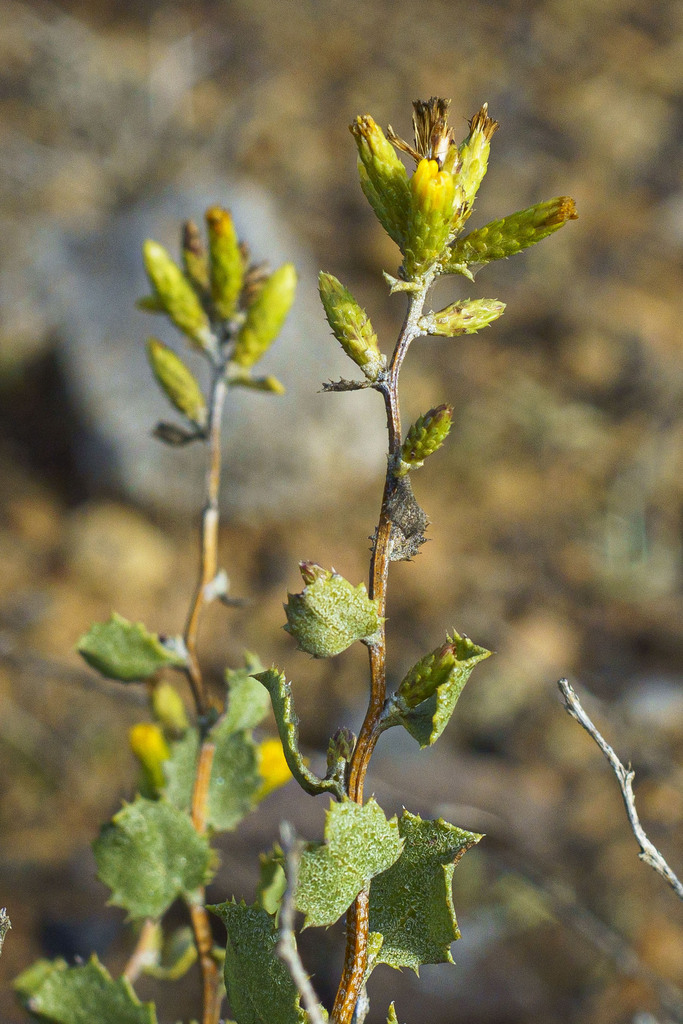
El Rosario Goldenbush
Hazardia rosarica
Hazardia rosarica is a species of flowering shrub in the family Asteraceae commonly known as the El Rosario goldenbush. Hazardia rosarica is a fragrant shrub characterized by its zigzagged branches, toothed glutinous leaves, and yellow flower heads of only disc flowers. This species is endemic to Mexico and is only found in the region near of the town of El Rosario in Baja California. It is usually found on north and east facing slopes and ridgetops close to the coast.
From the article Hazardia rosarica on Wikipedia (CC BY-SA), quoted section by section
Description
Hazardia rosarica is a shrub characterized by its lemony fragrance, glabrous zigzagged branches, toothed glutinous leaves, and yellow flower heads that only contain disc flowers. It is most similar to the polytypic Hazardia squarrosa, whose southern subspecies grindelioides approaches the range of H. rosarica, and both species share a lack of ray flowers. However, H. squarrosa is a much taller, larger shrub with a characteristic pubescence on its stems and a different fragrance, as opposed to H. rosarica with its smaller stature, completely hairless stems and sweet, lemony fragrance.
Morphology. Hazardia rosarica is a glutinous, fragrant shrub 2–9 dm (7.9–35.4 in) tall, with many erect to ascending branches emerging from a woody base. The branchlets are zigzag, and in youth are very tan and measure 1 mm (0.039 in) in diameter but become gray and measure up to 3 mm (0.12 in) thick in age. The internodes average around 5–15 mm (0.20–0.59 in), and the branchlets are glabrous and have glutinous to granular surfaces. The leaves range from sessile to subpetiolate, rarely with auriculate-clasping or subclasping bases, and are shaped obovate to spatulate with obtuse to rounded-acute tips. The leaves measure 10–25 mm (0.39–0.98 in) long by 5–12 mm (0.20–0.47 in) and 1–2 mm (0.039–0.079 in) wide at the base. …
Range & habitat
Hazardia rosarica is endemic to Mexico, and is only found in the state of Baja California. It occurs along the coastal foothills from northeast of El Socorro to the southeast of the town of El Rosario, usually within 8 km (5.0 mi) to 12 mi (19 km) of the coast. Hazardia rosarica is typically found at 75 m (246 ft) to 475 m (1,558 ft) in elevation on north and east facing slopes and ridgetops, and it usually grows in association with Agave shawii, Rosa minutifolia, Euphorbia misera, and Ambrosia chenopodiifolia. Other associates include Aesculus, Dudleya, and Bergerocactus, and Hazardia vernicosa. Although endemic to a small area, it is typically locally abundant where it is found.
Wikipedia: “Distribution and habitat”
At the table
In the protologue, Moran reported that most natives of El Rosario did not have a name for the plant, but that one man said the plant was used in a remedy for toothache.
Wikipedia: “Uses”
Where it lives
Recorded sightings
—
geo-referenced records in GBIF, from museums, herbaria and field observers.
Drag the globe to turn it. Dots are where records exist, not a range map; darker means more records.
In the stacks
Searching the stacks…
Every page naming Hazardia rosarica in the Biodiversity Heritage Library →
This page is assembled live from iNaturalist, GBIF, Wikipedia, the Source Library and the Internet Archive. It is not yet part of the hand-edited codex. iNaturalist taxon 280299.