On eBird ↗
Golden Dove
Live sightings near you, the range map, bar charts of when it is seen, and Macaulay Library photos and recordings.
Golden Dove
Ptilinopus luteovirens
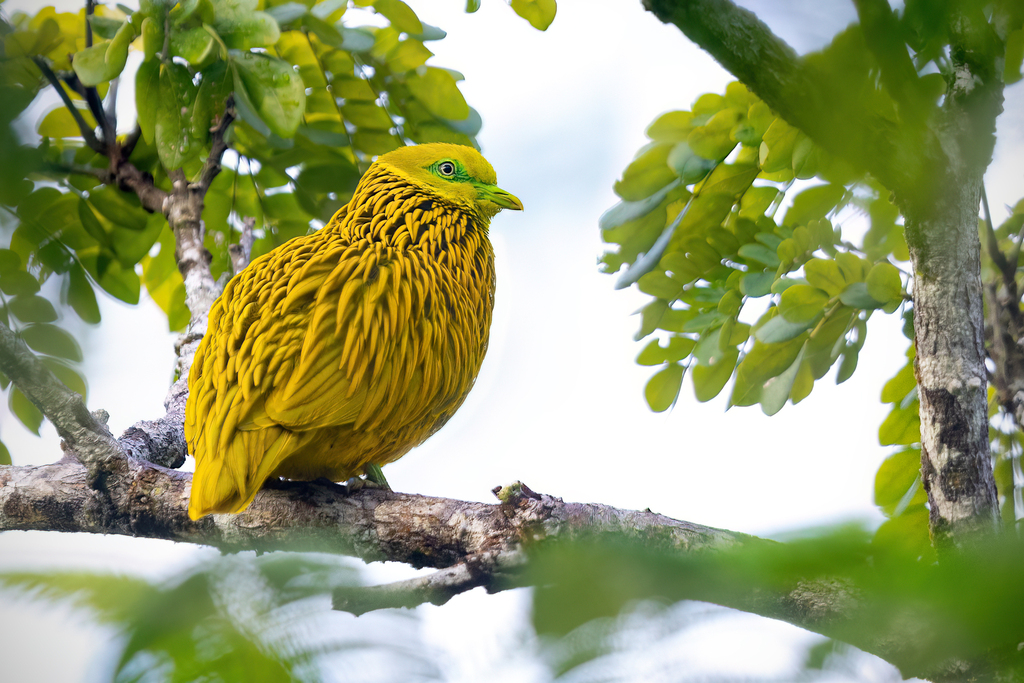
The golden dove (Ptilinopus luteovirens), also known as the golden fruit dove, lemon dove or yellow dove, is a small, approximately 20 cm (8 in) long, short-tailed fruit-dove in the family Columbidae. The common name refers to the males' bright golden-yellow colour. The body feathers appear almost iridescent due to their elongated shape and hair-like texture. The head is slightly duller with a greenish tinge. The bill, orbital skin and legs are bluish-green and the iris is whitish. The underwings and tail coverts are yellow. The female is a dark green bird with bare parts resembling those of the male. The young resembles the female.
The golden dove is endemic to the forests of Fiji. The diet consists mainly of various small fruits, berries and insects. The female usually lays a single white egg.
From the article Golden dove on Wikipedia (CC BY-SA), quoted section by section
Range & habitat
The golden dove is endemic to the islands of Viti Levu, Ovalau, Beqa, Ngau and Waya. It mainly inhabits open forest, gallery forest, and secondary growth, but is also found in mature rainforest with sparse undergrowth and tall trees. It is found between elevations of 60–1,200 m (200–3,940 ft). They are occasionally found near towns and villages.
Wikipedia: “Distribution and habitat”
Listen
Looking for field recordings…
Where it lives
Recorded sightings
—
geo-referenced records in GBIF, from museums, herbaria and field observers.
Drag the globe to turn it. Dots are where records exist, not a range map; darker means more records.
In the stacks
Searching the stacks…
Every page naming Ptilinopus luteovirens in the Biodiversity Heritage Library →
This page is assembled live from iNaturalist, GBIF, Wikipedia, the Source Library and the Internet Archive. It is not yet part of the hand-edited codex. iNaturalist taxon 2798.