On eBird ↗
Rose-crowned Fruit-Dove
Live sightings near you, the range map, bar charts of when it is seen, and Macaulay Library photos and recordings.
Rose-crowned Fruit Dove
Ptilinopus regina
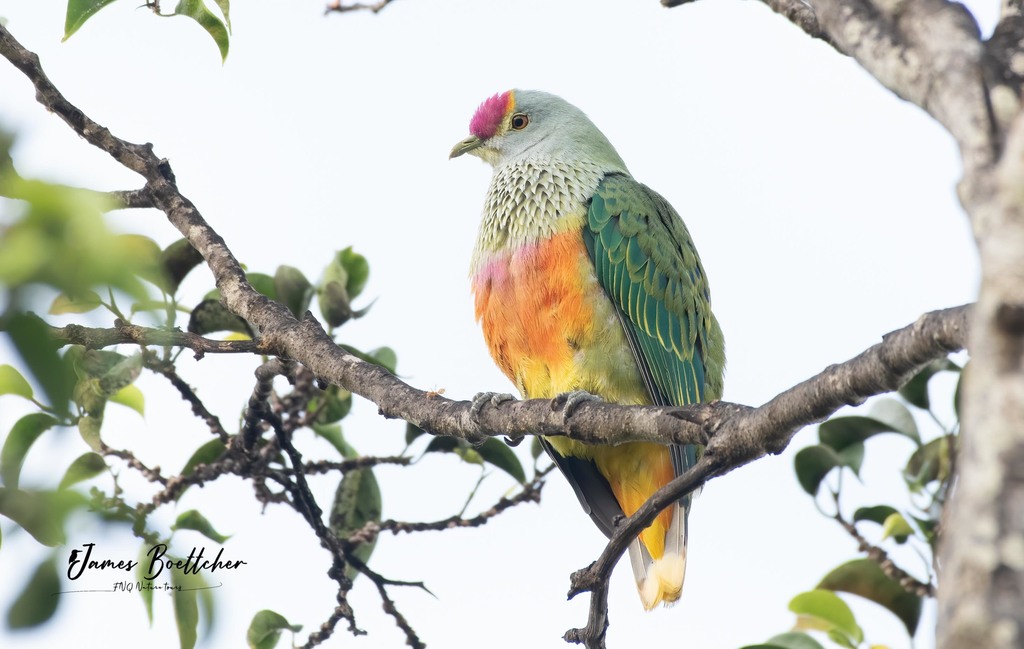
The rose-crowned fruit dove (Ptilinopus regina) also known as pink-capped fruit dove or Swainson's fruit dove, is a medium-sized, up to 22 cm long, green fruit dove with a grey head and breast, an orange belly, whitish throat, yellow-orange iris, and greyish green bill and feet. It has a pinkish-red crown with yellow border. The Indonesian subspecies, P. r. xanthogaster, has a whitish crown and paler grey head and breast. Both sexes are similar. The young has...
From the article Rose-crowned fruit dove on Wikipedia (CC BY-SA), quoted section by section
Description
The rose-crowned fruit dove is 22 cm (8.7 in) long and has a grey head and breast, an orange belly, whitish throat, yellow-orange iris, and greyish green bill and feet. It has a pinkish-red crown with yellow border. The Indonesian subspecies, P. r. xanthogaster, has a whitish crown and paler grey head and breast. Both sexes are similar. The young has a green-colored crown and plumage.
Range & habitat
The rose-crowned fruit dove is distributed in lowland rainforests of northern and eastern Australia, and monsoon forests of northern Australia, Lesser Sunda Islands and Maluku Islands of Indonesia. The diet consists mainly of various fruits, palms and vines. The female usually lays a single white egg. Widespread and common throughout its large range, the rose-crowned fruit dove is evaluated as Least Concern on the IUCN Red List of Threatened Species.
Wikipedia: “Distribution and habitat”
Listen
Looking for field recordings…
Where it lives
Recorded sightings
—
geo-referenced records in GBIF, from museums, herbaria and field observers.
Drag the globe to turn it. Dots are where records exist, not a range map; darker means more records.
In the stacks
Searching the stacks…
Every page naming Ptilinopus regina in the Biodiversity Heritage Library →
This page is assembled live from iNaturalist, GBIF, Wikipedia, the Source Library and the Internet Archive. It is not yet part of the hand-edited codex. iNaturalist taxon 2753.