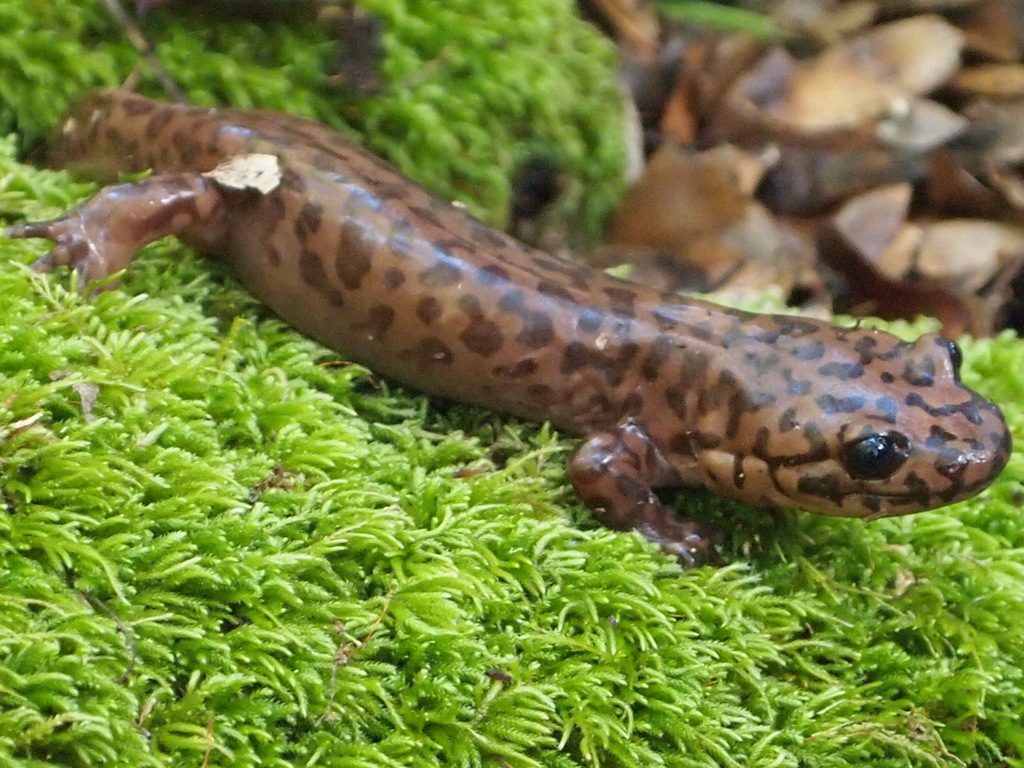
California Giant Salamander
Dicamptodon ensatus
The California giant salamander (Dicamptodon ensatus) is a species of salamander in the family Ambystomatidae. D. ensatus is endemic to California, in the western United States. Terrestrial adults spend most of their time on land in close proximity to fresh water. In contrast, during breeding, in larval development, and neoteny they spend their time inside shallow fresh water. The species once additionally included individuals now belonging to the species D. aterrimus (Idaho giant salamander) and D. tenebrosus (coastal giant salamander), under the common name Pacific giant salamander, which now refers to the whole genus.
From the article California giant salamander on Wikipedia (CC BY-SA), quoted section by section
Description
The adult California giant salamander can reach 17–30.5 cm (6.7–12.0 in) in total length (including tail). Like most salamanders, the California giant salamander has four toes on the front feet and five toes on the back feet. The California giant salamander's tail is approximately 40% of the total length of the salamander and is laterally compressed. The head, back, and sides of the salamander have a marbled or reticulate pattern of dark blotches on a light brown or brassy-colored background. They have a broad head with a shovel-like snout and a fold of skin across the throat called the gular fold. The eyes are medium in size and have a brass-flecked iris and a large black pupil. This species is one of the few salamanders capable of vocalizing.
Range & habitat
The California giant salamander is endemic to Northern California and lives up to 6,500 feet (2,000 m) primarily in damp, coastal forests including coast Douglas fir (Pseudotsuga menziesii var. menziesii) and California coast redwood (Sequoia sempervirens) in both montane and valley-foothill riparian habitats. They tend to be common where they occur. The adult terrestrial form is found under surface litter and in tunnels, while the adult aquatic and larval forms are found mainly in cool, rocky streams and occasionally in lakes and ponds. It is found in two (possibly three) isolated regions. The first range includes Sonoma, Napa, and Marin Counties, southwestern Lake County, western Glenn County, and southern Mendocino County. The other documented region is south of the San Francisco Bay from central San Mateo County to southern Santa Cruz County plus western Santa Clara County. The California giant salamander does not occur in the East Bay, forming a gap between these two populations. There is an unconfirmed sight record from Big Sur in Monterey County, approximately 75 miles (100 km) to the south of the documented population in the Santa Cruz area.
Wikipedia: “Geographic range”
What it does
Terrestrial adults search for prey such as snails, slugs, insects (such as beetles, caddisfly larvae, moths, and flies), other invertebrates, small mice (such as white-footed mice), shrews, possibly reptiles, and other amphibians (including reports of smaller D. ensatus) under surface objects and in tunnels. Aquatic adults and larvae eat aquatic invertebrates, fish, snakes, and other amphibians.
Wikipedia: “Diet”
Listen
Looking for field recordings…
Where it lives
Recorded sightings
—
geo-referenced records in GBIF, from museums, herbaria and field observers.
Drag the globe to turn it. Dots are where records exist, not a range map; darker means more records.
In the stacks
Searching the stacks…
Every page naming Dicamptodon ensatus in the Biodiversity Heritage Library →
This page is assembled live from iNaturalist, GBIF, Wikipedia, the Source Library and the Internet Archive. It is not yet part of the hand-edited codex. iNaturalist taxon 26823.