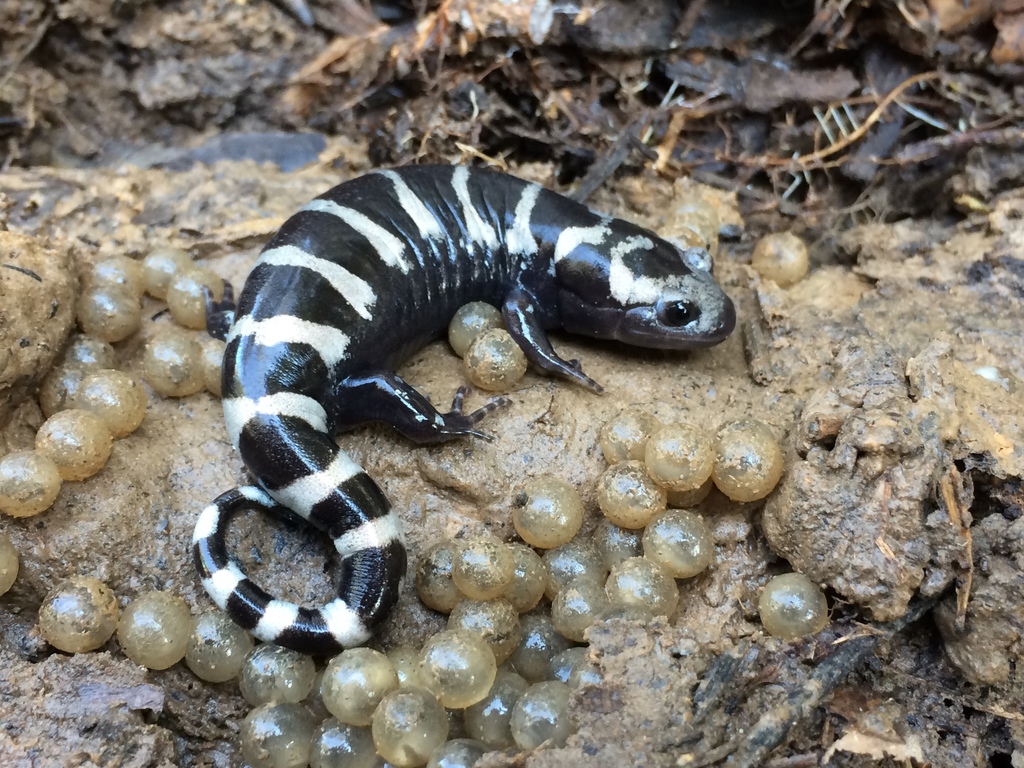
Marbled Salamander
Ambystoma opacum
The marbled salamander (Ambystoma opacum) is a species of mole salamander found in the eastern United States.
From the article Marbled salamander on Wikipedia (CC BY-SA), quoted section by section
Description
The marbled salamander is a stout, black and white banded salamander. It exhibits sexual dimorphism with bands of females tending to be light gray, while those of males are bright white. Males also have a larger proportion of white dorsal surface area relative to females. Females have been reported to have more asymmetrical dorsal markings, while the males have more symmetrical markings. Like most salamanders, they go through metamorphosis including an aquatic life stage. Juveniles have white flecks that eventually develop into bands as they reach adulthood. Adults can grow to about 11 cm (4 in), small compared to other members of its genus. Like most of the mole salamanders, it is secretive, spending most of its life under logs or in burrows.
Range & habitat
Marbled salamanders are found in the eastern United States, from southern New England to northern Florida, and west to Illinois and Texas. Their habitats are damp woodlands, forests, and places with soft and wet soil. Seasonally flooded areas are essential for breeding, but the adult salamanders are terrestrial. Like many salamanders, marbled salamanders have poison glands to deter predators. The marbled salamander is the state salamander of North Carolina.
Wikipedia: “Habitat and range”
What it does
Marbled salamanders will migrate to seasonal pond basins in the late summer and early fall where they will court and deposit eggs. Courtship of this species takes place on land. The males will compete by butting heads and blocking another male's movement with its tail. When courting the female, a male will nudge the vent of a female with its snout, with the intent that the female will respond in kind. This back-and-forth nudging has the appearance of a dance as the two salamanders circle around one another. There is no association between mating success and size of salamander, it depends only on this display. This display culminates with the male depositing a spermatophore and the female moving to take it into her cloaca. The female will then lay between 50 and 200 eggs, often remaining with them until the nest floods. One fairly unique parental care behavioral characteristic of Marbled Salamanders is that when the mothers stay with their eggs, wrapping their bodies around the eggs to form a bowl shape to collect water over the eggs. Water must make extended contact with the eggs in order for them to begin hatching. Nest site selection can be important to reproductive success. Marbled salamanders tend to favor sites at mid to higher elevations. …
Wikipedia: “Reproduction”
Listen
Looking for field recordings…
Where it lives
Recorded sightings
—
geo-referenced records in GBIF, from museums, herbaria and field observers.
Drag the globe to turn it. Dots are where records exist, not a range map; darker means more records.
In the stacks
Searching the stacks…
Every page naming Ambystoma opacum in the Biodiversity Heritage Library →
This page is assembled live from iNaturalist, GBIF, Wikipedia, the Source Library and the Internet Archive. It is not yet part of the hand-edited codex. iNaturalist taxon 26736.