- Animals
- ›Chordates
- ›Vertebrates
- ›Birds
- ›Cranes, Rails, and Allies
- ›Rails, Gallinules, and Coots
- ›Anurolimnas
On eBird ↗
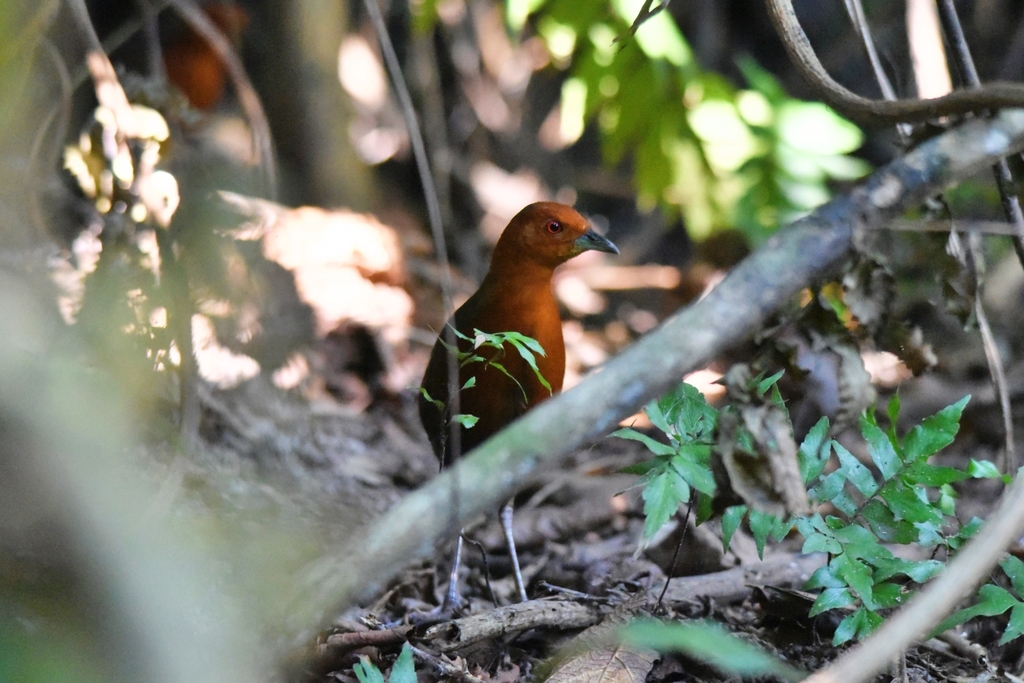
Chestnut-headed Crake
Live sightings near you, the range map, bar charts of when it is seen, and Macaulay Library photos and recordings.
Chestnut-headed Crake
Anurolimnas castaneiceps
The chestnut-headed crake (Anurolimnas castaneiceps) is a species of bird in subfamily Rallinae of family Rallidae, the rails, gallinules, and coots. It is the only species placed in the genus Anurolimnas. It is found in Bolivia, Brazil, Colombia, Ecuador, and Peru.
From the article Chestnut-headed crake on Wikipedia (CC BY-SA), quoted section by section
Description
The chestnut-headed crake is 19 to 21.5 cm (7.5 to 8.5 in) long. One female weighed 126 g (4.4 oz). The sexes are alike. Adults' bills have a mostly black maxilla that is greenish below the nostrils and a greenish mandible with a black tip. The nominate subspecies' forecrown, sides of the head and neck, and breast are bright rufous. Their throat is orange-rufous or light buff. Their crown, back, rump, wing coverts, belly, and vent area are brownish olive. Their legs and feet are dull brown or olivaceous. Immatures are duller; they are brown or brownish olive where the adult is rufous and their throat is pale grayish buff. Subspecies A. c. coccineipes has red legs and feet but very similar plumage to the nominate. Some authors state that it has greener (less brown) upperparts and tawny tones to the rufous areas, but others find no significant difference between the subspecies.
Range & habitat
The nominate subspecies of chestnut-headed crake is found from southern Colombia south through eastern Ecuador into northern Peru. Its southern limit in Peru is the left bank of the Rio Napo and in Ecuador it is the same or perhaps somewhat beyond it. R. c. coccineipes is found from the Rio Napo (or vicinity) in Ecuador and Peru south into extreme northwestern Bolivia. A separate population is found in Brazil's Acre state. The species inhabits humid landscapes with a dense understory such as secondary forest, where it especially favors overgrown agricultural plots in tropical evergreen forest. Unlike most others of its family, it can be found far from water. In Colombia it is found up to 1,500 m (4,900 ft); in Ecuador it mostly occurs below 700 m (2,300 ft) but can be found as high as 1,000 m (3,300 ft). The chestnut-headed crake is a year-round resident throughout its range.
Wikipedia: “Distribution and habitat”
What it does
The chestnut-headed crake forages by probing debris and rotten wood and flicking aside leaves while walking on the ground. It also pecks at similar substrates above the ground by stretching up. Its diet has not been documented but is assumed to be invertebrates and seeds.
Wikipedia: “Feeding”
Listen
Looking for field recordings…
Where it lives
Recorded sightings
—
geo-referenced records in GBIF, from museums, herbaria and field observers.
Drag the globe to turn it. Dots are where records exist, not a range map; darker means more records.
In the stacks
Searching the stacks…
Every page naming Anurolimnas castaneiceps in the Biodiversity Heritage Library →
This page is assembled live from iNaturalist, GBIF, Wikipedia, the Source Library and the Internet Archive. It is not yet part of the hand-edited codex. iNaturalist taxon 261.