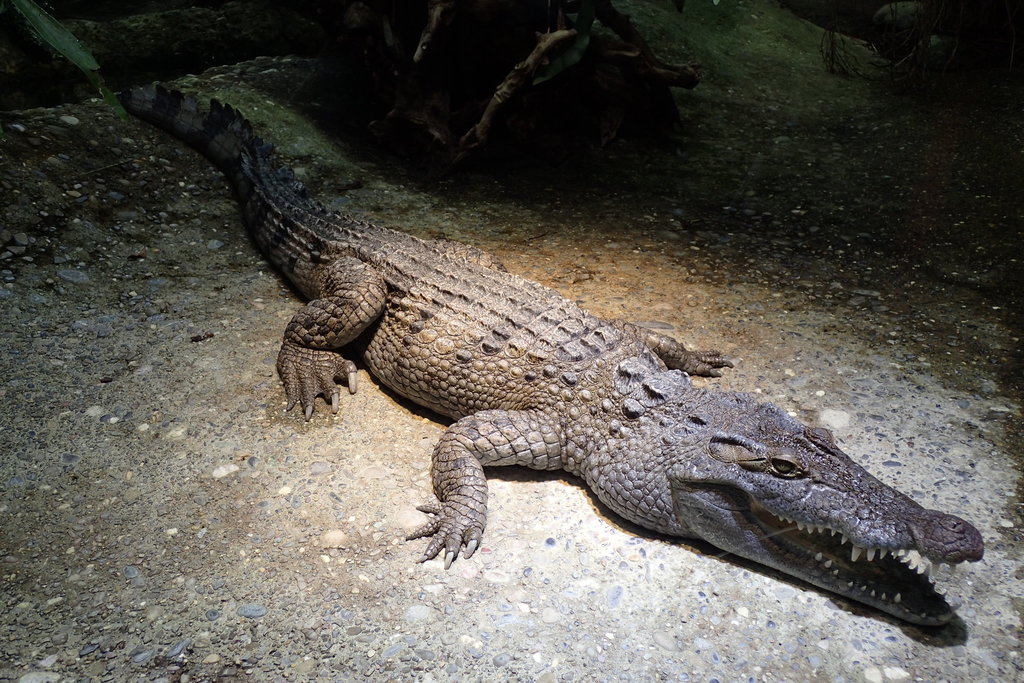
Philippine Crocodile
Crocodylus mindorensis
The Philippine crocodile (Crocodylus mindorensis), also known as the Mindoro crocodile, the Philippine freshwater crocodile, the bukarot in Ilocano, and more generally as a buwaya in most Filipino lowland cultures, is endemic to the Philippines. It has been listed as critically endangered since 2008 due to exploitation and unsustainable fishing methods, such as dynamite fishing. Conservation methods are being taken by the Dutch/Filipino Mabuwaya foundation, the Crocodile Conservation Society and the Zoological Institute of HerpaWorld in Mindoro island. It is strictly prohibited to kill a crocodile in the country, and it is punishable by law.
From the article Philippine crocodile on Wikipedia (CC BY-SA), quoted section by section
Description
The Philippine crocodile is a crocodilian endemic to the Philippines. It is a relatively small, freshwater crocodile. It has a relatively broad snout and thick bony plates on its back (heavy dorsal armor). This is a fairly small species, reaching breeding maturity at 1.5 m (4 ft 11 in) and 15 kg (33 lb) in both sexes. A 69-kilogram (152 lb) individual was found to have a bite force of 2,736 N (615 lbf). Adults rarely exceed 2.7 m (8 ft 10 in) and 90 kg (200 lb), and only the largest males attain record maximum size of up to 3.5 m (11 ft), perhaps reaching the maximum weight of 210 kg (460 lb) in exceptional individuals. Females are slightly smaller than males. Philippine crocodiles are golden-brown in color, which darkens as they mature.
Wikipedia: “Characteristics”
Range & habitat
The Philippine crocodile has been extirpated in Samar, Jolo, Negros, Masbate, and Busuanga. Populations still survive in the Northern Sierra Madre Natural Park within the Luzon rainforest, San Mariano, Isabela, Dalupiri Island in the Babuyan Islands, Abra in Luzon and the Ligawasan Marsh, Lake Sebu in South Cotabato, Pulangi River in Bukidnon, Paghungawan Marsh in Siargao Island, and possibly in the Agusan Marsh Wildlife Sanctuary in Mindanao. The Philippine crocodile wildlife populations that reside in these locations live geographically isolated from each other, which ultimately impacts their population level differentiation and decreases genetic diversity. It was historically found in parts of Visayas and until the numbers were drastically cut by, mainly, habitat destruction. These crocodiles eat ailing fish in a significantly higher proportion than healthy fish, thus improving the common health of the fish stock. By preying on the most common fish, they balance the fish population; any species which suddenly becomes dominant is put back in its proper proportion. Crocodile droppings are nutritious for the fish and contain critically important chemicals.
Wikipedia: “Distribution and habitat”
In human culture
In the pre-colonial anito beliefs throughout the Philippine islands, crocodiles (both C. mindorensis and C. porosus) were feared and revered, which played a key role in their survival up until modern times. The Spaniards recorded that rivers and lakes were filled with crocodiles, and people often lived and fished close to them, which alarmed most European observers. Some communities put up small bamboo fences to keep crocodiles out from certain areas and people avoided provoking them, but in general, they did not take many specific precautions against them. There was an unspoken "peace pact" between crocodiles and people. There were very strict taboos against killing crocodiles or eating crocodile meat, though crocodiles which attack or kill a person are always killed by the community. It was widely believed that crocodiles never attacked people arbitrarily. Thus attacks by crocodiles were regarded with fatalistic attitudes, as being the fault of the victim for transgressing taboos, or as punishment by the spirits for breaking an oath. The Spanish conquistador Miguel López de Legazpi records in 1571 that his treaties with Sulayman, Ache, and Lakandula of Manila and Tondo were sworn on the condition that they would die and be eaten by crocodiles if they break the agreements. …
Wikipedia: “Mythology, folklore, and cultural significance”
Where it lives
Recorded sightings
—
geo-referenced records in GBIF, from museums, herbaria and field observers.
Drag the globe to turn it. Dots are where records exist, not a range map; darker means more records.
In the stacks
Searching the stacks…
Every page naming Crocodylus mindorensis in the Biodiversity Heritage Library →
This page is assembled live from iNaturalist, GBIF, Wikipedia, the Source Library and the Internet Archive. It is not yet part of the hand-edited codex. iNaturalist taxon 26076.