
Crocodilians
Crocodylia
Crocodylia or Crocodilia () is an order of semiaquatic, predatory reptiles that are known as crocodilians. They appeared 83.5 million years ago in the Late Cretaceous period (Campanian stage) and are the closest living relatives of birds, as the two groups are the only known survivors of the Archosauria. Members of the crocodilian total group, the clade Pseudosuchia, appeared about 250 million years ago in the Early Triassic period, and diversified during the Mesozoic era. The order includes the true crocodiles (family Crocodylidae), the alligators and caimans (family Alligatoridae), and the gharial and false gharial (family Gavialidae). Although the term "crocodiles" is sometimes used to refer to all of these families, the term "crocodilians" is less ambiguous.
Extant crocodilians have flat heads with long snouts and tails that are compressed on the sides, with their eyes, ears, and nostrils at the top of the head. Alligators and caimans tend to have broader U-shaped jaws that, when closed, show only the upper teeth, whereas crocodiles usually have narrower V-shaped jaws with both rows of teeth visible when closed. Gharials have extremely slender, elongated jaws. The teeth are conical and peg-like, and the bite is powerful. All crocodilians are good swimmers and can move on land in a "high walk" position, traveling with their legs erect rather than sprawling. Crocodilians have thick skin covered in non-overlapping scales and, like birds, have a four-chambered heart and lungs with unidirectional airflow.
4 branches of this order, most-observed first · about 27 known species

Alligators and Caimans
familyAlligatoridae
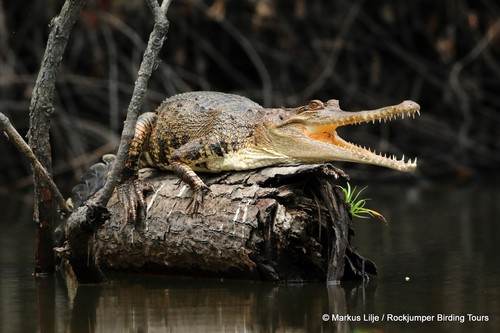
Crocodiles
familyCrocodylidae

Gharials
familyGavialidae

Deinosuchus
genusDeinosuchus
Where it lives
Recorded sightings
—
geo-referenced records in GBIF, from museums, herbaria and field observers.
Drag the globe to turn it. Dots are where records exist, not a range map; darker means more records.
In the stacks
Searching the stacks…
Every page naming Crocodylia in the Biodiversity Heritage Library →
This page is assembled live from iNaturalist, GBIF, Wikipedia, the Source Library and the Internet Archive. It is not yet part of the hand-edited codex. iNaturalist taxon 26039.