- Animals
- ›Chordates
- ›Vertebrates
- ›Birds
- ›Rollers, Kingfishers, and Allies
- ›Kingfishers
- ›Water Kingfishers
- ›Megaceryle
On eBird ↗
Crested Kingfisher
Live sightings near you, the range map, bar charts of when it is seen, and Macaulay Library photos and recordings.
Crested Kingfisher
Megaceryle lugubris
The crested kingfisher (Megaceryle lugubris) is a very large kingfisher that is native to parts of southern Asia. It is part of the kingfisher genus Megaceryle with three other species: the giant kingfisher (Megaceryle maxima), the ringed kingfisher (Megaceryle torquata), and the belted kingfisher (Megaceryle alcyon) with which it forms a species complex.
From the article Crested kingfisher on Wikipedia (CC BY-SA), quoted section by section
Description
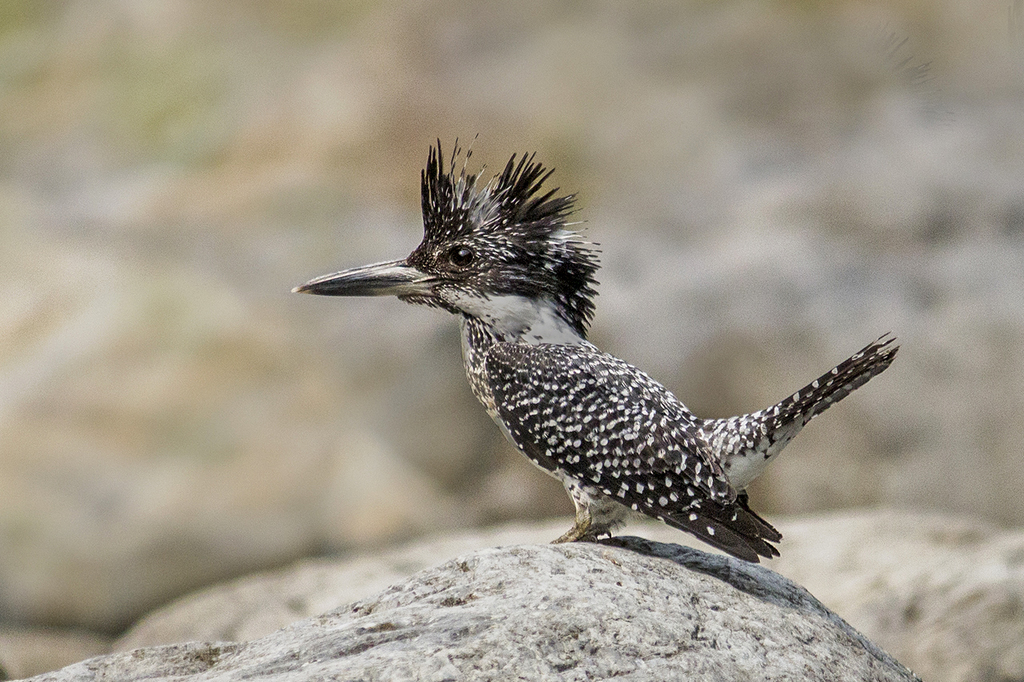
The crested kingfisher is a very large, stocky black and white bird, usually between 38 and 43 cm (15 and 17 in) tall, and weighs between 230 and 280 g (8 and 10 oz). It has a large, pointed black bill with a yellowish-white tip and a large, shaggy black and white barred crest. It has finely barred black and white upperparts with flanks barred grey and white, while its belly is white with a black-speckled breastband. It has a white collar that starts at the bottom of the bill and goes to the back of the neck. The tail feathers are black with 6 to 8 white bars. Males and females are the same size but exhibit sexual dimorphism in their plumage. Females have bright pink-cinnamon underwing coverts washed with pale rufous, while males lack this and instead have rufus-orange feathers on the breastband.
Range & habitat
The crested kingfisher has the most restricted distribution of all the Cerylinae kingfishers. It can be seen from northeast Afghanistan to central Vietnam and Japan. The four subspecies of crested kingfishers also differ in distribution range, with M. l. continentalis found in the western-central Himalayas, from Afghanistan to Bhutan; M. l. guttulata found in the eastern Himalayas to central China and northern Indochina from Bhutan to Vietnam, China and North Korea; M. l. pallida found in Hokkaido (northern Japan), and southern Kuril Islands (Russia); and finally M. l. lugubris found in central and southern Japan (Honshu, Shikoku and Kyushu). Crested kingfishers are also known to migrate altitudinally in winter to avoid frozen rivers when living higher up in the Himalayas and in Japan. In Hokkaido, the birds remain around hot springs, while elsewhere, the kingfishers seem to be sedentary.
Wikipedia: “Distribution range”
What it does
Like the other Megaceryle species, the crested kingfisher is a specialist fish-eater. Unlike other kingfishers, the crested kingfisher is rarely seen diving after hovering and prefers diving from a high perch. This species of kingfisher is often seen perched on trees or other high, suitable points above a body of water, watching for fish under the surface of the water. When they spot a prey item, they dive head first into the water after their prey. This foraging behavior is also apparent in the shape of the bill, which Forshaw (1983) described as laterally compressed and pointed, which is more suited for striking at and grasping prey. In areas where competition with other species of kingfisher arise, such as with the common kingfisher (Alcedo atthis) along the Chikuma River in Central Japan, the crested kingfisher hunts mainly in larger open channels and rarely uses small channels and temporal pools as a way of food-niche differentiation. Crested kingfishers in this area also tended to dive from higher positions than common kingfishers and caught food at significantly deeper sites than these, regardless of the foraging behavior.
Wikipedia: “Feeding”
Listen
Looking for field recordings…
Where it lives
Recorded sightings
—
geo-referenced records in GBIF, from museums, herbaria and field observers.
Drag the globe to turn it. Dots are where records exist, not a range map; darker means more records.
In the stacks
Searching the stacks…
Every page naming Megaceryle lugubris in the Biodiversity Heritage Library →
This page is assembled live from iNaturalist, GBIF, Wikipedia, the Source Library and the Internet Archive. It is not yet part of the hand-edited codex. iNaturalist taxon 2556.