On eBird ↗
Black-necked Crane
Live sightings near you, the range map, bar charts of when it is seen, and Macaulay Library photos and recordings.
Black-necked Crane
Grus nigricollis
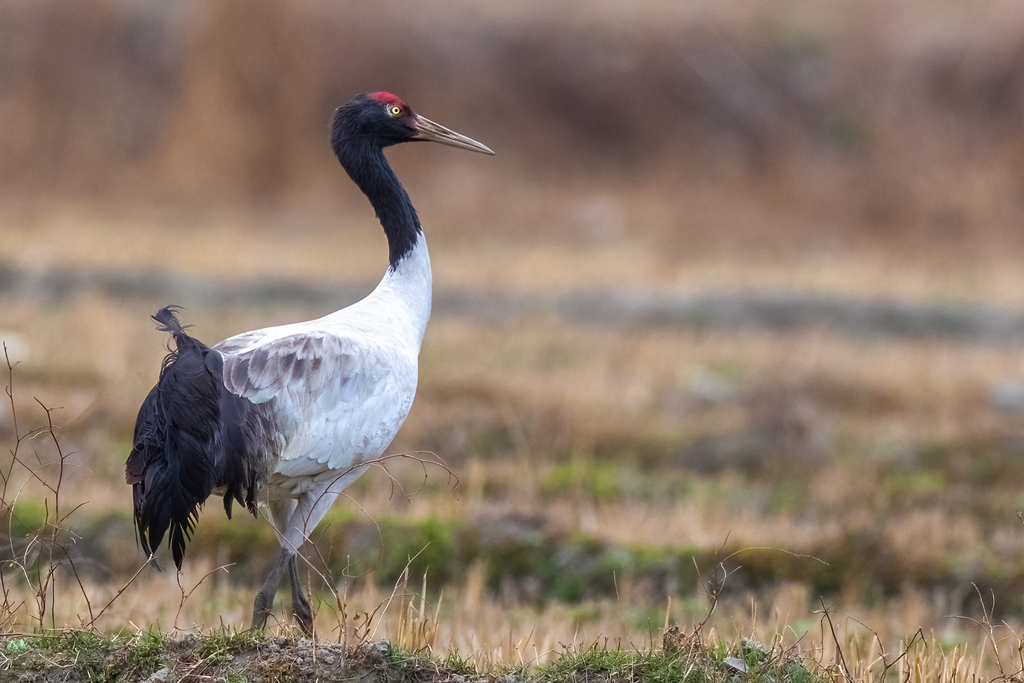
The black-necked crane (Grus nigricollis) is a medium-sized crane in Asia that breeds on the Tibetan Plateau and remote parts of India and Bhutan. It is 139 cm (55 in) long with a 235 cm (7.71 ft) wingspan, and it weighs 5.5 kg (12 lb). It is whitish-gray, with a black head, red crown patch, black upper neck and legs, and white patch to the rear of the eye. It has black primaries and secondaries. Both sexes are similar. Some populations are known to make seasonal movements. It is revered in Buddhist traditions and culturally protected across much of its range. A festival in Bhutan celebrates the bird while the Indian union territory of Ladakh has designated it as the state bird.
From the article Black-necked crane on Wikipedia (CC BY-SA), quoted section by section
Description
This medium-sized crane is mostly grey with a black head and neck. The lores and crown are naked and dull red. A small patch of white feathers are present below and behind the eye. The tail is black and makes it easy to distinguish at a distance from the similar looking common crane which has grey tail.
Range & habitat
The black-necked crane summers mainly in the high-altitude Tibetan Plateau. The breeding areas are alpine meadows, lakeside and riverine marshes and river valleys. They also make use of barley and wheat fields in these areas. Wintering areas tend to be in sheltered valleys or lower altitudes. The largest populations are in China with smaller numbers extending into Vietnam, Bhutan and India. Small populations have been noted in northern Sikkim. A small group of 20 to 40 was once known to regularly visit the Subansiri area in the Apa Tani valley until 1975, and vagrants have been recorded in Nepal.
Wikipedia: “Distribution and habitat”
What it does
Their loud trumpeting calls are similar to those of other cranes. These birds are very wary, but in some areas they are accustomed to the local people who do not disturb them. These cranes appear to be able to distinguish people in traditional dress and are especially wary of others.
Diet and feeding. They feed on the tubers of sedges, plant roots, earthworms, insects and other invertebrates, frogs and other small vertebrates. They may also feed on fallen grains of barley, oats and buckwheat and will sometimes dig up and feed on potatoes, carrots and turnips. Black-necked cranes forage on the ground in small groups, often with one bird acting as a sentinel. In winter, the groups arrive and leave the feeding grounds together, but may split into family groups, each group keeping their own small feeding territories in a big marshes or fields. They spend nearly 75% of the day foraging with peak feeding in the early morning and late afternoon. While foraging, they keep walking and they also walk long distances between the feeding spots. In this manner, they cover several kilometers a day while foraging.
Reproduction. Like many other crane species, they are believed to form long-lasting pair bonds and dancing displays are made during the breeding season. …
Wikipedia: “Behaviour and ecology”
Listen
Looking for field recordings…
Where it lives
Recorded sightings
—
geo-referenced records in GBIF, from museums, herbaria and field observers.
Drag the globe to turn it. Dots are where records exist, not a range map; darker means more records.
In the stacks
Searching the stacks…
Every page naming Grus nigricollis in the Biodiversity Heritage Library →
This page is assembled live from iNaturalist, GBIF, Wikipedia, the Source Library and the Internet Archive. It is not yet part of the hand-edited codex. iNaturalist taxon 25.