- Plants
- ›Vascular Plants
- ›flowering plants
- ›Dicots
- ›Sunflowers, Bellflowers, Fanflowers, and Allies
- ›Sunflowers, Daisies, Asters, and Allies
- ›Asteroideae
- ›Sunflowers and Allies
- ›Ecliptinae
- ›Sphagneticola
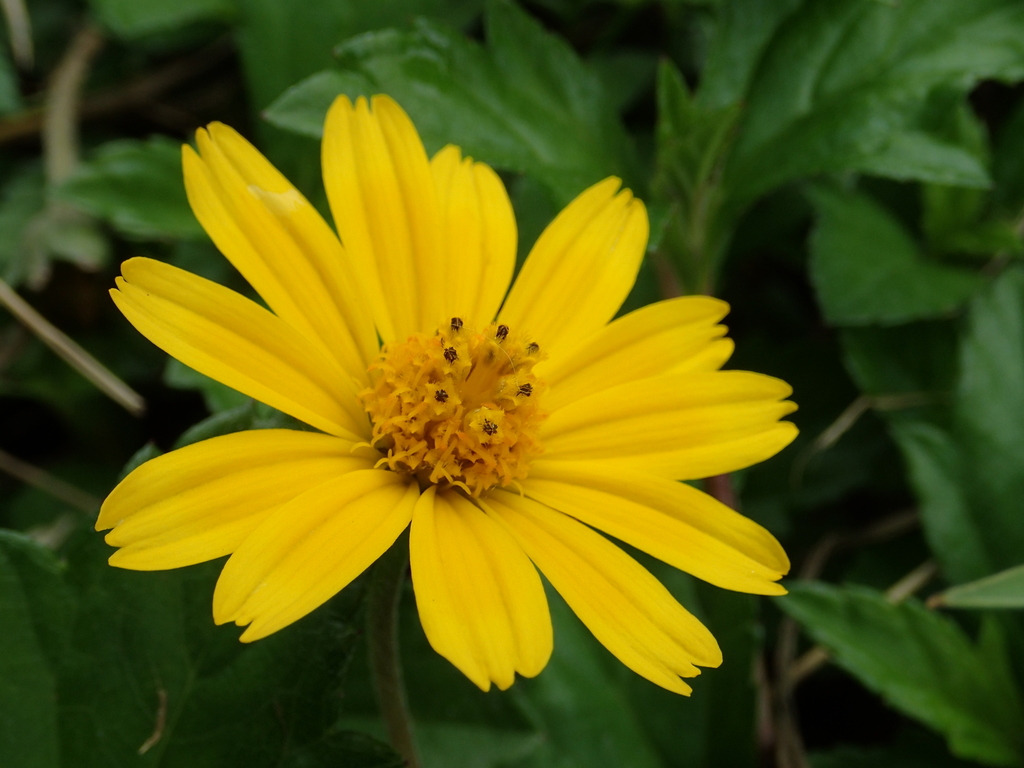
Trailing Daisy
Sphagneticola trilobata
Sphagneticola trilobata, commonly known as the Bay Biscayne creeping-oxeye, Singapore daisy, creeping-oxeye, trailing daisy, and wedelia, is a plant in the Heliantheae tribe of the Asteraceae (sunflower) family. It is native to Mexico, Central America, and the Caribbean, but now grows throughout the Neotropics. It is widely cultivated as an ornamental groundcover.
From the article Sphagneticola trilobata on Wikipedia (CC BY-SA), quoted section by section
Description
Spreading, mat-forming perennial herb up to 30 cm in height. Has rounded stems up to 40 cm long, rooting at nodes and with the flowering stems ascending. Leaves are fleshy, hairy, 4–9 cm long and 2–5 cm wide, serrate or irregularly toothed, normally with pairs of lateral lobes, and dark green above and lighter green below. Its surface is hairy or glabrous, rarely scaly.
Inflorescence. Peduncles are 3–10 cm long; involucres are campanulate to hemispherical, about 1 cm high; chaffy bracts are lanceolate, rigid. The flowers are bright yellow ray florets of about 8-13 per head, rays are 6–15 mm long; disk-corollas 4–5 mm long. The pappus is a crown of short fimbriate scales. The seeds are tuberculate achenes, 4–5 mm long. Propagation is mostly vegetatively as seeds are usually not fertile. In the tropics it is free-flowering, and elsewhere it blooms mostly from spring to autumn.
Range & habitat
It has a very wide ecological tolerance range, but grows best in sunny areas with well-drained, moist soil at low elevations.
Wikipedia: “Habitat”
Where it lives
Recorded sightings
—
geo-referenced records in GBIF, from museums, herbaria and field observers.
Drag the globe to turn it. Dots are where records exist, not a range map; darker means more records.
In the stacks
Searching the stacks…
Every page naming Sphagneticola trilobata in the Biodiversity Heritage Library →
This page is assembled live from iNaturalist, GBIF, Wikipedia, the Source Library and the Internet Archive. It is not yet part of the hand-edited codex. iNaturalist taxon 246102.