- Animals
- ›Chordates
- ›Vertebrates
- ›Reptiles
- ›Snakes and Lizards
- ›Lizards
- ›Iguanas and Allies
- ›Iguanas, Anoles, and Allies
- ›Phrynosomatid Lizards
- ›Phrynosomatine Lizards
- ›Phrynosoma
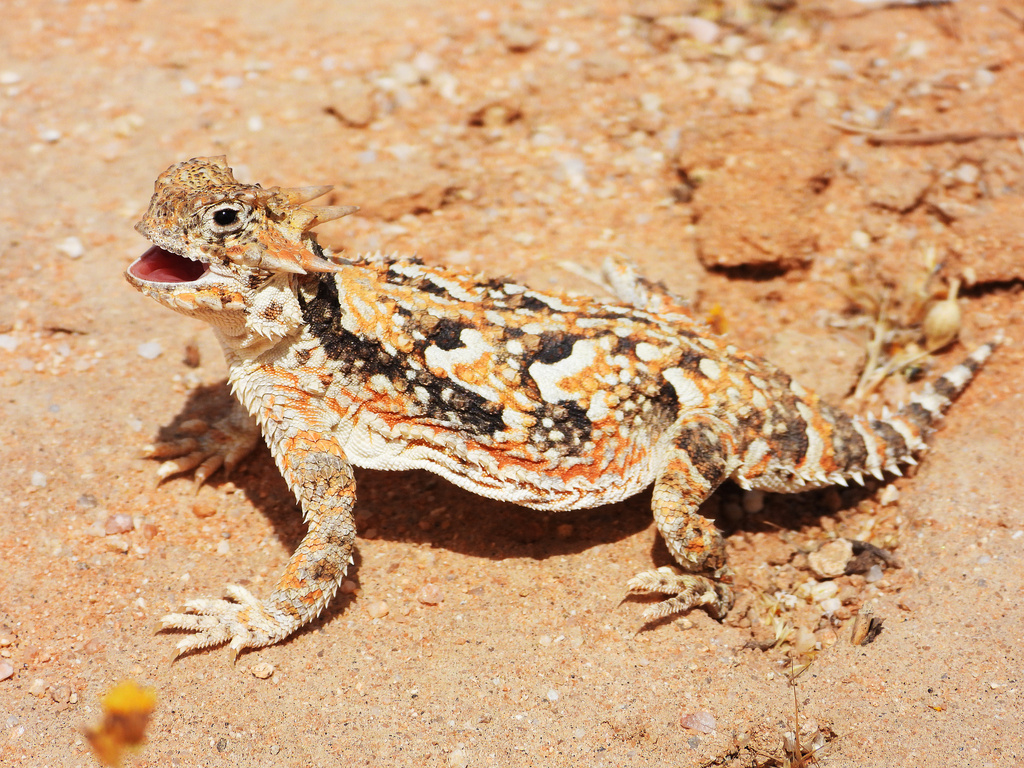
Desert Horned Lizard
Phrynosoma platyrhinos
The desert horned lizard (Phrynosoma platyrhinos) is a species of phrynosomatid lizard native to western North America. They are often referred to as "horny toads", although they are not toads, but lizards.
From the article Desert horned lizard on Wikipedia (CC BY-SA), quoted section by section
Description
There are several important characteristics that can be used to identify desert horned lizards from other horned lizards. Horned lizards can be distinguished from other lizards by the large pointed scales that protrude from the back of their heads, giving them the appearance of having horns, as well as the flat and broad shape of their bodies. This species of lizard has a distinctive flat body with one row of fringe scales down the sides. They are a medium sized lizard and can grow up to approximately 3.75 inches (95 mm) in size. They have one row of slightly enlarged scales on each side of the throat. Colours can vary and generally blend in with the color of the surrounding soil, but they usually have a beige, tan, or reddish dorsum with contrasting, wavy blotches of darker color. They have two dark blotches on the neck that are very prominent and are bordered posteriorly by a light white or grey color. They also have scattered pointed scales and other irregular dark blotches along the dorsum of their body. Unlike other horned lizards, Phrynosoma platyrhinos individuals do not have a prominent dorsal stripe. Their dorsal stripe can appear faintly or be entirely absent depending on the individual. They also have pointed scales on the dorsum (back) of the body. Juveniles are similar to adults, but have shorter and less-pronounced cranial spines. …
Range & habitat
They typically range from southern Idaho in the north to northern Mexico in the south. These lizards can generally be found in areas with desert climates throughout western North America. Changes in the environment due to climate change can trigger shifts in the geographic ranges of animals. Phrynosoma platyrhinos has experienced some changes after the Last Glacial Maximum (LGM) which ended approximately 21,000 years ago. The end of the LGM resulted in the expansion of deserts throughout western North America, and with that expansion Phrynsoma platyrhinos had more areas suitable for them to live in. At the end of the LGM P. platyrhinos was able to expand north into the Great Basin, which is now part of their current geographical range.
Wikipedia: “Distribution”
What it does
Desert horned lizards prey primarily on invertebrates, such as ants (including red harvester ants,) crickets, grasshoppers, beetles, worms, flies, ladybugs, meal worms and some plant material. They can often be found in the vicinity of ant hills, where they sit and wait for ants to pass by. Ants contain a large amount of chitin, an indigestible compound, this makes them not as nutrient rich, so larger amounts must be consumed to sustain Phrynosoma platyrhinos. As an evolutionary advantage desert horned lizards developed larger stomachs to allow them to consume larger concentrations of ants. When they find an area of soft sand, they usually shake themselves vigorously, throwing sand over their backs and leaving only their head exposed. This allows them to hide from predators and await their unsuspecting prey.
Wikipedia: “Diet”
Where it lives
Recorded sightings
—
geo-referenced records in GBIF, from museums, herbaria and field observers.
Drag the globe to turn it. Dots are where records exist, not a range map; darker means more records.
In the stacks
Searching the stacks…
Every page naming Phrynosoma platyrhinos in the Biodiversity Heritage Library →
This page is assembled live from iNaturalist, GBIF, Wikipedia, the Source Library and the Internet Archive. It is not yet part of the hand-edited codex. iNaturalist taxon 243904.