- Animals
- ›Arthropods
- ›Hexapods
- ›Insects
- ›Winged and Once-winged Insects
- ›Butterflies and Moths
- ›Geometrid and Swallowtail Moths
- ›Geometer Moths
- ›Ennominae
- ›Boarmiini
- ›Ascotis
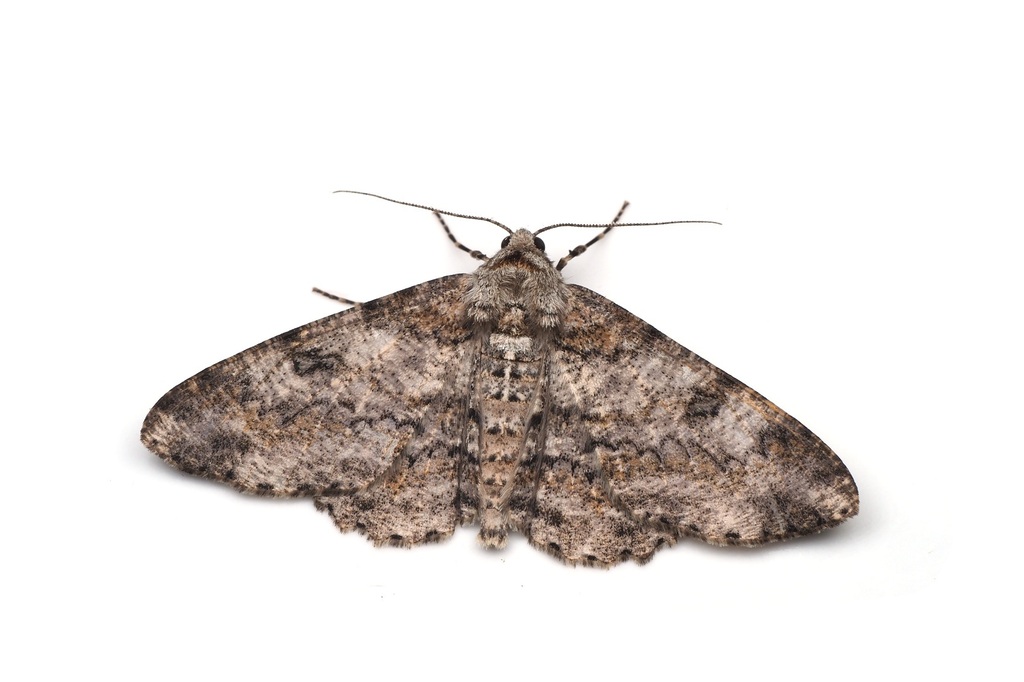
Citrus Looper
Ascotis selenaria
Ascotis selenaria, the giant looper, is a moth of the family Geometridae. The species was first described by Michael Denis and Ignaz Schiffermüller in 1775.
From the article Ascotis selenaria on Wikipedia (CC BY-SA), quoted section by section
Description
Ascotis selenaria has a wingspan of 38–48 mm. The front wings are characterized by a yellowish-white ground color, with numerous dark grey markings and two brownish sharply toothed transverse lines. The front and rear wings show distinctive moon shaped spots. The color and pattern of the caterpillars vary from green to yellow/green or brown resembling twigs. They have a characteristic bulbous swelling on the thorax and move with a looping motion as usual in measuring worms. The giant looper has two generations per year in southern Europe, flying from April to May and from July to August. However, further North it's possible that they only fly in one generation. They are attracted to light. The caterpillars can be found from September to October (first generation) and in June and July (second generation). If only one generation is present because of climate conditions, the moths fly from late June to early August, and the caterpillars can be encountered from August to September. The moths are nocturnal.
The caterpillars reach a length up to 55 millimeters. …
Range & habitat
This species is distributed in Southern Europe from Spain and western Mediterranean through the Balkans, in Central Europe, in Eastern Europe up to the Ural mountains, Africa, Anatolia from the Caucasus Mountains up to Altai Mountains, Korea and Japan. It is also reported from India from Dehra Dun in the north and Coimbatore in the south. It has also been found once in Öland, Sweden in 2019 and a couple of times in Denmark after 2022, mostly on Bornholm.
Wikipedia: “Distribution”
Listen
Looking for field recordings…
Where it lives
Recorded sightings
—
geo-referenced records in GBIF, from museums, herbaria and field observers.
Drag the globe to turn it. Dots are where records exist, not a range map; darker means more records.
In the stacks
Searching the stacks…
Every page naming Ascotis selenaria in the Biodiversity Heritage Library →
This page is assembled live from iNaturalist, GBIF, Wikipedia, the Source Library and the Internet Archive. It is not yet part of the hand-edited codex. iNaturalist taxon 243770.