- Animals
- ›Arthropods
- ›Hexapods
- ›Insects
- ›Winged and Once-winged Insects
- ›Beetles
- ›Water, Rove, Scarab, Long-horned, Leaf, and Snout Beetles
- ›Cucujiform Beetles
- ›Leaf Beetles and Allies
- ›Leaf Beetles
- ›Skeletonizing Leaf and Flea Beetles
- ›Galerucini
- ›Xanthogaleruca
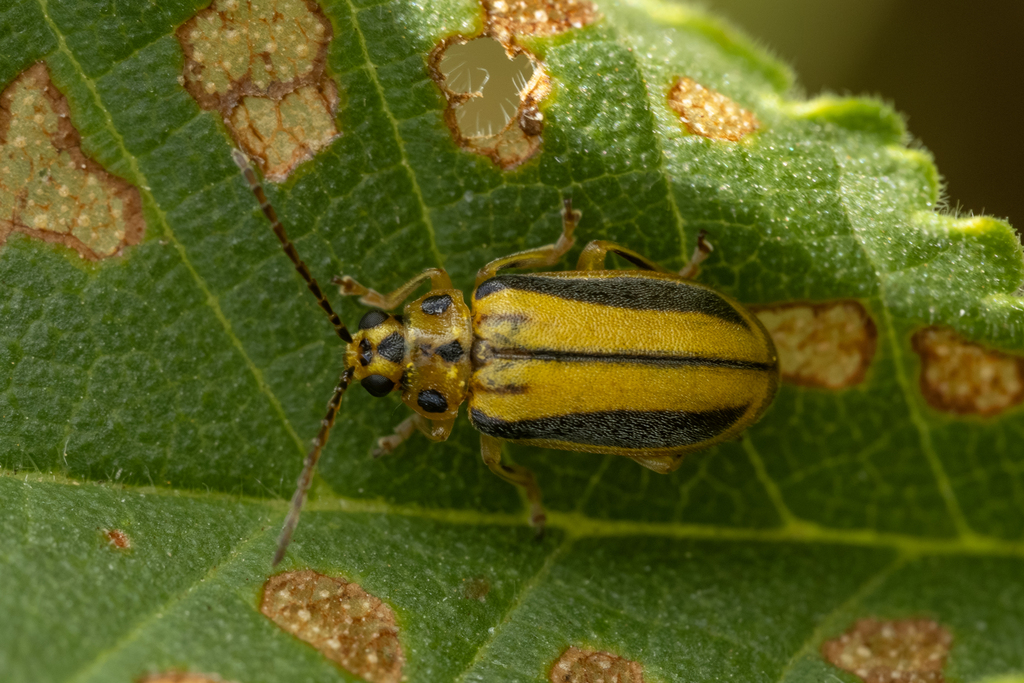
Elm Leaf Beetle
Xanthogaleruca luteola
Xanthogaleruca luteola, commonly known as the elm-leaf beetle, is a beetle species in the family Chrysomelidae that is native to Europe but invasive in other parts of the world.
From the article Elm leaf beetle on Wikipedia (CC BY-SA), quoted section by section
Description
The imago (adult beetle) is 6–8 mm in length, and ranges from yellow to green in colour, with a spot on its head, an hourglass mark and two spots on the pronotum, and a broad, dark stripe along the edge of each elytron. The larvae are usually black, occasionally black and yellow, with multiple rows of dots on the back and on the sides and < 13 mm long. The pupae are orange-yellow with black chaetae. The eggs are yellow, and laid in spindle-like clusters of < 25 on the undersides of the elm leaves.
Range & habitat
These beetles are common in the Western Palearctic realm from Portugal to Central Asia. Indigenous to Europe, they were accidentally introduced to North America and Australia, and are now widespread, and are serious pests in Australia and parts of North America.
Wikipedia: “Distribution”
What it does
X. luteola is a serious pest of the elm. Both the adults and larvae feed on the emergent leaves of the elm. Repeated heavy infestation rarely kills the tree outright, but weakens it, rendering it vulnerable to disease. Falling branches encourage elm bark beetles (Scolytus multistriatus and S. schevyrewi) to proliferate; the beetles are vectors of Dutch elm disease. Elm leaf beetles become active in the spring once temperatures rise above 52 °F (11 °C). In fact, weather is one of the most limiting factors in their population growth. A late spring freeze or long winter can kill off entire colonies. The adults depart their hibernation sites (often human residences), the females laying their eggs on the underside of the elm leaves. The ova hatch after one week, and the larvae immediately feed on the underside of the leaves. This larval stage lasts between two and three weeks, at the end of which larvae migrate to the lower part of the trees in search of bark crevices in which to pupate. The next generation emerges in midsummer after two to three weeks' pupation, and begins feeding on the leaves. The female can lay about 800 ova, but this ovipositing may be interrupted by shortening of the photoperiod to less than 14 hours, inducing a brief feeding bout before the search for a hibernation site. Hosts are known to include English elm (U. …
Wikipedia: “Ecology”
Listen
Looking for field recordings…
Where it lives
Recorded sightings
—
geo-referenced records in GBIF, from museums, herbaria and field observers.
Drag the globe to turn it. Dots are where records exist, not a range map; darker means more records.
In the stacks
Searching the stacks…
Every page naming Xanthogaleruca luteola in the Biodiversity Heritage Library →
This page is assembled live from iNaturalist, GBIF, Wikipedia, the Source Library and the Internet Archive. It is not yet part of the hand-edited codex. iNaturalist taxon 233683.