- Animals
- ›Arthropods
- ›Hexapods
- ›Insects
- ›Winged and Once-winged Insects
- ›Ants, Bees, Wasps, and Sawflies
- ›Narrow-waisted Wasps, Ants, and Bees
- ›Ants, Bees, and Stinging Wasps
- ›Vespoid Wasps
- ›Hornets, Paper Wasps, Potter Wasps, and Allies
- ›Hornets and Yellowjackets
- ›Vespula
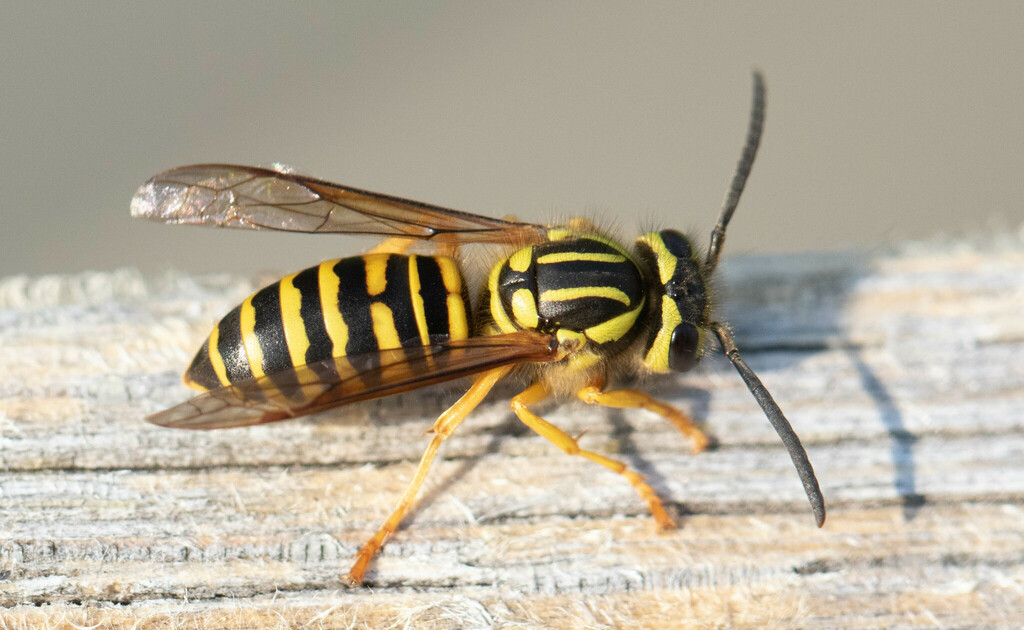
Southern Yellowjacket
Vespula squamosa
Vespula squamosa, or the southern yellowjacket, is a social wasp. This species can be identified by its distinctive black and yellow patterning and orange queen. This species is typically found in eastern North America, and its territory extends as far south as Central America. Within these territories, they create enormous, multiple-comb nests. The colonies may be either annual or perennial depending on the climate, and in many perennial nests, polygyny takes place. In addition, this species uses pheromones both as a sexual attractant and an alarm signal. This species feeds on insects and animal carcasses; it does not produce honey. V. squamosa, a social insect, has developed a parasitic relationship with the species V. vidua and V. maculifrons. Due to their painful, venomous stings, the species is considered a pest.
From the article Vespula squamosa on Wikipedia (CC BY-SA), quoted section by section
Description
V. squamosa is typically about 0.5 inches (1.3 cm) long and distinguishable by its black body and yellow striping pattern over its entire body. This species has clear wings and a hairless body. While the males and workers resemble other yellowjackets, the queen has a unique appearance. She is significantly larger than the males and workers and is more orange in color. In addition, both V. squamosa and the V. sulphurea have two stripes on their scuta, which differentiates them from other species.
Wikipedia: “Description and identification”
Range & habitat
Southern yellowjackets are typically found in the eastern United States and as far south as Mexico and Guatemala. Their territory expands as far west as Texas and as far east as the Atlantic Ocean. These areas tend to have fairly warm weather, and in some cases, tropical climates. Within these territories, nests are typically found in unnatural habitats, such as yards, parks, and sides of roads. Some colonies, though, are found in pine forests. Their parasitic relationship with V. maculifrons can result in V. squamosa colony formation in hardwood forests, a habitat more typical of V. maculifrons. Most nests are subterranean, though some have been found above ground or in walls, close to V. maculifrons nests.
Nests. Southern yellowjackets' nests are typically built either in unnatural or disturbed environments such as yards, picnic tables, and other artificial environments and can be aerial or underground. They are usually made from chewed vegetable fibers. Colonies have been reported to contain from 9000 to more than 450,000 cells. One of the largest reported nests occupied a pine tree and the dirt underneath it. The nest was around 114.3 centimetres (45.0 in) in diameter at its widest point and had over 50 combs in the trunk section alone. While most social wasps have annual nests, many instances of multiple-season V. …
Wikipedia: “Distribution and habitat”
What it does
This species is predatory and typically eats live insects, but they also feed on the flesh of deceased prey. They typically prey on arthropods, including spiders and caterpillars. For larvae to grow into the pupal state, adult workers find prey and bring food back for them. When establishing the colony, the queen goes out in search of nectar and insects for the larvae, as well. This species does not produce honey, though.
Wikipedia: “Diet”
Listen
Looking for field recordings…
Where it lives
Recorded sightings
—
geo-referenced records in GBIF, from museums, herbaria and field observers.
Drag the globe to turn it. Dots are where records exist, not a range map; darker means more records.
In the stacks
Searching the stacks…
Every page naming Vespula squamosa in the Biodiversity Heritage Library →
This page is assembled live from iNaturalist, GBIF, Wikipedia, the Source Library and the Internet Archive. It is not yet part of the hand-edited codex. iNaturalist taxon 233560.