- Animals
- ›Arthropods
- ›Hexapods
- ›Insects
- ›Winged and Once-winged Insects
- ›Butterflies and Moths
- ›Clearwing moths
- ›Clearwing Moths
- ›Sesiinae
- ›Synanthedonini
- ›Synanthedon
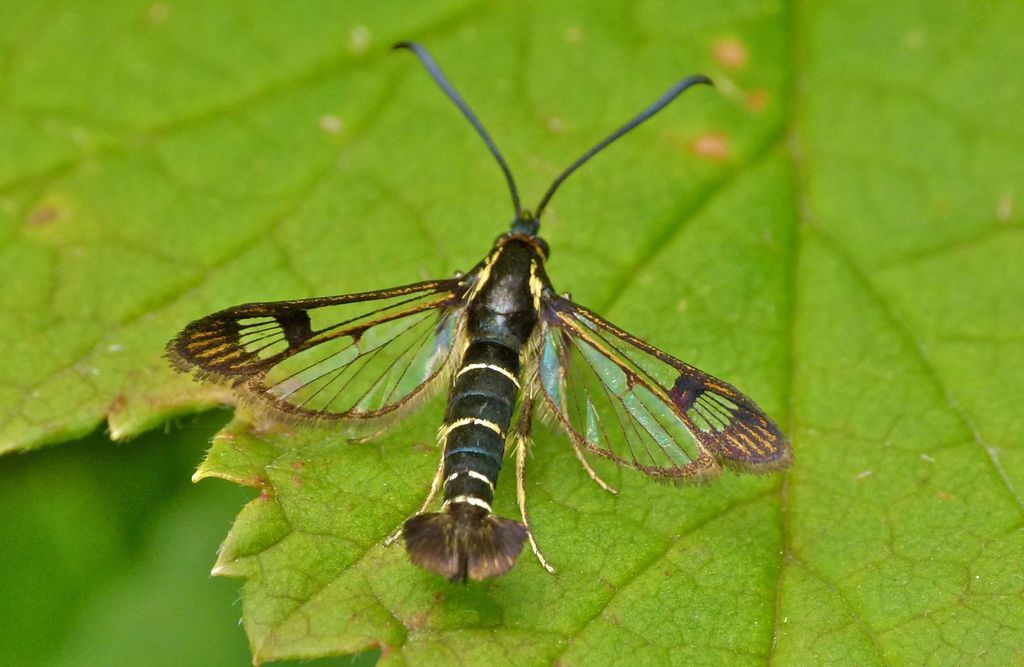
Currant Clearwing Moth
Synanthedon tipuliformis
Synanthedon tipuliformis, known as the currant clearwing, is a moth of the family Sesiidae. It is endemic to the Palearctic ecozone, but is an invasive species in the Nearctic ecozone and the Australasia ecozone.
From the article Synanthedon tipuliformis on Wikipedia (CC BY-SA), quoted section by section
Description
The wingspan is 17–20 millimetres (0.67–0.79 in). The moths have transparent wings, which are scaled only on the wing veins, the discal spot and the wing edges. The scales shine in blue-black shades. At the apex of the forewings there are weakly formed reddish or yellowish longitudinal stripes. In the middle, an elongated black-brown discal spot can be seen, which extends from the front to the back edge. The hind wings have a narrow dark marginal band and a small black-brown discal spot. The antennae are black and yellow dusty on the underside. The black thorax has lateral yellow stripes. On segments two, four, six and seven of the black abdomen there are thin yellow rings in the males. Female moths show equally coloured rings on segments two, four and six. The tufts are strongly fan-shaped and of blue-black color.
Listen
Looking for field recordings…
Where it lives
Recorded sightings
—
geo-referenced records in GBIF, from museums, herbaria and field observers.
Drag the globe to turn it. Dots are where records exist, not a range map; darker means more records.
In the stacks
Searching the stacks…
Every page naming Synanthedon tipuliformis in the Biodiversity Heritage Library →
This page is assembled live from iNaturalist, GBIF, Wikipedia, the Source Library and the Internet Archive. It is not yet part of the hand-edited codex. iNaturalist taxon 232127.