- Animals
- ›Arthropods
- ›Hexapods
- ›Insects
- ›Winged and Once-winged Insects
- ›Beetles
- ›Water, Rove, Scarab, Long-horned, Leaf, and Snout Beetles
- ›Bostrichiform Beetles
- ›Carpet, Powderpost, and Deathwatch Beetles
- ›Deathwatch, Spider, and Wood-borer Beetles
- ›Death-watch Beetles
- ›Stegobiini
- ›Stegobium
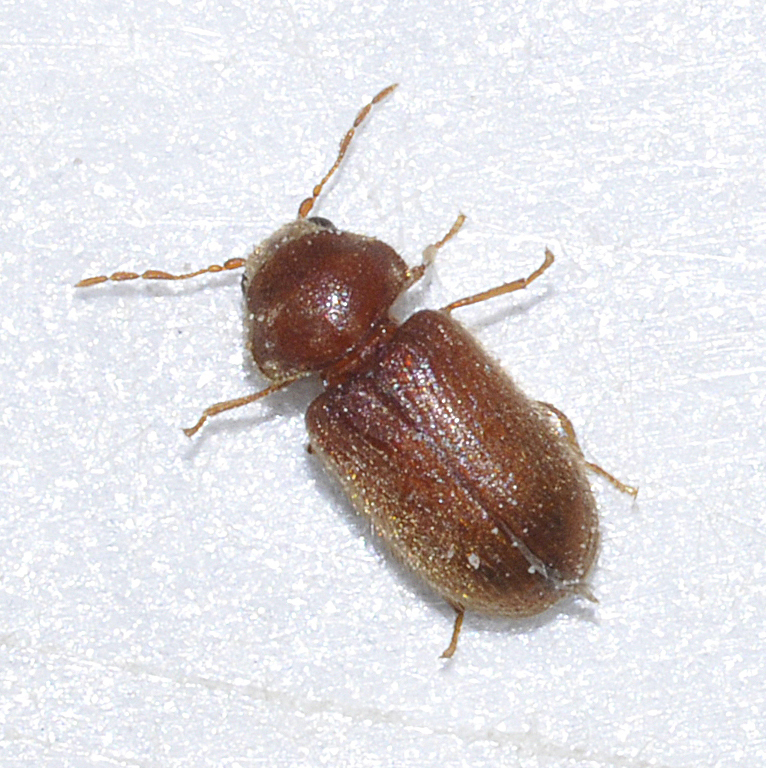
Drugstore Beetle
Stegobium paniceum
The drugstore beetle (Stegobium paniceum), also known as the bread beetle, biscuit beetle, and misnamed as the biscuit weevil (despite not being a weevil), is a small brown beetle that infests a wide variety of dried plant products, where it is among the most common non-weevils. It is the only living member of the genus Stegobium. It belongs to the family Ptinidae, which also includes the deathwatch beetle, furniture beetle and cigarette beetle. A notable characteristic of this species is the symbiotic relationship the beetles have with a yeast-like fungus which is transmitted from female to larvae through the oviduct.
The drugstore beetle is distributed worldwide with higher prevalence in warmer climates. It is commonly confused with the cigarette beetle, as they have a similar size and coloring. Adults possess antennae ending in 3-segmented clubs, while cigarette beetles have serrated (saw-like) antennae. Their bodies are lined with grooves running longitudinally along the elytra, whereas the cigarette beetle is smooth.
From the article Drugstore beetle on Wikipedia (CC BY-SA), quoted section by section
Description
Adult drugstore beetles are between 2.5 and 3.5 millimetres (3⁄32 and 1⁄8 in) long and have a reddish-brown colour with a cylindrical body. Larvae are habitually curled. The pupa is proportionally more slender than that of the cigarette beetle. Males and females appear nearly identical, except that males have a sexually dimorphic slot-like structure on the tarsal claws which can only be observed under a microscope. During the pupal stage, males and females can be differentiated as the female genital papillae are bulging outwards and divergent, while the male genital papillae are not protruding and are not as pronounced. As adults carry their genitals within their body, there is no reliable way to distinguish sexes in live specimen beyond the pupal stage.
At the table
Drugstore beetles primarily feed and cause damage during the larval stage. The drugstore beetle attacks a wide variety of food sources including dried herbs and medicinal plants, earning its name. This species is known for feeding on both food and non-food materials. The beetle eats bread, grain, coffee beans, powdered milk, sweets like cookies and chocolates, spices and herbs, dried fruit, seeds, and more. They also consume museum specimens, wool, hair, leather, books, upholstery, and manuscripts. Adults gnaw through packaging forming large holes in the material, leading to their deterioration, contamination, and loss of structural integrity.
Wikipedia: “Food resources”
In human culture
The life cycle of this beetle transitions from the egg, to 4-6 larval instars, the construction of a cocoon for the pupa, and finally, the adult stage. The female can lay up to 75 eggs, depositing them in or near sources of food. Approximately 80% of her eggs end up being fertile. The egg stage lasts around 7–20 days at a temperature between 20 °C and 27.5 °C. The larvae then form a cocoon of silk and food material which they use to pupate. The pupa stays in the cocoon for varying amounts of time before the adult emerges. Between temperatures 20 °C and 27.5 °C, the pupal stage typically lasts from 5–12 days. Temperature and relative humidity play an important role in the growth and development of drugstore beetles, with the optimal range being between 15 °C and 35 °C, and an ideal temperature of 30 °C. Studies have found that increasing the relative humidity or temperature shortened the incubation period for these eggs and the pupal period. At peak conditions, it takes the eggs around 40 days to develop into adults. At the end of this cycle, adults live for about 85 days at 17.5 °C. The specific length of each stage depends on the temperature and food sources available to the beetles.
Wikipedia: “Life history”
Listen
Looking for field recordings…
Where it lives
Recorded sightings
—
geo-referenced records in GBIF, from museums, herbaria and field observers.
Drag the globe to turn it. Dots are where records exist, not a range map; darker means more records.
In the stacks
Searching the stacks…
Every page naming Stegobium paniceum in the Biodiversity Heritage Library →
This page is assembled live from iNaturalist, GBIF, Wikipedia, the Source Library and the Internet Archive. It is not yet part of the hand-edited codex. iNaturalist taxon 231494.