On eBird ↗
Long-tailed Ground-Roller
Live sightings near you, the range map, bar charts of when it is seen, and Macaulay Library photos and recordings.
Long-tailed Ground-Roller
Uratelornis chimaera
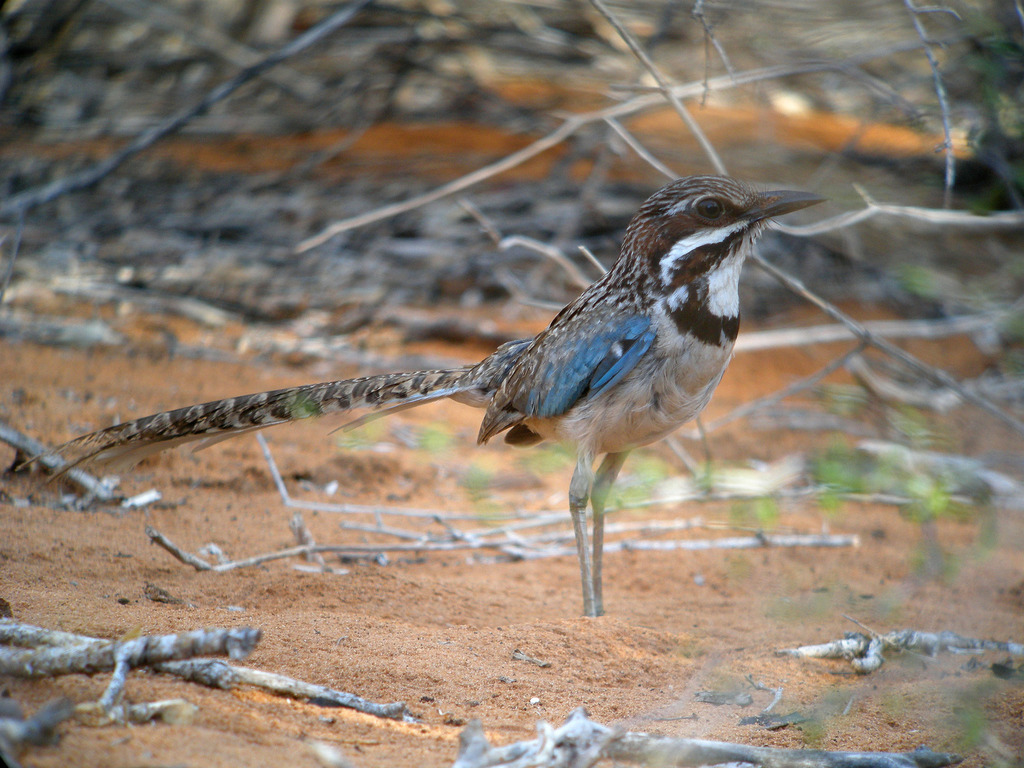
The long-tailed ground roller (Uratelornis chimaera) is a species of bird in the ground roller family Brachypteraciidae, placed in the monotypic genus Uratelornis. Endemic to arid spiny forests near the coast in southwestern Madagascar, this ground roller occurs at extremely low population densities throughout its habitat. This species requires shade and a deep layer of leaves on the ground, and it is absent from parts of the spiny forest lacking these features. It has no recognized subspecies, and its closest relative is the scaly ground roller. The long-tailed ground roller is the only ground roller to definitively display sexual dimorphism (differences in plumage or size between sexes). It is a medium-sized bird with a plump silhouette and a long tail. The upperparts are dark brown with black streaks while the underparts are light gray. The white throat is framed by black malar stripes and a black breastband, and a white stripe is present at the base of the bill. Sky-blue feathers are visible at the edge of the wings and the tail. Calls are rarely made outside the breeding season, though multiple courtship calls are made.
These ground rollers feed primarily on invertebrates, including ants, beetles, butterflies, and worms, which they find by searching through deep leaf litter or by remaining still and watching attentively. The ground roller primarily runs through its habitat on its strong legs, as its wings are relatively weak. It is a monogamous species, and it defends a territory during the breeding season of October to February.
From the article Long-tailed ground roller on Wikipedia (CC BY-SA), quoted section by section
Description
The long-tailed ground roller's silhouette is highly distinctive due to its long tail and plump silhouette. The bird is 34 to 47 centimeters (13 to 19 in) long, although its tail can contribute up to 30 centimeters (12 in) of the length, which makes it the longest tail of any of the ground rollers. This ground roller has short wings and long, pinkish-brown legs. The male has a sandy buff crown and dark brown upperparts with black streaks. Its supercilium is a pale buff color, while the ear-coverts are brown. The eyes are brown, while the short and stout beak is black. Its tongue is long with a brush-like tip to help it collect insects. A white stripe is present at the base of the bill and is surrounded by brown and black malar stripes. These malar stripes and the black breastband frame a white throat. The tail has 15 to 20 dark brown bars marking it, while the outer rectrices are sky blue; this sky blue is also present on the wing-coverts. In flight, the bird's two black and white bands on the primaries and secondaries are conspicuous. The underparts are a light gray, and the breast white. The toes are zygodactylous, with the first and fourth toes turned outwards and the middle two toes turned inwards. The female resembles the male, but is smaller and has a narrower chestband and a shorter tail. Also, the female loses her tail while nesting. …
Range & habitat
Endemic to the island nation of Madagascar, the long-tailed ground roller inhabits a narrow strip of suitable habitat by the coast in the southwestern part of the island. This strip is bordered by the Mangoky River in the north, the Fiherenana River in the south, and lowland hills in the east. It totals about 10,500 square kilometers (4,100 sq mi) in area; however, the species is extremely uncommon within its range and occurs at densities of about 0.8 to 10 per square kilometer (2.1 to 25 per square mile). This area ranges in elevation from sea level to 100 meters (330 ft). The long-tailed ground roller does not migrate, though it may disperse across a larger area outside the breeding season. This species' prime habitat is spiny forest, a mix of sub-arid thorn-scrub and deciduous woodland that only receives on average 500 millimeters (20 in) of water a year and is covered in sandy soil. The dominant plants in these spiny forests belong to the cactus-like family Didiereaceae (especially Didierea madagascariensis) and more tree-like family Euphorbiaceae (especially Euphorbia stenoclada). Baobab trees are also prevalent. It was formerly believed that the long-tailed ground roller preferred an undisturbed forest habitat, while tolerating small amounts of disturbance. Later studies have concluded that it actually prefers degraded habitat. …
Wikipedia: “Distribution and habitat”
What it does
The long-tailed ground roller is a shy and elusive bird and, if seen by a human observer, it either freezes or runs away. As its short wings suggest, the species rarely flies, but it is a powerful runner. While largely terrestrial, it roosts in low trees and bushes, and sings from low perches. Long-tailed ground rollers are solitary outside the breeding season. Although diurnal, it does occasionally forage at night unlike most other ground rollers. When calling, this ground roller bobs its head and raises its tail. The long-tailed ground roller also raises its tail when it is excited.
Diet. This species forages almost exclusively from the ground, where it alternates between remaining still and watching attentively and actively searching for it by rummaging through deep leaf litter. It eats a wide range of invertebrates, including ants, beetles, butterflies, caterpillars, cockroaches, grasshoppers, woodlice, and worms, and occasionally small vertebrates. Despite the long-tailed ground roller's poor flying abilities, it has been seen catching butterflies in midair.
Reproduction. The breeding season coincides with the rainy season, which lasts from October to January. During this period this bird abandons its solitary habits to find a mate, with which it remains monogamous. Males form territories during the breeding season, and they defend their area with territorial calls. …
Wikipedia: “Ecology and behavior”
Listen
Looking for field recordings…
Where it lives
Recorded sightings
—
geo-referenced records in GBIF, from museums, herbaria and field observers.
Drag the globe to turn it. Dots are where records exist, not a range map; darker means more records.
In the stacks
Searching the stacks…
Every page naming Uratelornis chimaera in the Biodiversity Heritage Library →
This page is assembled live from iNaturalist, GBIF, Wikipedia, the Source Library and the Internet Archive. It is not yet part of the hand-edited codex. iNaturalist taxon 2313.