On eBird ↗
Dollarbird
Live sightings near you, the range map, bar charts of when it is seen, and Macaulay Library photos and recordings.
Dollarbird
Eurystomus orientalis
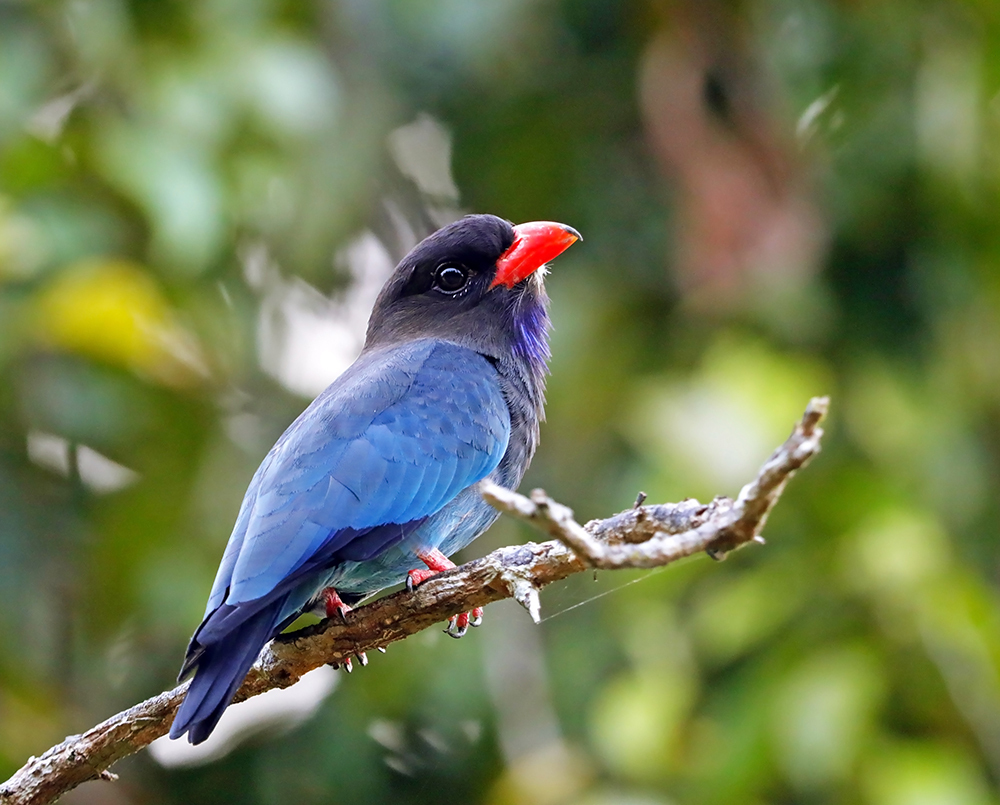
The Oriental dollarbird (Eurystomus orientalis) is a bird of the roller family, so named because of the distinctive pale blue or white, coin-shaped spots on its wings. It can be found from Australia to Korea, Japan and India.
From the article Oriental dollarbird on Wikipedia (CC BY-SA), quoted section by section
Description
The oriental dollarbird 27–32 cm long. It is dark brown but this is heavily washed with a bluish-green sheen on the back and wing coverts. Its belly and undertail coverts are light coloured, and it has glossy bright blue colouring on its throat and undertail. Its flight feathers are a darker blue. Its bill is short and wide and in mature animals is coloured orange-red with a black tip. It has very light blue-white patches on the outer parts of its wings which are highly visible in flight. The females are slightly duller than the males but overall the two are very similar. Immature birds are much duller than the adults and do not have the blue colouring on their throats. They also have dark blackish-grey to brown bills and feet instead of the red of the adults.
Range & habitat
The oriental dollarbird is found from Australia to Japan and India. At least two subspecies (E. o. cyanocollis and E. o. pacificus) are migratory; the former breeds in northeastern Asia and winters southeastern Asia, and the latter in northern and eastern Australia between the months of September and April and winters in New Guinea and nearby islands. The birds prefer open wooded areas with hole-bearing trees to build nests in.
Wikipedia: “Distribution and habitat”
What it does
The oriental dollarbird is most commonly seen singly with a distinctive upright silhouette on a bare branch high in a tree, from which it hawks for flying insects, often returning to the same perch after a few seconds.
Wikipedia: “Behaviour and ecology”
In human culture
The generic name derives from Ancient Greek eurustomos 'wide-mouthed' and the specific epithet is Latin orientalis 'eastern'. The name "dollarbird" is from the round bluish-white patch on the wing, visible in flight or when stretching its wings, "said to resemble a silver dollar" (coin). Alternative names for the oriental dollarbird include the Asian dollarbird, Australian roller (E. o. pacificus), dark roller, dollar roller, dollarbird, eastern broad-billed roller and oriental broad-billed roller.
Wikipedia: “Etymology”
Listen
Looking for field recordings…
Where it lives
Recorded sightings
—
geo-referenced records in GBIF, from museums, herbaria and field observers.
Drag the globe to turn it. Dots are where records exist, not a range map; darker means more records.
In the stacks
Searching the stacks…
Every page naming Eurystomus orientalis in the Biodiversity Heritage Library →
This page is assembled live from iNaturalist, GBIF, Wikipedia, the Source Library and the Internet Archive. It is not yet part of the hand-edited codex. iNaturalist taxon 2293.