- Animals
- ›Arthropods
- ›Hexapods
- ›Insects
- ›Winged and Once-winged Insects
- ›Butterflies and Moths
- ›Butterflies
- ›Swallowtails and Parnassians
- ›Swallowtails
- ›Fluted Swallowtails
- ›Papilio
- ›Pterourus
- ›Papilio glaucus
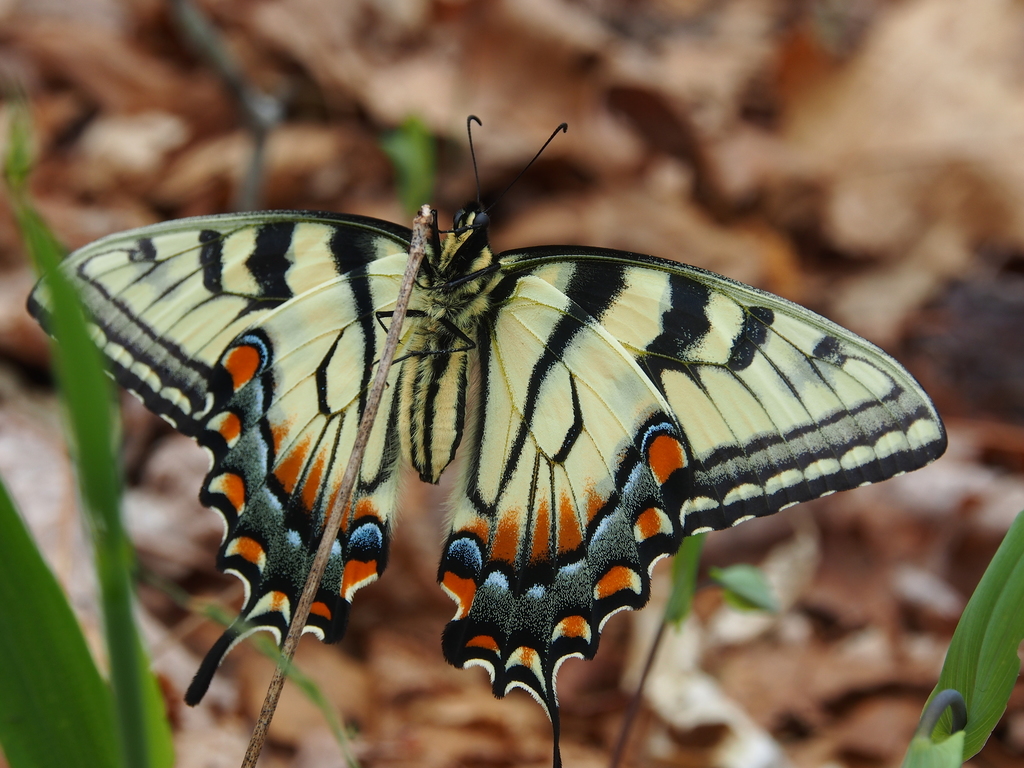
Appalachian Tiger Swallowtail
Papilio appalachiensis
Papilio appalachiensis, the Appalachian tiger swallowtail, is a species of swallowtail butterfly found in eastern North America, particularly in the Appalachian Mountains. It is a hybrid of another two Papilio species, Papilio canadensis and Papilio glaucus, with which it shares many characteristics. The butterflies are normally yellow and contain black patterns in their wings. Their wingspans range from 86 to 115 mm. The caterpillars range in color from green and yellow to orange and are ornamented with black specks that give them the appearance of a bird dropping, which is useful for camouflage, or a large eye, a form of mimicry that is also efficient for protection.
This species is univoltine. Females lay their eggs in May.
From the article Papilio appalachiensis on Wikipedia (CC BY-SA), quoted section by section
Description
The Appalachian tiger swallowtail has similarities to both parent species; it resembles P. canadensis as it is adapted to a cooler temperature and has only one brood per year (univoltine), but also resembles P. glaucus as it displays sex-limited polymorphism with the dark female morph displaying mimicry. However, research has shown that P. appalachiensis may be more closely related genetically to P. canadensis than to P. glaucus. Females of P. appalachiensis are generally larger than those of P. glaucus. Their wings are slightly angular and have vertical black stripes that are narrower than those on P. glaucus. The hindwing scallops are also less curved and more angular than those of P. glaucus. Additionally, the spots on their hindwings are also less crescent shaped and rectangular compared to those of P. glaucus. Males' hindwings tend to be more triangular. The female has two forms: yellow and black. Both the yellow and black forms have a slight blue tint on the topside of the hindwings that is significantly reduced from the stronger blue tint on those of the tiger swallowtails. On the topside of the hindwing, there is a large orange spot. Their wingspan is 86–115 mm (3.4–4.5 in). Initially, no black forms of P. appalachiensis were thought to exist, but researchers found two black females on the summit of Spruce Knob in West Virginia.
Caterpillar. …
Wikipedia: “Appearance”
Range & habitat
The butterfly is found in the eastern United States, specifically in the Appalachian Mountains, ranging from Pennsylvania to Georgia. It is notably larger than both the eastern tiger swallowtail and the Canadian tiger swallowtail.
Wikipedia: “Distribution”
What it does
The Appalachian tiger swallowtail is univoltine. Female butterflies usually lay their singular brood from May to June. During the mating season, the males fly through the treetops, scouting for females. Females, though, tend to be difficult to find because they prefer to hide in the forest canopy. After mating, females lay their eggs singularly on host plant leaves. The caterpillars, after hatching, then eat the host plants' leaves and undergo chrysalis throughout the winter. Pupation occurs around late June to July and pupae diapause until spring. Adults hatch in May.
Wikipedia: “Life cycle”
Listen
Looking for field recordings…
Where it lives
Recorded sightings
—
geo-referenced records in GBIF, from museums, herbaria and field observers.
Drag the globe to turn it. Dots are where records exist, not a range map; darker means more records.
In the stacks
Searching the stacks…
Every page naming Papilio appalachiensis in the Biodiversity Heritage Library →
This page is assembled live from iNaturalist, GBIF, Wikipedia, the Source Library and the Internet Archive. It is not yet part of the hand-edited codex. iNaturalist taxon 226950.