 NL·0375
Herbarium of the Nature Library
- Name
- Coracias caudatus
- Family
- Coraciidae
- Native to
- Eastern and southern Africa, from Ethiopia and Somalia to northern South Africa and Namibia
- Habitat
- Savanna, Open woodland
On eBird ↗
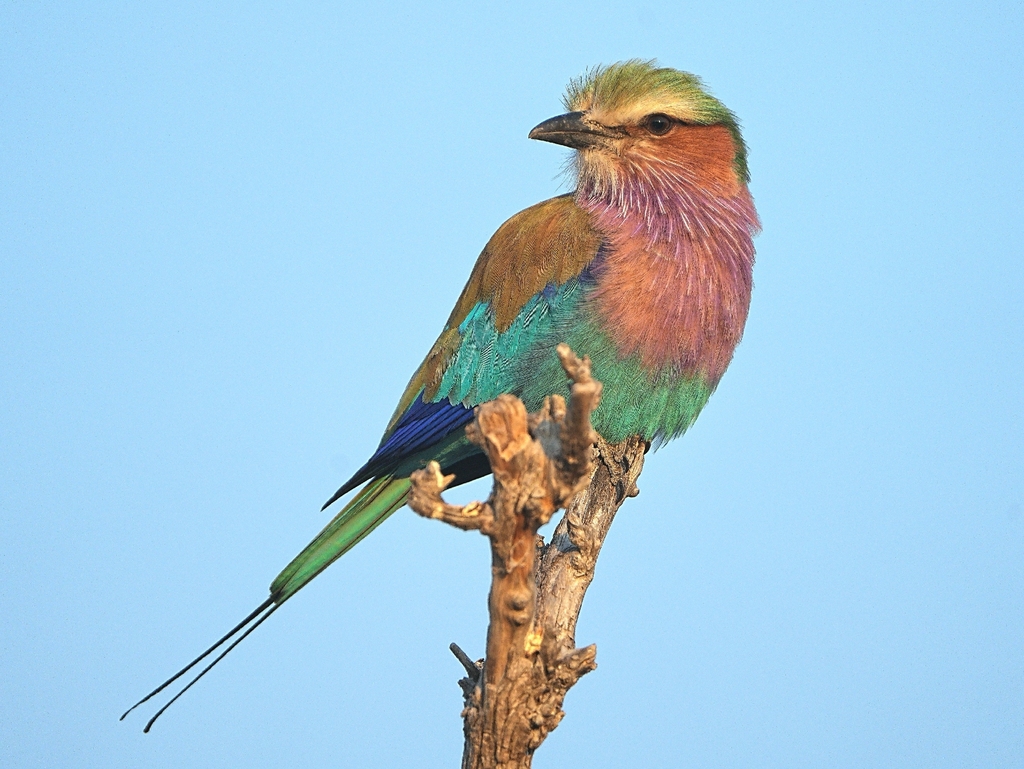
Lilac-breasted Roller
Live sightings near you, the range map, bar charts of when it is seen, and Macaulay Library photos and recordings.
Lilac-breasted roller
Coracias caudatus
Also calledGewone troupant (Afrikaans) · Rollier à longs brins (French)
One of Africa's most photographed birds: a stocky perch-hunter painted in turquoise, ultramarine, lilac and cinnamon, with two long tail streamers. It sits conspicuously on dead branches and drops onto insects and lizards on the ground.
The lilac-breasted roller is an African bird of the roller family, Coraciidae. It is widely distributed in Southern and Eastern Africa, and is a vagrant to the southern Arabian Peninsula. It prefers open woodland and savanna, and it is for the most part absent from treeless places. Usually found alone or in pairs, it perches at the tops of trees, poles or other high vantage points from where it can spot insects, amphibians and small birds moving about on the ground. Nesting takes place in a natural hole in a tree where a clutch of 2–4 eggs are laid, and incubated by both parents, who are extremely aggressive in defence of their nest, taking on raptors and other birds. During the breeding season the male will rise to a fair height, descending in swoops and dives, while uttering harsh, discordant cries. The sexes do not differ in coloration, and juveniles lack the long tail streamers of adults. This species is unofficially considered the national bird of Kenya. Alternative names for the lilac-breasted roller include the fork-tailed roller, lilac-throated roller, Mosilikatze's roller, and troupand. Wikipedia
What it can do
- iSit-and-wait hunter that spots small prey from exposed perches
- iiPerforms a tumbling, rolling display flight that gives rollers their name
- iiiDefends nest holes aggressively, diving at raptors and other intruders
In the field
Field marks
- aLilac throat and breast (blue-breasted in the northern subspecies lorti)
- bTurquoise belly, crown greenish, back cinnamon-brown
- cBrilliant ultramarine and turquoise wings, flashing in flight
- dTwo long, thin, dark outer tail streamers
- eHeavy black bill
- Voice
- Harsh, grating 'rak' or 'kaak' calls, run together into a crackling series during the display flight.
- Not to be confused with
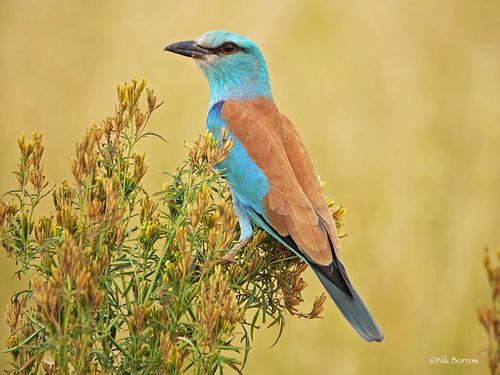
- European roller (a winter visitor) has a blue head and breast and no tail streamers. Abyssinian roller has entirely blue underparts and even longer streamers and lives north of the equator. Racket-tailed roller has a blue breast and spatulate tips to its streamers. Purple roller is larger, with streaked purple-brown underparts and a square tail.
- Where to see it
- Maasai Mara, Serengeti, Kruger, Okavango Delta, Chobe and Etosha; often on roadside dead trees
- When
- Resident year-round
Listen
Looking for field recordings…
Life & habits
- Diet
- Large insects, scorpions, centipedes, small lizards, frogs and occasionally small birds
- Habitat
- Acacia savanna and open woodland with scattered perches
- Size
- About 36 cm including tail streamers; 100–130 g
In display a bird climbs steeply and then dives with rocking, side-to-side rolls while calling harshly.
Where it lives
Recorded sightings
—
geo-referenced records in GBIF, from museums, herbaria and field observers.
Native range
Eastern and southern Africa, from Ethiopia and Somalia to northern South Africa and Namibia
Drag the globe to turn it. Dots are where records exist, not a range map; darker means more records.
In the old herbals & bestiaries
No plate in the Source Library names this exact species, so these show its closest relatives as the old naturalists drew them: same genus, or the same kind of animal. Click a plate to read the page it came from, with translation.

Historiae Animalium Liber III: De Avium Natura
Relative · Conrad Gesner · 1555 · p.715

Ornithology
Relative · Ulisse Aldrovandi · 1599 · p.803

History of Animals, Book I: On Viviparous Quadrupeds
Relative · Conrad Gessner · 1554 · p.860

Ornithology: The History of Birds
Relative · Ulisse Aldrovandi · 1599 · p.800

Ornithologiae: de avibus historiae libri XII
Relative · Ulisse Aldrovandi · 1599 · p.813

Ornithologiae: de avibus historiae libri XII
Relative · Ulisse Aldrovandi · 1599 · p.787
In the stacks
Searching the stacks…
Every page naming Coracias caudatus in the Biodiversity Heritage Library →
Marginalia
Rollers take their common name from the tumbling display flight; the genus name Coracias comes from the Greek korakias, a kind of crow.
Curiosity
In the subspecies Coracias caudatus lorti of Ethiopia and Somalia the 'lilac' breast is blue, so not every lilac-breasted roller has one.
Kinship
- kingdomAnimalia
- ›phylumChordata
- ›subphylumVertebrata
- ›classAves
- ›orderCoraciiformes
- ›familyCoraciidae
- ›genusCoracias
Neighbours on the shelf

Photographs: iNaturalist contributors under the licences shown. Records: GBIF.org. Historical plates: Source Library (CC BY-SA 4.0; originals public domain). Summary text: Nature Library editors and Wikipedia (CC BY-SA). Medicinal and edibility notes are historical and educational, not advice. iNaturalist taxon 2269.