On eBird ↗
Blue-bellied Roller
Live sightings near you, the range map, bar charts of when it is seen, and Macaulay Library photos and recordings.
Blue-bellied Roller
Coracias cyanogaster
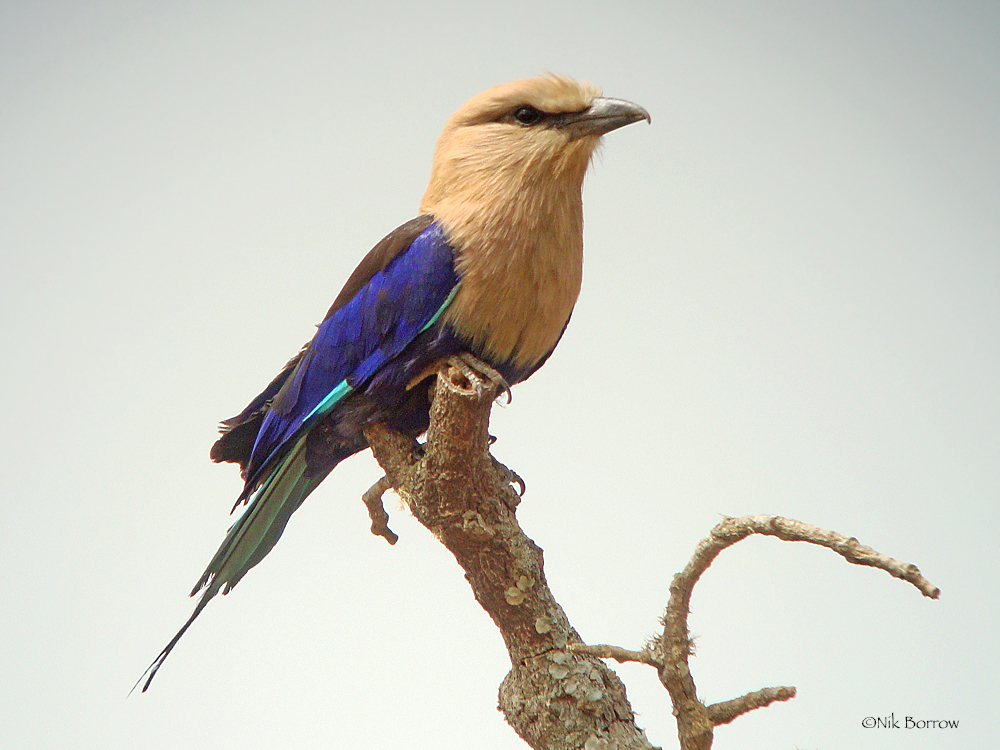
The blue-bellied roller (Coracias cyanogaster) is a member of the roller family of birds which breeds across Africa in a narrow belt from Senegal to northeast Democratic Republic of the Congo. It is resident, apart from some local seasonal movements, in mature moist savannah dominated by Isoberlinia trees.
From the article Blue-bellied roller on Wikipedia (CC BY-SA), quoted section by section
Description
The blue-bellied roller is a large bird, nearly the size of a jackdaw at 28–30 cm (11–12 in). It has a very dark brown back, buffy or chalky white head, neck and breast, with the rest of the plumage mainly blue. Adults have 6 cm (2.4 in) tail streamers. Sexes are similar, but the juvenile is a drabber version of the adult. The blue-bellied roller is striking in its strong direct flight, with the brilliant blues of the wings contrasting with the dark back and cream colored head, and the tail streamers trailing behind. The call of blue-bellied roller is a harsh clicking ga-ga-ga sound.
Range & habitat
This is a common bird of warm open country with some trees. These rollers often perch prominently on trees, posts, or overhead wires, like giant shrikes, whilst watching for the grasshoppers and other large insects on which they feed.
Wikipedia: “Distribution and habitat”
What it does
The display of this bird is a lapwing-like display, with the twists and turns that give this species its English name. It nests in a hole in a tree - a tree cavity.
Wikipedia: “Behaviour and ecology”
Listen
Looking for field recordings…
Where it lives
Recorded sightings
—
geo-referenced records in GBIF, from museums, herbaria and field observers.
Drag the globe to turn it. Dots are where records exist, not a range map; darker means more records.
In the stacks
Searching the stacks…
Every page naming Coracias cyanogaster in the Biodiversity Heritage Library →
This page is assembled live from iNaturalist, GBIF, Wikipedia, the Source Library and the Internet Archive. It is not yet part of the hand-edited codex. iNaturalist taxon 2264.