- Animals
- ›Arthropods
- ›Hexapods
- ›Insects
- ›Winged and Once-winged Insects
- ›Beetles
- ›Water, Rove, Scarab, Long-horned, Leaf, and Snout Beetles
- ›Cucujiform Beetles
- ›Darkling Beetles and Allies
- ›Blister Beetles
- ›Meloinae
- ›Meloini
- ›Meloe
- ›Meloe
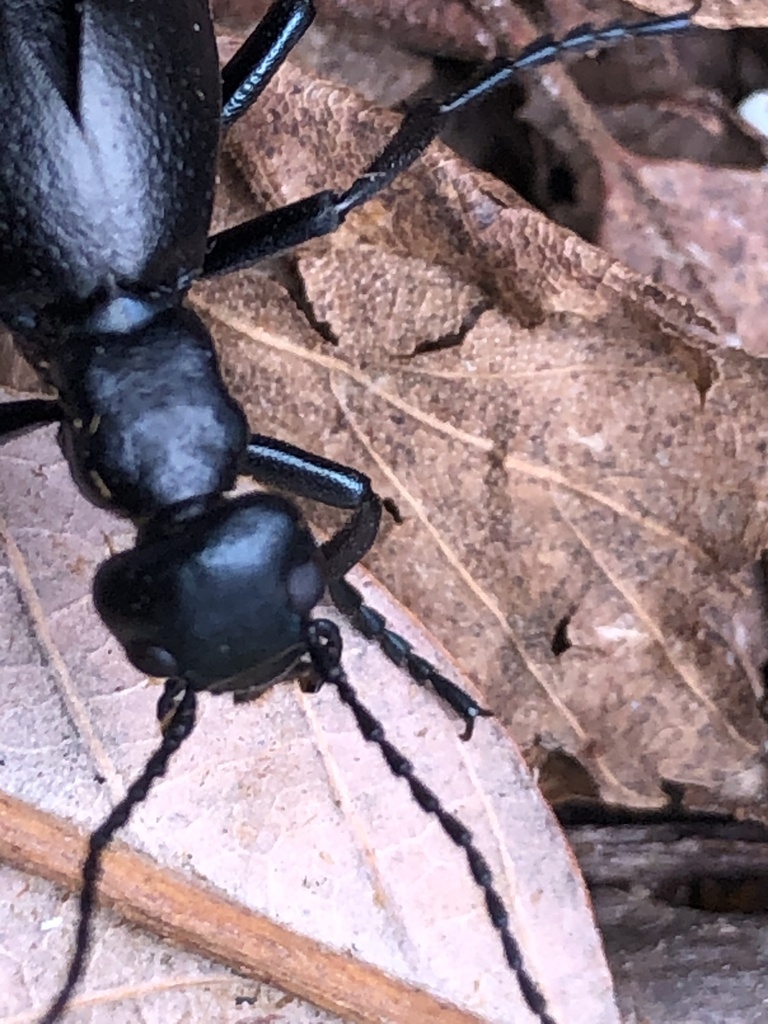
Buttercup Oil Beetle
Meloe americanus
Meloe americanus is a type of blister beetle (Meloidae) found in North America. It is most relevant to the fields of agriculture and veterinary medicine. Adult beetles feed on different types of plants, which cause crop damage. They also release a fluid containing a chemical that is toxic, and at high concentrations lethal, to mammals. The first instar larvae are uniquely active and mobile, utilizing phoresy and parasitism to feed and mature through their developmental stages.
From the article Meloe americanus on Wikipedia (CC BY-SA), quoted section by section
Description
Meloe americanus, or the American oil beetle, is a type of blister beetle. It belongs to the genus Meloe, which is one of the larger genera in the Meloidae family, with 146 known species. They are called “oil beetles” because of a fluid they release from their joints when they feel threatened. Adult body length ranges from 7 mm to 17 mm [8]. M. americanus are entirely black, and sometimes they can be seen with a blue metallic hue. They are soft-bodied and long-legged, with their neck region skinnier than their head and abdomen. The elytra are short and abbreviated, while the hind wings are not present. Therefore, M. americanus are unable to fly as adults. Both females and males have similar appearances, with females being generally larger than males in size. There is, however, sexual dimorphism in their antennal structure: females have straight, linear antennae while males have a bend around the middle of their antennae.
Range & habitat
M. americanus is native to the northeastern regions of the United States, but they can also be found in central and southern regions of the United States. Out of all species of the Meloe genus, M. americanus is one of two that can be found in Mississippi, Louisiana, and Alabama. The presence of M. americanus in the south can be explained by the mild winters and the seasonal activity of flowering forbs that attract Apoidea. Usually, species of Meloe display a correlation between their pattern of geographic distribution and their seasonal activity as adults. M. americanus adults become active during the late autumn to early winter months, which explains why they can be found in places with milder climates.
Wikipedia: “Geographic range”
What it does
There are four general life stages of a beetle: egg, larva, pupa, and adult. A Meloe egg can range from a yellow to deep orange color. They are cylindrical and about 0.5 to 2 mm long. Eggs can hatch within 30 days, but sometimes it can take up to 130 days or more for larvae to emerge after the eggs are laid. The remaining larval, pupal, and adult stages can be divided into nine instars in M. americanus. The larvae are less than 1.6 mm in length, and light to dark brown in color. The larval stage is split into four stages, or seven instars. The first instar is called the triungulin phase because we see the emergence of triungulin larvae. The triungulin larvae are the most active out of all the larval stages. They climb foliage and wait for potential hosts to which they attach to, so that they can be transported to a host's nest, where further development occurs. The second through fifth instars make up the first grub phase. In this phase, larvae are still active, feeding and maturing inside the cells of bees. The next stage is the coarctate phase, or the sixth instar. Larvae in this phase become increasingly inactive and sedentary. The seventh instar is the second grub phase. These larvae are completely inactive. The pupal stage is the eighth instar, and the adult stage is the ninth and final instar. Temporal patterns of occurrence are dependent on temperature. Adult M. …
Wikipedia: “Life cycle”
At the table
Adults and larvae of M. americanus have unique diets. Adults are phytophagous, meaning they only eat plants. They feed on the flowers, stems, and leaves of herbaceous plants. The most common families of plants that M. americanus feed on are Ranunculaceae and Compositae. Most of the plants that the adult beetles eat are relatively small, meaning that they feed at or near ground level, which makes them vulnerable to predators. Therefore, they do not spend a lot of time resting on their plants, like other blister beetles might do. M. americanus larvae are entomophagous, meaning they eat other insects. Their food sources consist of grasshopper eggs, bee eggs and larvae, and any provisions found in the nest of bees. Bee larval cells are provisioned with a viscous mixture of nectar and pollen, and the bee eggs are placed atop the provisions. They reach these cells via phoresy, or the act of latching themselves on to another insect for the purpose of dispersal.
Wikipedia: “Food resources”
Listen
Looking for field recordings…
Where it lives
Recorded sightings
—
geo-referenced records in GBIF, from museums, herbaria and field observers.
Drag the globe to turn it. Dots are where records exist, not a range map; darker means more records.
In the stacks
Searching the stacks…
Every page naming Meloe americanus in the Biodiversity Heritage Library →
This page is assembled live from iNaturalist, GBIF, Wikipedia, the Source Library and the Internet Archive. It is not yet part of the hand-edited codex. iNaturalist taxon 224874.