On eBird ↗
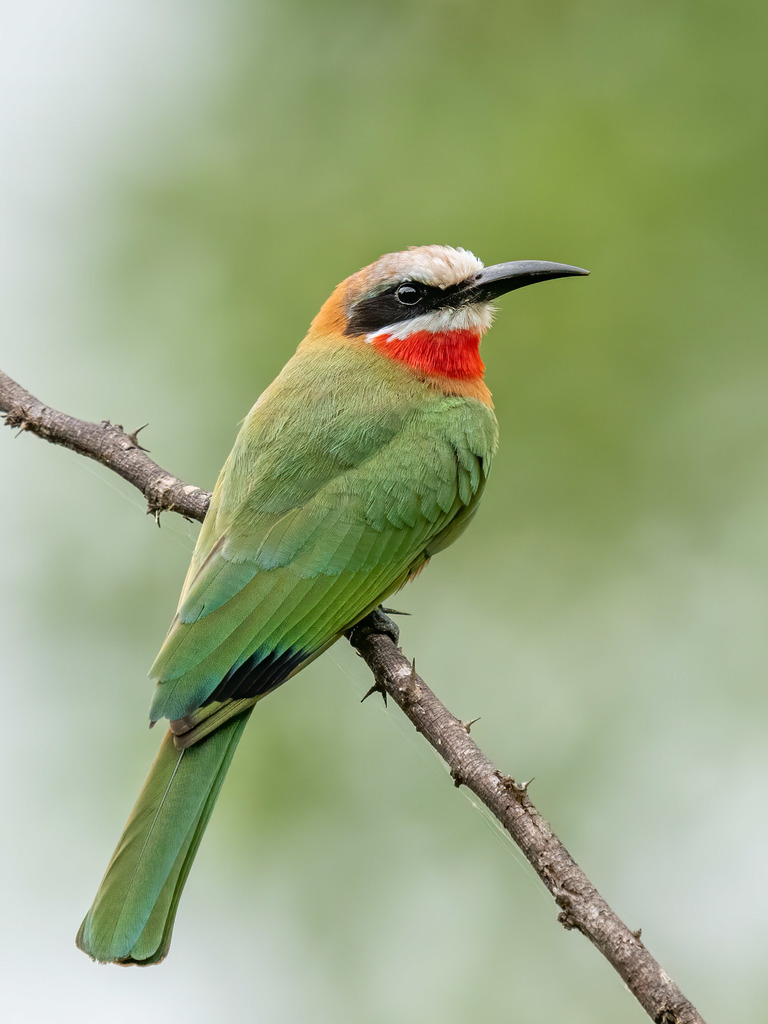
White-fronted Bee-eater
Live sightings near you, the range map, bar charts of when it is seen, and Macaulay Library photos and recordings.
White-fronted Bee-eater
Merops bullockoides
The white-fronted bee-eater (Merops bullockoides) is a species of bee-eater widely distributed in sub-equatorial Africa.
The species has a distinctive white forehead, a square tail, and a bright red patch on its throat. It nests in small colonies, digging holes in cliffs or earthen banks, and can usually be seen in low trees, waiting to hunt passing insects by making quick hawking flights or gliding down before hovering briefly to catch the prey.
From the article White-fronted bee-eater on Wikipedia (CC BY-SA), quoted section by section
Description
This species, like other bee-eaters, is a richly coloured, slender bird, but with a distinctive black mask, white forehead, square tail and a bright red throat. The size is 23 cm (9 in.). The upperparts are green, with cinnamon underparts. The call is a deep squeak.
Range & habitat
White-fronted bee-eaters are found in the vast savannah regions of sub-equatorial Africa. The habitat commonly consists of open country, often near gullies, where bees, their prey, live.
Wikipedia: “Distribution”
What it does
White-fronted bee-eaters nest in colonies averaging 200 individuals, digging, roosting, and nesting holes in cliffs or banks of earth. A population of bee-eaters may range across many square kilometres of savannah, but will come to the same colony to roost, socialize, and to breed. White-fronted bee-eaters have one of the most complex family-based social systems found in birds. Colonies comprise socially monogamous, extended family groups with overlapping generations, known as "clans", which exhibit cooperative breeding. Non-breeding individuals become helpers to relatives and assist to raise their brood. In white-fronted bee-eaters, this helping behavior is particularly well developed, with helpers assisting in half of all nesting attempts. These helpers may contribute to all aspects of the reproductive attempt, from digging the roosting or nesting chamber, to allofeeding the female, incubating and feeding the young; and have a large effect on increasing the number of young produced. Only 50% of non-breeders in a colony typically become helpers, and whether or not an individual becomes a helper and to whom it provides aid is heavily dependent on the degree of kinship involved. Non-breeders are most likely to become helpers when breeding pairs are genetically close relatives. …
Wikipedia: “Nesting and reproduction”
Listen
Looking for field recordings…
Where it lives
Recorded sightings
—
geo-referenced records in GBIF, from museums, herbaria and field observers.
Drag the globe to turn it. Dots are where records exist, not a range map; darker means more records.
In the stacks
Searching the stacks…
Every page naming Merops bullockoides in the Biodiversity Heritage Library →
This page is assembled live from iNaturalist, GBIF, Wikipedia, the Source Library and the Internet Archive. It is not yet part of the hand-edited codex. iNaturalist taxon 2248.