- Animals
- ›Arthropods
- ›Hexapods
- ›Insects
- ›Winged and Once-winged Insects
- ›Butterflies and Moths
- ›Hawk, Sphinx, Silk, Emperor, and Allied Moths
- ›Sphinx Moths
- ›Sphinginae
- ›Sphingini
- ›Sphingina
- ›Manduca
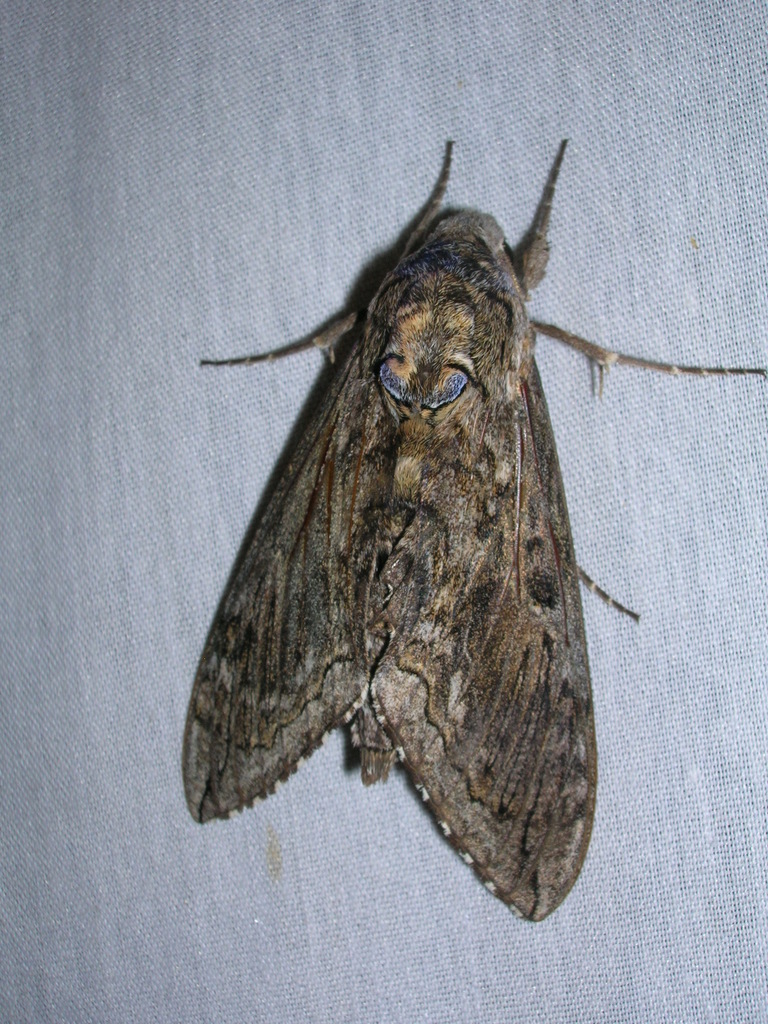
Hawaiian Hornworm Sphinx
Manduca blackburni
Manduca blackburni, commonly known as Blackburn's sphinx moth, Hawaiian tomato hornworm, and Hawaiian tobacco hornworm, is a species of moth in the family Sphingidae. It is endemic to Hawaii. Previously known from all of the main islands, this rare moth is now limited to Maui, the Big Island, and Kahoʻolawe. It is found in coastal mesic and dry forests at elevations from sea level 5,000 ft (1,500 m).
From the article Manduca blackburni on Wikipedia (CC BY-SA), quoted section by section
Description
The Blackburn's Sphinx moth is characterized by a thick, spindle-shaped body that typically has five orange spots on each side of the abdomen. The moth has long, narrow forewings that are brown in color with black bands that run across the top margins of the hindwings. The larva can grow to around 3.5-4 inches and can be one of two color morphs; one with a bright green body and the other with a grey body. Both larval morphs have scattered white speckles along the back and a horizontal white stripe on each segment of the body.
Wikipedia: “Morphology”
Range & habitat
Manduca blackburni is endemic to Hawaii and was previously known to reside on all of the main islands. This rare moth is now limited to Maui, the Big Island, and Kahoʻolawe after 82% of the moth's habitat was lost. It is found in coastal mesic and dry forests at elevations from sea level to 5,000 ft (1,500 m).
Wikipedia: “Distribution and habitat”
What it does
Larvae feed on plants in the nightshade family, Solanaceae, especially native ʻaiea (Nothocestrum spp.), but also non-native tomatoes (Solanum lycopersicum), tobacco (Nicotiana tabacum), tree tobacco (N. glauca), jimson weed (Datura stramonium), and eggplant (Solanum melongena). The adult feeds on nectar from native plants such as koali ʻawa (Ipomoea indica) and maiapilo (Capparis sandwichiana). Adults may also feed on flowers of the native caper (Capparis spinosa) and wild leadwort (Plumbago zeylanica).
Wikipedia: “Diet and ecology”
In human culture
Sphingid moths can develop in as little as 56 days, with four life stages that are observable as the moth grows from an egg into an adult. The first life stage is the egg; an ovoid light green shell that turns pale beige as the larva develops. A pronounced caudal horn is visible roughly 24 hours before the egg hatches, signifying that the second life stage is about to occur; the larva. The larva spends most of its time actively feeding on leaf tissue of the host plants. The third life stage begins when the larva becomes a pupa, which may remain in a state of torpor within the soil for up to a year. The fourth life stage is when the pupa becomes an adult. The fully matured moth emerges from the ground and females lay eggs, starting the life cycle for the next generation.
Diet and ecology. Larvae feed on plants in the nightshade family, Solanaceae, especially native ʻaiea (Nothocestrum spp.), but also non-native tomatoes (Solanum lycopersicum), tobacco (Nicotiana tabacum), tree tobacco (N. glauca), jimson weed (Datura stramonium), and eggplant (Solanum melongena). The adult feeds on nectar from native plants such as koali ʻawa (Ipomoea indica) and maiapilo (Capparis sandwichiana). Adults may also feed on flowers of the native caper (Capparis spinosa) and wild leadwort (Plumbago zeylanica).
Distribution and habitat. …
Wikipedia: “Life History”
Listen
Looking for field recordings…
Where it lives
Recorded sightings
—
geo-referenced records in GBIF, from museums, herbaria and field observers.
Drag the globe to turn it. Dots are where records exist, not a range map; darker means more records.
In the stacks
Searching the stacks…
Every page naming Manduca blackburni in the Biodiversity Heritage Library →
This page is assembled live from iNaturalist, GBIF, Wikipedia, the Source Library and the Internet Archive. It is not yet part of the hand-edited codex. iNaturalist taxon 224417.