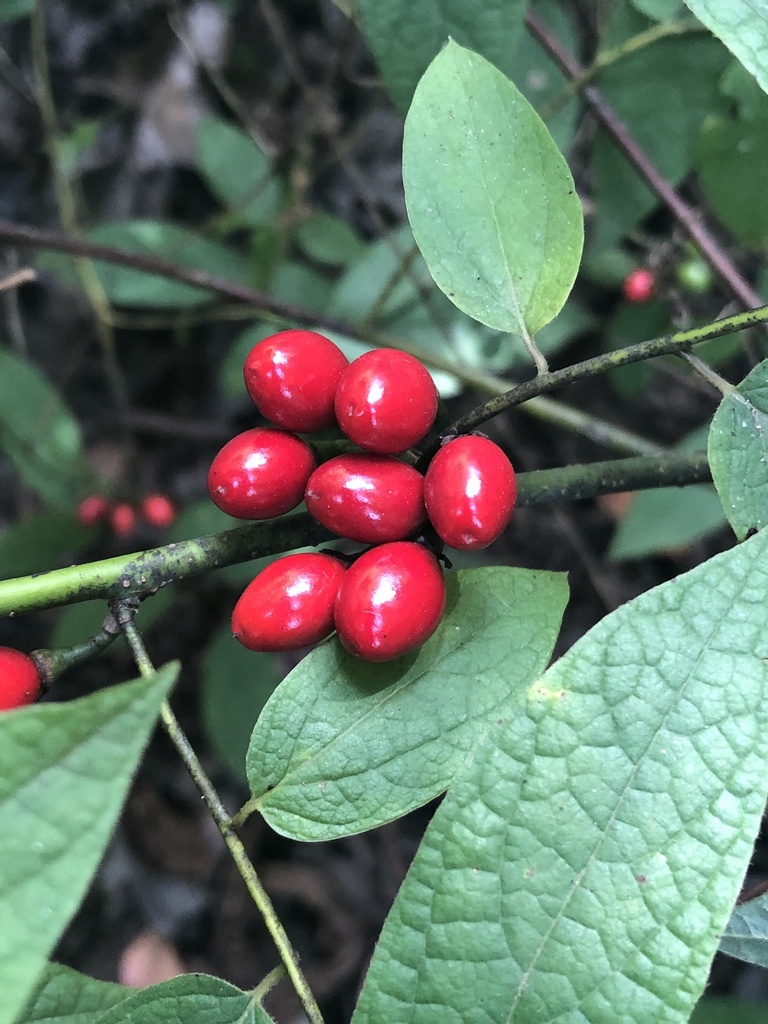
southern spicebush
Lindera melissifolia
Lindera melissifolia, common name pondberry or southern spicebush, is a stoloniferous, deciduous, aromatic shrub in the laurel family. This endangered species is native to the southeastern United States, and its demise is associated with habitat loss from extensive drainage of wetlands for agriculture and forestry. Restoration efforts are currently being conducted.
From the article Lindera melissifolia on Wikipedia (CC BY-SA), quoted section by section
Description
Form: Pondberry occurs in dense thickets with erect or ascending shoots up to 2 m (6.6 ft) tall and few branches; stems are connected underground by stolons. Thickets of female plants tend to be smaller than those of males and are sometimes absent from populations. Die-back of stems is a fairly common occurrence. Foliage: The drooping, alternate leaves are oblong-elliptic to narrowly ovate, 5–16 cm (2.0–6.3 in) long, 2–6 cm (0.8–2.4 in) wide, and tend to be strongly tapered to a point at the tip. Undersides are strongly net-veined and covered with short, soft hairs. When crushed, the leaves strongly resemble sassafras (Sassafras albidum) in fragrance. Foliage is deciduous. Flowers: Stems flower after two to four years of growth. Male and female flowers, each 5–6 mm (0.20–0.24 in) across, are produced on different plants (dioecious). Flowers appear before the leaves (February to mid-March) in tight, stalkless clusters. The petal-like tepals are pale to bright yellow, oblong, and 2 mm (0.08 in) long. Male flowers occur in dense clusters, with 9-12 stamens surrounded by two whorls of tepals. Female flowers are less conspicuous, with fewer flowers per cluster and a single pistil surrounded by two whorls of tepals; the outer whorl is petal-like and the inner whorl is reduced to nectar-producing scales. Flowers remain open for about 1 week making thickets conspicuous. …
Range & habitat
Pondberry occurs in shallow depression ponds in wetland habitats with hydric soils, along margins of cypress ponds, and in seasonally wet, low areas among bottomland hardwoods. At present there are some 36 populations in Alabama, Arkansas, Georgia, Mississippi, Missouri, North Carolina, and South Carolina. It has apparently been extirpated from Louisiana and possibly Florida. Most of these populations are located in Lower Mississippi Alluvial Plain, with the largest population being in the Delta National Forest in western Mississippi.
Wikipedia: “Habitat and range”
What it does
Pondberry has probably always been a rare species, and knowledge of its ecology is limited. In Mississippi, pondberry occurs in bottomland hardwood forests. In northeastern Arkansas and southeastern Missouri pondberry is found on the bottoms and edges of shallow seasonal ponds in old dune fields, but in southeastern Arkansas it occurs in low habitats along a river. In South Carolina the species occurs in areas with karst topography, around the edges of sinkholes, and in Georgia it occurs along the borders of sphagnum bogs. Sunlight at the different sites ranges from deep shade to almost full sun. Most pondberry colonies occur in light shade beneath a forest canopy, but a few grow in almost full sunlight. Pondberry appears to be able to occupy widely different habitats as long as its requirements for water are met. In open conditions, competition from other plant species may be a problem. Many of the remaining populations consist only of male plants and are apparently the sprouts of a single individual. Habitat fragmentation severely affects dioecious species like pondberry because populations with plants of a single sex can only vegetatively reproduce. With significant habitat loss, plants become ever more isolated, lessening the likelihood that pollinators will travel from male to female plants.
Wikipedia: “Ecology”
At the table
Pondberry fruit are eaten by hermit thrushes, northern cardinals, and perhaps other birds. Animals observed to consume pondberry seeds located on a cleared soil surface in a hardwood forest included: northern cardinal, brown thrasher (Toxostoma rufum), swamp rabbit (Sylvilagus aquaticus), armadillo (Dasypus novemcinctus), and gray squirrel (Sciurus carolinensis). Swamp rabbits have been observed browsing on stems. The spicebush swallowtail (Papilio troilus) larvae feed on the leaves and roll themselves in a leaf making a tent. Leaf cutter bees (Megachilidae spp.) cut circular sections from the leaf margins, sometimes removing most of the leaf. A vintage use of pondberry fruit in the rural South was as projectiles in toy pop guns constructed by children from hollowed-out elderberry (Sambucus canadensis) stems.
Wikipedia: “Uses”
How it is grown
Clones expand vegetatively through stolons, and this mechanism of vegetative reproduction is the principal way that colonies develop. Stems usually live 6 or 7 years, and when a stem dies it is usually replaced by a new stem that grows from the base of the plant. Thus, mature colonies often include some dead stems intermingled with numerous live stems. Despite the regular production of mature fruit, virtually no seedlings of pondberry have been observed at any of the known sites. The cause of this apparent lack of natural reproduction is not currently known, but the consequences are clear—it severely reduces the species' chance for long-term survival. Sexual reproduction of pondberry is critical for long-range dispersal and genetic diversity. Before modern flood control was imposed along the Mississippi River and its tributaries, historic floods may have been an important mechanism in fruit and/or seed dispersal over long distances or for creating suitable conditions for seedling establishment. Although the fruit of pondberry sinks in water after a short time, the seed with the pulp removed will float for a day or sometimes longer. Characteristics of pondberry's fruit—the showy color, fleshy pulp, and its persistent on stems—suggest that animals, particularly birds, may be important dispersal agents. …
Wikipedia: “Propagation”
Where it lives
Recorded sightings
—
geo-referenced records in GBIF, from museums, herbaria and field observers.
Drag the globe to turn it. Dots are where records exist, not a range map; darker means more records.
In the stacks
Searching the stacks…
Every page naming Lindera melissifolia in the Biodiversity Heritage Library →
This page is assembled live from iNaturalist, GBIF, Wikipedia, the Source Library and the Internet Archive. It is not yet part of the hand-edited codex. iNaturalist taxon 223835.