On eBird ↗
Olive Bee-eater
Live sightings near you, the range map, bar charts of when it is seen, and Macaulay Library photos and recordings.
Olive Bee-eater
Merops superciliosus
The olive bee-eater or Madagascar bee-eater (Merops superciliosus) is a bee-eater species in the genus Merops. It is native to the southern half of Africa where it is present in Angola; Botswana; Burundi; Comoros; Democratic Republic of the Congo; Djibouti; Eritrea; Ethiopia; Kenya; Madagascar; Malawi; Mayotte; Mozambique; Namibia; Rwanda; Somalia; South Sudan; Sudan; Tanzania; Uganda; Zambia; Zimbabwe. It is a common species with a wide range so the International Union for Conservation of Nature has rated their conservation status as "least concern".
From the article Olive bee-eater on Wikipedia (CC BY-SA), quoted section by section
Description
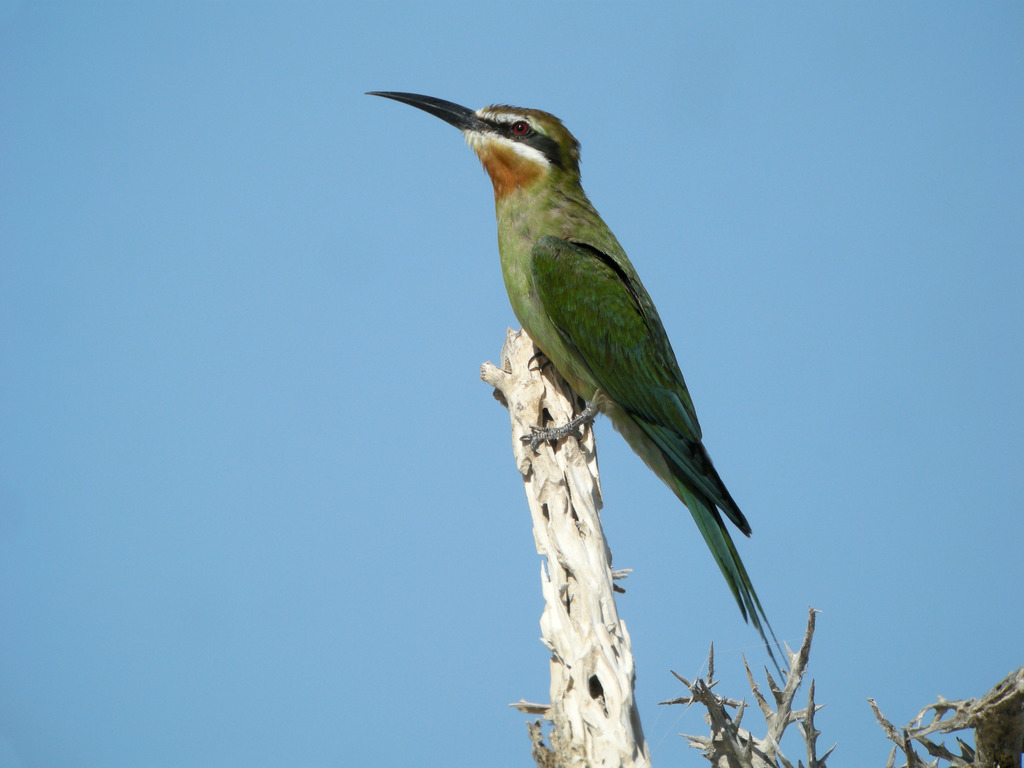
The olive bee-eater grows to a length of 23 to 26 cm (9.1 to 10.2 in) with its tail streamers adding up to 7 cm (2.8 in). The sexes are similar, and adults have bronzy-green plumage with an olive cap and white forehead, eyebrows, chin and cheeks. The rump and tail are blue, apart from the streamers, which are black.
Range & habitat
The olive bee-eater is found in the grassland and coastal mountain forests of East Africa and Madagascar, and an isolated population can be found in coastal Angola. There are two subspecies; M. s. superciliosus occurs in eastern Ethiopia, Somalia and Kenya, and southwards through East Africa to southern Mozambique and the Zambezi Valley, as well as the Comoro Islands and Madagascar; M. s. alternans occurs in western Angola and northwestern Namibia.
Wikipedia: “Distribution”
What it does
They are partially migratory, and usually breed only in the southern portion of their range, moving north for the dry season in southern Africa. It lays four eggs in a burrow nest at the beginning of the southern African wet season, and the chicks usually hatch at the beginning of December. Unlike most bee-eaters, the species does not practice cooperative breeding and post-fledging dependence is only around 19 days, which is typical of temperate zone passerines and about half that of most Meropidae species.
Wikipedia: “Ecology”
Listen
Looking for field recordings…
Where it lives
Recorded sightings
—
geo-referenced records in GBIF, from museums, herbaria and field observers.
Drag the globe to turn it. Dots are where records exist, not a range map; darker means more records.
In the stacks
Searching the stacks…
Every page naming Merops superciliosus in the Biodiversity Heritage Library →
This page is assembled live from iNaturalist, GBIF, Wikipedia, the Source Library and the Internet Archive. It is not yet part of the hand-edited codex. iNaturalist taxon 2226.