On eBird ↗
Little Bee-eater
Live sightings near you, the range map, bar charts of when it is seen, and Macaulay Library photos and recordings.
Little Bee-eater
Merops pusillus
The little bee-eater (Merops pusillus) is a bird species in the bee-eater family, Meropidae. They are found in Sub-Saharan Africa. They should not be confused with the little green bee-eater (Merops orientalis). Migration is limited to seasonal movements depending on rainfall patterns. They inhabit various biomes, such as savanna, bushveld, and even marsh-like areas.
From the article Little bee-eater on Wikipedia (CC BY-SA), quoted section by section
Description
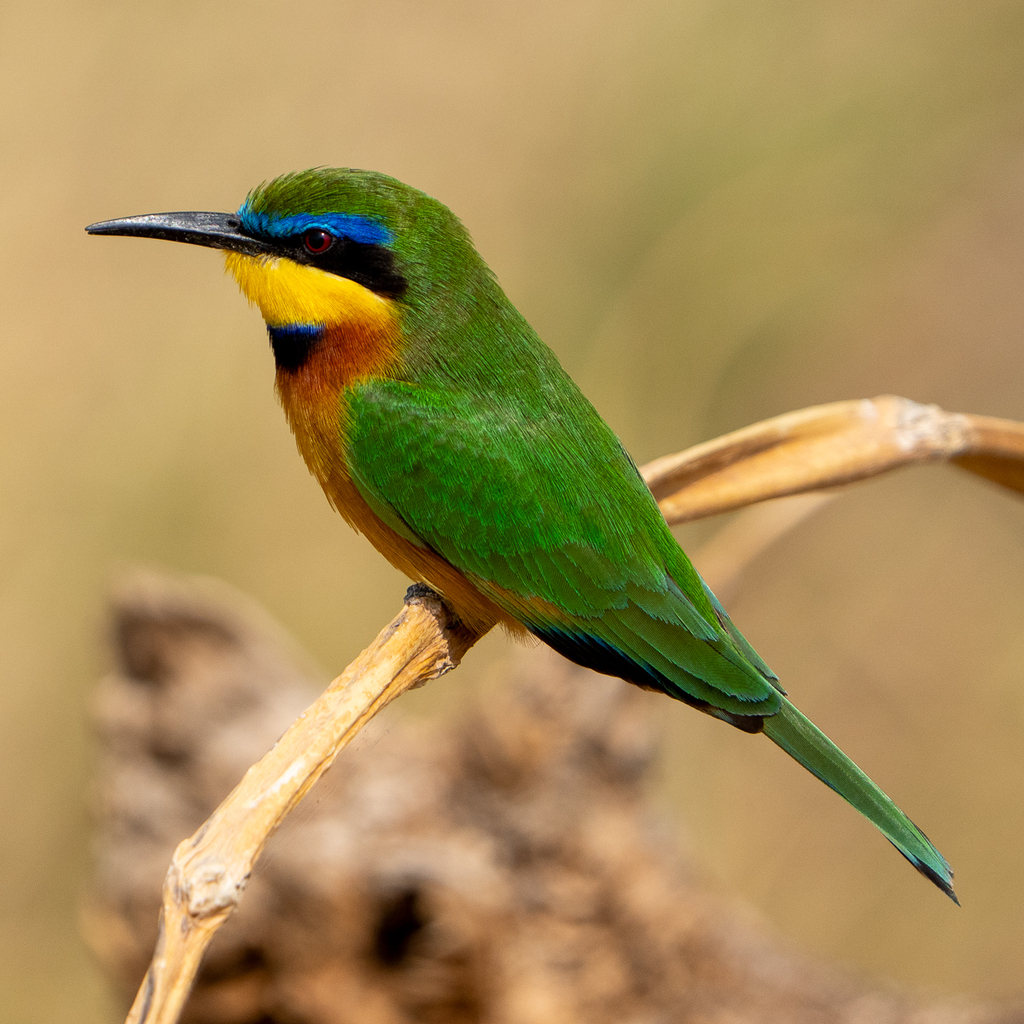
Members of this species, like other bee-eaters, are rich and brightly coloured slender birds. They have green upper parts, yellow throats, black gorgets, and rich brown upper breasts fading to buffish ochre on the belly. Their wings are green and brown. Their beaks and legs are black. Tail is square in shape with a slight fork or v-shape at the end. They reach a length of 15–17 cm, which makes them the smallest African bee-eater. Sexes are alike. Often silent, their call is a soft "seep". They are often hard to spot since their green backs and wings act as camouflage.
What it does
These are abundant and tame birds, familiar throughout their range. There have been estimated to be between 60 and 80 million little bee-eaters. They breed in open country with bushes, preferably near water. Just as the name suggests, bee-eaters predominantly eat insects, especially bees, wasps and hornets, who are caught in the air by sorties from an open perch. This species often hunts from low perches, maybe only a metre or less high. Before eating their meal, a bee-eater removes the stinger by repeatedly hitting the insect on a hard surface. Unlike most bee-eaters, these are solitary nesters, making a tunnel in sandy banks, or sometimes in the entrance to an Aardvark den. They lay 4 to 6 spherical white eggs. Both the male and the female take care of the eggs. These birds roost communally, lined up on a tree branch.
Wikipedia: “Ecology”
Listen
Looking for field recordings…
Where it lives
Recorded sightings
—
geo-referenced records in GBIF, from museums, herbaria and field observers.
Drag the globe to turn it. Dots are where records exist, not a range map; darker means more records.
In the old herbals & bestiaries

In the stacks
Searching the stacks…
Every page naming Merops pusillus in the Biodiversity Heritage Library →
This page is assembled live from iNaturalist, GBIF, Wikipedia, the Source Library and the Internet Archive. It is not yet part of the hand-edited codex. iNaturalist taxon 2185.