- Animals
- ›Arthropods
- ›Hexapods
- ›Insects
- ›Winged and Once-winged Insects
- ›Beetles
- ›Water, Rove, Scarab, Long-horned, Leaf, and Snout Beetles
- ›Elateriform Beetles
- ›Click, Firefly, and Soldier Beetles
- ›Soldier Beetles
- ›Chauliognathinae
- ›Chauliognathini
- ›Chauliognathus
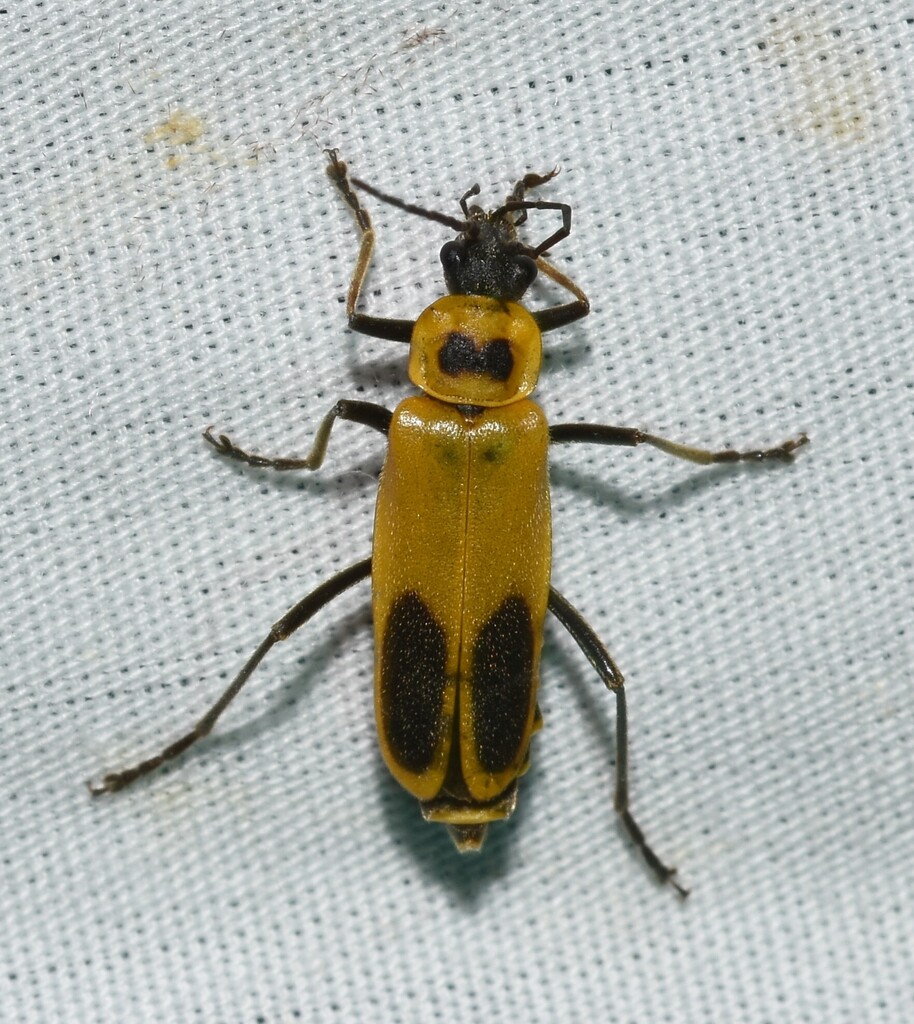
Goldenrod Soldier Beetle
Chauliognathus pensylvanicus
The goldenrod soldier beetle or Pennsylvania leatherwing (Chauliognathus pensylvanicus) is a species of soldier beetle (Cantharidae).
From the article Goldenrod soldier beetle on Wikipedia (CC BY-SA), quoted section by section
Description
Soldier beetles are just around five-eighths of an inch (1.6 cm) long. They have elongated, leathery elytra that cover almost the entirety of their abdomen. They are an orangish, brownish color and have distinct black patches. They also have a dark spot on their pronotum that is elongated horizontally. This is essential for identifying the species when comparing it to margined leatherwing (Chauliognathus marginatus), which is elongated vertically.
Wikipedia: “Morphology”
Range & habitat
The species is native to North America and is one of the most common species of soldier beetle in the Midwest. It ranges from Eastern to Central Canada down through Florida and Northern Texas. Some populations can be seen as far west as Colorado.
Wikipedia: “Distribution”
What it does
Adults of the species are univoltine, meaning they only reproduce once a year. Adult females lay clusters of eggs in soil or leaf litter. Larvae have a slender body and are dark colored with dense hairs. During this stage, they mostly reside in the leaf litter, but can climb plants. Overwintering of larvae happens in the soil. They feed on grasshopper eggs, small caterpillars and other soft-bodied insects. These larvae then go through a pupal stage in early summer before becoming an adult, emerging around July.
Wikipedia: “Life cycle”
Listen
Looking for field recordings…
Where it lives
Recorded sightings
—
geo-referenced records in GBIF, from museums, herbaria and field observers.
Drag the globe to turn it. Dots are where records exist, not a range map; darker means more records.
In the stacks
This page is assembled live from iNaturalist, GBIF, Wikipedia, the Source Library and the Internet Archive. It is not yet part of the hand-edited codex. iNaturalist taxon 216649.