- Animals
- ›Arthropods
- ›Hexapods
- ›Insects
- ›Winged and Once-winged Insects
- ›Beetles
- ›Water, Rove, Scarab, Long-horned, Leaf, and Snout Beetles
- ›Cucujiform Beetles
- ›Leaf Beetles and Allies
- ›Leaf Beetles
- ›Skeletonizing Leaf and Flea Beetles
- ›Flea Beetles
- ›Blepharidina
- ›Blepharida
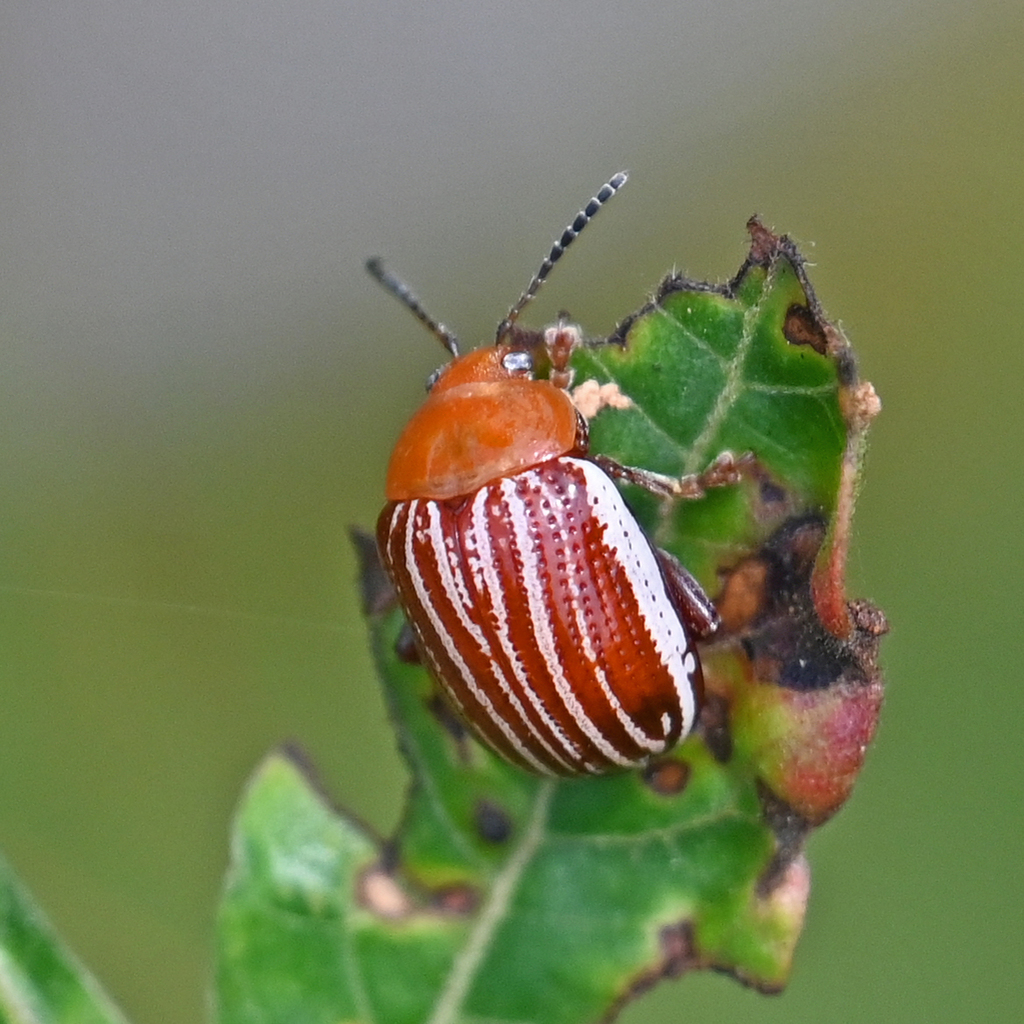
Sumac Flea Beetle
Blepharida rhois
The sumac flea beetle, Blepharida rhois, is most commonly found in North America and is a member of the herbivorous beetle family, Chrysomelidae. More specifically, this beetle is part of the Alticinae subfamily, a highly diverse subfamily that includes more than 1000 species in 550 genera. Members of the Alticinae subfamily are distinguished by their enlarged metafemora and their ability to jump up to 100 times their length. This gives the beetle the ability to catapult jump in order to escape approaching predators. This ability has led to the common name of “flea beetle.” Both larvae and adults are typically a quarter of an inch long. While adults are cream colored with irregular reddish patterns, larvae are typically gray with yellow stripes.
This beetle primarily feeds on the external surface of Rhus leaves. Through this diet, larvae are able to digest useful chemical compounds that can be used as a form of chemical defense against predators. This defense system is contained in a fecal shield, a key characteristic of this beetle’s larvae. Because Rhus plants are necessary for the production of this chemical defense system, B. rhois’ geographic distribution often correlates with the presence of Rhus plants.
From the article Blepharida rhois on Wikipedia (CC BY-SA), quoted section by section
Range & habitat
The Blepharida genus includes 73 different species, half of which are from tropical Africa, and the other half are from the New World tropics. The Blepharida rhois is a species of outlying distribution found widespread in North America. It is most commonly spotted in states of the more northerly regions of the continent. This species distribution extends from Virgian to Alberta in the east and Montana in the west. This is atypical as all other members of the Blepharida species inhabit Mexico and Central America.
Wikipedia: “Geographic range”
What it does
This beetle can be considered a pest for the sumac tree. Because larvae cause most of the primary damage to plants during their intense feeding phase, integrated pest management programs advise for leaves to be monitored for larvae in mid to late May. To inhibit B. rhois as a pest, the soil may be broken up by farmers during July when the beetle is pupating in the soil. Insecticides may be applied to branches and leaves of plants shortly after egg hatching to control larvae feeding. While pesticides are only needed in more extreme cases where monitoring is ineffective, the pesticides used may include Bacillus thuringiensis var. tenebrionis, carbamade, lead arsenate, and pyrethroid. This is primarily to ensure Rhus plants maintain overall health because larvae feeding can lead to plant death if unmonitored.
== References ==
Wikipedia: “Interactions with humans and livestock”
At the table
Adults and larvae are considered dietary specialists that exclusively feed on the sumac genus, Rhus. This species of beetle typically feeds on smooth sumac, R. glabra, exclusively. Most New World species feed on Bursera instead, so this beetle is one of the few New World species that feeds on Rhus. This beetle’s herbivory pattern is extremely patchy. Some regions of plants become defoliated while nearby regions are untouched, indicating that this variation may be due to secondary chemistry among the plants. Host versus non-host plants have been found to differ in the amount of chemicals that B. rhois larvae can incorporate into their defense, specifically the presence of tannic acid conjugates and of phytol. B. rhois typically feed on the external surface of leaves. Larvae, after emerging from the fecula after 10 to 14 days, will crawl up the stems of the Rhus plant and feed on the youngest leaf tissue or flower bud. Larvae will feed alone on young leaflets, but when feeding on an older leaf, they may line up in groups. Larvae, unable to fly and lacking a hard protective cuticle, face exposure and vulnerability to predators. The fecal shield provides a source of chemical defense, so the larvae deter predators that want to take advantage of its vulnerability while feeding.
Wikipedia: “Food resources”
Listen
Looking for field recordings…
Where it lives
Recorded sightings
—
geo-referenced records in GBIF, from museums, herbaria and field observers.
Drag the globe to turn it. Dots are where records exist, not a range map; darker means more records.
In the stacks
Searching the stacks…
Every page naming Blepharida rhois in the Biodiversity Heritage Library →
This page is assembled live from iNaturalist, GBIF, Wikipedia, the Source Library and the Internet Archive. It is not yet part of the hand-edited codex. iNaturalist taxon 215269.