 NL·0413
Herbarium of the Nature Library
- Name
- Phyllobates terribilis
- Family
- Dendrobatidae
- Native to
- Pacific lowland rainforest of Cauca department, Colombia
- Habitat
- Tropical rainforest
Golden poison frog
Phyllobates terribilis
Also calledGolden poison dart frog · Kokoi (Emberá) · Rana dorada (Spanish)
Probably the most poisonous animal on Earth for its size. This thumb-sized yellow, orange or mint-green frog lives in a few rainforest valleys of Colombia's Pacific coast. Its skin holds batrachotoxin, which Emberá hunters used to poison blowgun darts.
The golden poison frog, also known as the golden dart frog or golden poison arrow frog, is a poison dart frog endemic to the rainforests of Colombia. The golden poison frog has become endangered due to habitat destruction within its naturally limited range. Despite its small size, this frog is considered to be the most poisonous extant animal species on the planet. Wikipedia
What it can do
- iIts skin contains batrachotoxin, which keeps sodium channels in nerves and muscle open and can cause fatal heart failure
- iiA single wild frog is estimated to carry enough toxin to kill about ten people
- iiiHas resistant sodium channels so it is not harmed by its own poison
- ivGets its toxin from its wild diet; captive-bred frogs are harmless
In the field
Field marks
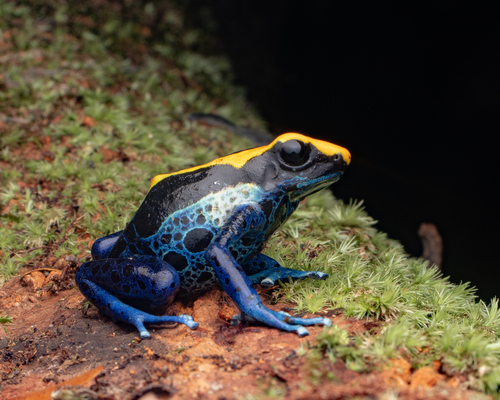
- aUniform bright yellow, orange or pale metallic green
- bBlack eyes; often black spots on the toe tips
- cLarger than most poison frogs
- dActive in daylight on the forest floor
- Voice
- A long series of rapid trills given by males
- Not to be confused with
- The Kokoe poison frog (P. aurotaenia) is black with orange or green stripes. The black-legged poison frog (P. bicolor) is yellow-orange with dark legs and is smaller.
- Where to see it
- Only in a few areas in Cauca, Colombia (Rio Saija drainage); best seen in zoos
- When
- Resident
Listen
Looking for field recordings…
Life & habits
- Diet
- Ants, beetles and other small invertebrates
- Habitat
- Leaf litter of humid lowland rainforest near streams
- Size
- ~4.5–5.5 cm
- Lifespan
- ~5–10 years in captivity
Active by day and bold because of its toxin. Males carry tadpoles on their backs to water. Wild frogs must never be touched: toxin on the skin can enter through cuts.
Where it lives
Recorded sightings
—
geo-referenced records in GBIF, from museums, herbaria and field observers.
Native range
Pacific lowland rainforest of Cauca department, Colombia
Drag the globe to turn it. Dots are where records exist, not a range map; darker means more records.
In the stacks
Searching the stacks…
Every page naming Phyllobates terribilis in the Biodiversity Heritage Library →
Marginalia
The Emberá people of Colombia rub blowgun darts on the backs of living frogs to poison them, without killing the frogs. Scientists Charles Myers, John Daly and Borys Malkin described the species in 1978.
Curiosity
Batrachotoxin is also found in the feathers of some New Guinea birds, the pitohuis and blue-capped ifrit, which probably get it from beetles.
Kinship




Photographs: iNaturalist contributors under the licences shown. Records: GBIF.org. Historical plates: Source Library (CC BY-SA 4.0; originals public domain). Summary text: Nature Library editors and Wikipedia (CC BY-SA). Medicinal and edibility notes are historical and educational, not advice. iNaturalist taxon 21217.