On eBird ↗
Jamaican Tody
Live sightings near you, the range map, bar charts of when it is seen, and Macaulay Library photos and recordings.
Jamaican Tody
Todus todus
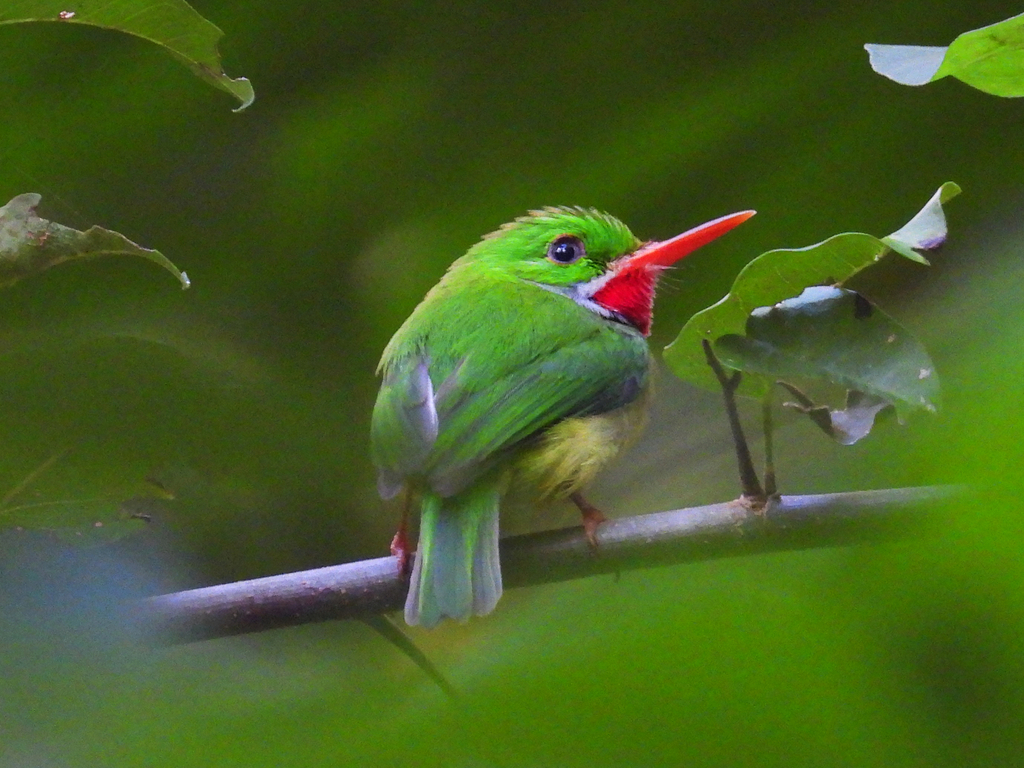
Found only in Jamaica, the Jamaican tody (Todus todus) is a small and colourful bird, predominantly green above, with a red throat and yellow underparts, with some pink on the sides. It has a large head and a long, flat bill. It perches on small branches, with its bills unturned and, like its Cuban relative (the Cuban tody), takes insects, larvae, and fruit. The Jamaican tody nests in burrows, which it excavates in muddy banks or...
From the article Jamaican tody on Wikipedia (CC BY-SA), quoted section by section
Description
The Jamaican tody is a small, chunky bird that averages about 9 cm (or 4.25") in size. The wing size for all tody species ranges between 42.8mm and 50.3mm. The Jamaican tody's wing size is intermediate between these sizes (about 46mm) compared to the Cuban and Puerto Rican todies, which tend to have smaller wings, and the broad-billed tody, which has the largest. The wing size of the Jamaican tody correlates with their average flight distance, which is about 1.5m, and their maximum flight distance, which is 26m. The average weight of the Jamaican tody is around 6.4 grams. They have a bright green head, red throat and a long, broad and flat red bill. They look very similar to the Puerto Rican tody (Todus mexicanus) but have a whitish breast that is blended with green, becoming even slightly yellow on the abdomen and under the tail-coverts. The Jamaican tody also has blue-gray subauricular feathers. Their legs and feet are reddish brown. Todies are generally a sexually monomorphic genus. However, some tody species have different eye colors between males and females, but in the Jamaican tody, this iris color is undistinguishable. Jamaican todies are very quiet birds during nonbreeding months but can be heard more frequently during the spring and summer. The vocalizations of the Jamaican tody are predominately a loud beep sound and a throat-rattle. …
Range & habitat
The Jamaican tody is endemic to Jamaica. They are found all around the island and can be seen near the semi-arid coast or in the humid mountains. They generally travel in pairs and can be found most commonly in forested areas, occurring in second-growth, untouched habitats, including mesic limestone forests, arid limestone forests, montane forest, shaded coffee plantations and even mangroves. The Jamaican tody is most visible during the spring and summer months, and are much more silent and easy to find during the fall and winter.
Wikipedia: “Distribution and habitat”
What it does
Todies can be found generally performing two bathing techniques, bathing in flight after a dive and bathing in wet plant leaves or in light rain. They also perform bill-wiping, where they will clean both sides of their beak, from base to tip, especially after eating or preening and fluffing their feathers. To fluff their head feathers, they will shake their head back and forth in a fast, jerky movement. Todies also preen their feathers with their flat bills and this mainly occurs in their breast and wing areas on their body.
Wikipedia: “Maintenance behavior”
At the table
The Jamaican tody uses a sit-and-watch foraging strategy to capture its prey, which is similar to other todies in the genus Todus that can be found on nearby islands in the West Indies. They nearly entirely feed on insects and the larvae of insects but will occasionally eat fruit as well. The majority of their foraging is done below nine-tenths of the maximum canopy height of the forest, and is done in both dry and wet forests. From a perch, Jamaican todies scan the undersides and occasionally, uppersides of leaves for insects in which they will swoop down or up, respectively to catch insects. The smaller insects are swallowed in air while the larger ones are smashed against twigs before consuming. This insect consumption occurs almost continuously throughout the day, where they will eat around 1 to 2 insects per minute if available. The method of drinking for the Jamaican tody has not been observed but it is assumed that they get most of their water from leaf droplets and food they consume.
Wikipedia: “Food and feeding”
Listen
Looking for field recordings…
Where it lives
Recorded sightings
—
geo-referenced records in GBIF, from museums, herbaria and field observers.
Drag the globe to turn it. Dots are where records exist, not a range map; darker means more records.
In the stacks
Searching the stacks…
Every page naming Todus todus in the Biodiversity Heritage Library →
This page is assembled live from iNaturalist, GBIF, Wikipedia, the Source Library and the Internet Archive. It is not yet part of the hand-edited codex. iNaturalist taxon 2119.