- Animals
- ›Arthropods
- ›Hexapods
- ›Insects
- ›Winged and Once-winged Insects
- ›Beetles
- ›Water, Rove, Scarab, Long-horned, Leaf, and Snout Beetles
- ›Scarabaeiform Beetles
- ›Scarabs, Stag Beetles, and Allies
- ›Scarabs
- ›Dung Beetles
- ›Phanaeini
- ›Coprophanaeus
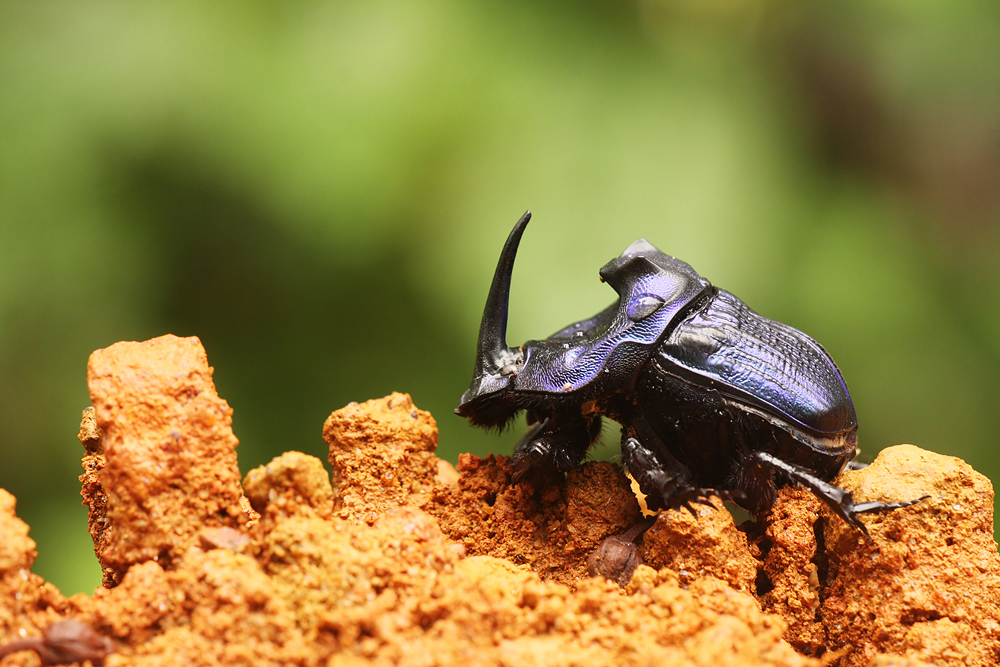
Giant Dung Digger
Coprophanaeus lancifer
Coprophanaeus lancifer is a large species of beetle belonging to the family Scarabaeidae (scarab beetles).
From the article Coprophanaeus lancifer on Wikipedia (CC BY-SA), quoted section by section
Description
Adults typically are 28–56 mm (1.1–2.2 in) long, with an average length of 44 mm (1.7 in). They can weigh up to 10 g, which is heavier than a hummingbird. This makes C. lancifer and the closely related C. ensifer some of the largest dung beetles in the world (together with certain Catharsius and Heliocopris) and the largest in the Americas. This beetle has a horn on the head that is always greater in size in males than females. However, this difference in size is insignificant in small individuals. Because the sexually dimorphic horn is only obviously present in large males and only obviously absent in large females, C. lancifer is characterized by its reduced sexual dimorphism compared with other species of the genus.
Range & habitat
It is found widely in the Amazon rainforest in South America and can be found throughout Venezuela, French Guina, Guyana, Suriname, Brazil, Bolivia, and Peru. They are floor dwelling beetles that are mostly found in terra firma habitats and less commonly found in floodplain forests. Coprophanaeus lancifer beetles have been found in forests in northeastern Brazil according to a recent historical biogeographical study. This is the first record of the Coprophanaeus genus being found in large quantities in the South American continent. Such a finding is especially prevalent considering Coprophanaeus beetles have been under severe threat due to habitat fragmentation and agricultural urbanization/expansion in the greater Atlantic forest region.
Wikipedia: “Distribution”
What it does
Although part of the true dung beetle subfamily Scarabaeinae, C. lancifer primarily is a necrophage that feeds on vertebrate carcasses, although it also may feed on feces or occasionally even ripe fallen fruits. There are also reports that this beetle feeds on decomposing millipedes. They are capable of flying up to 5 km per day to find and bury their food. These distances mean that C. lancifer are able to disperse seeds that are often found in dung. They are paracoprids, meaning that adults dig tunnels into the soil under the carcass and move parts of this food source to a nest chamber where the eggs are laid. Once carcasses become bloated, the beetles are able to roll the carcass onto its back. Later in the decomposition process, they are able to dismember small hoof bones and move them as far as 30 cm from the carcass. These beetles are able to create deep lesions and other artifacts on a carcass that may cause confusion on the reason for the animal's death. Because of their feeding on carrion, they are of interest to forensic entomology. These crepuscular beetles are excellent diggers and good fliers. They appear to fly only at dusk. Like other horned beetles, once C. lancifer finds a carcass, they build a burrow nearby and look for a sexual partner. These beetles are also capable of stagnating their active time above ground to avoid other beetles.
Wikipedia: “Feeding”
Listen
Looking for field recordings…
Where it lives
Recorded sightings
—
geo-referenced records in GBIF, from museums, herbaria and field observers.
Drag the globe to turn it. Dots are where records exist, not a range map; darker means more records.
In the stacks
Searching the stacks…
Every page naming Coprophanaeus lancifer in the Biodiversity Heritage Library →
This page is assembled live from iNaturalist, GBIF, Wikipedia, the Source Library and the Internet Archive. It is not yet part of the hand-edited codex. iNaturalist taxon 210586.