- Animals
- ›Chordates
- ›Vertebrates
- ›Ray-finned Fishes
- ›Spiny-rayed fishes
- ›Blennies, Damselfishes and Allies
- ›Blennies
- ›Combtooth Blennies
- ›Salariin Blennies
- ›Lipophrys
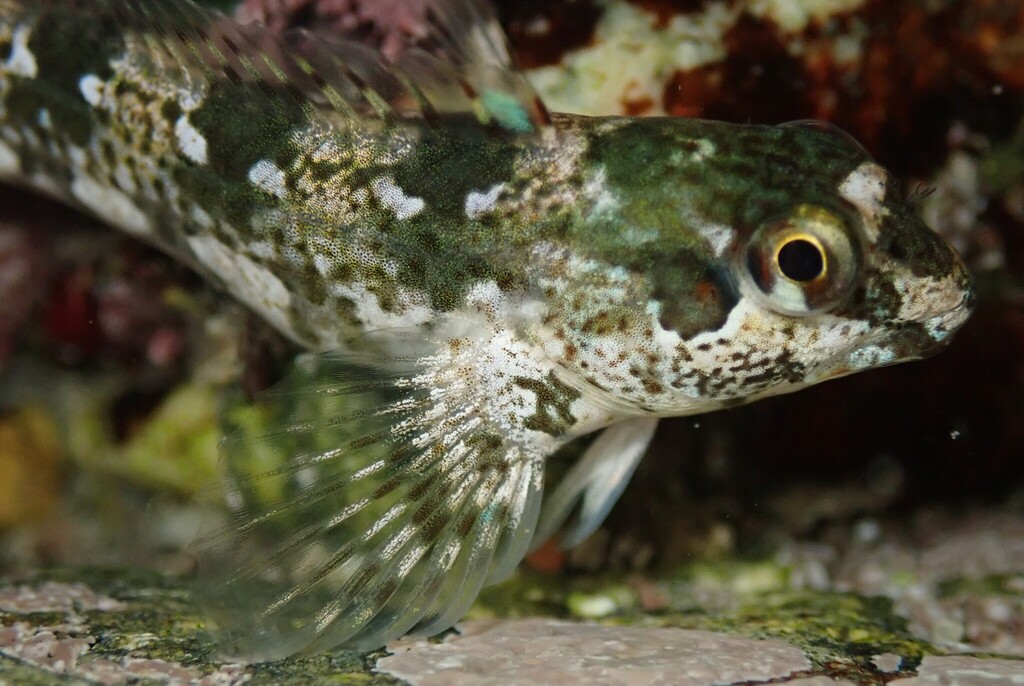
Shanny
Lipophrys pholis
Lipophrys pholis, commonly known as shanny, also known as the smooth blenny or common blenny, is a species of combtooth blenny. It matures at two years of age. Distributed in the Eastern Atlantic from the southern Norway to Morocco and Madeira, including the Mediterranean and the Balearics. Lipophrys pholis feed primarily on crustaceans, but also feed on other invertebrates and plants.
From the article Lipophrys pholis on Wikipedia (CC BY-SA), quoted section by section
Description
Lipophrys pholis has an elongated body which measures up to 16 centimetres (6.3 in) in length. It is the typical blenny shape having an elongated body and a rather large and blunt head with relatively large eyes set high on its head and as they age they grow a fleshy ridge on the forehead. The background colour is brownish, marked with green or yellow spots and they have dark spots arranged in 5–6 vertical bars along the body with a single large black spot near the origin of the dorsal fin. The background colour can vary depending on the surrounding habitat and individuals vary from blotched, dark brown to blackish. The males change in colour to being all black with a contrasting white mouth and a pale blue margin to the dorsal fin when in breeding condition.
Range & habitat
Lipophrys pholis has a wide distribution in the north-eastern Atlantic Ocean and the western Mediterranean. It extends from Norway to Morocco and Madeira and in to the Mediterranean as far east as the Balearic Islands. It is very common around the coasts of Britain and Ireland.
Wikipedia: “Distribution”
Where it lives
Recorded sightings
—
geo-referenced records in GBIF, from museums, herbaria and field observers.
Drag the globe to turn it. Dots are where records exist, not a range map; darker means more records.
In the stacks
Searching the stacks…
Every page naming Lipophrys pholis in the Biodiversity Heritage Library →
This page is assembled live from iNaturalist, GBIF, Wikipedia, the Source Library and the Internet Archive. It is not yet part of the hand-edited codex. iNaturalist taxon 210294.