- Plants
- ›Vascular Plants
- ›flowering plants
- ›Dicots
- ›Legumes, Milkworts, and Allies
- ›Legumes
- ›Acacias, Mimosas, Mesquites, and Allies
- ›Ingeae
- ›Inga
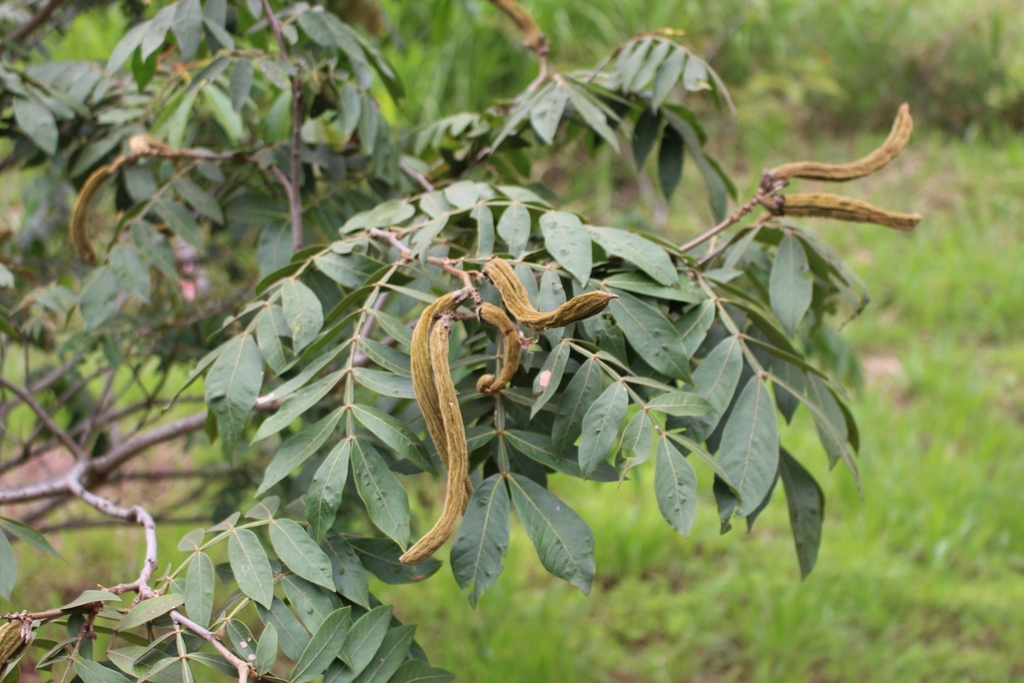
river koko
Inga vera
Inga edulis, known as ice-cream bean, paterna, whitey, padoo, cushín (short variety), joaquiniquil, cuaniquil (both from Nahuatl: cuahuxinicuile combining cuahuitl "tree"; icxitl "feet" and necuilli "crooked") guama, or guaba, is a fruit native to Central and South America. It is in the mimosoid tribe of the legume family Fabaceae. It is widely grown, especially by Indigenous Amazonians, for shade, food, timber, medicines, and production of the alcoholic beverage cachiri. It is popular in Peru, Ecuador, Pernambuco-Brazil, Venezuela, Guyana, Costa Rica and Colombia. The taxonomic generic name Inga is derived from its name with the Tupí people of South America (ingá) while the specific name edulis is Latin for "edible". The common name "ice-cream bean" alludes to the sweet flavor and smooth texture of the pulp.
From the article Inga edulis on Wikipedia (CC BY-SA), quoted section by section
What it does
Inga species are symbiotic with ants (e.g., Pheidole species), which feed on the nectar of the extrafloral nectaries. In exchange, the ants patrol over the Inga plant to protect it against herbivores. Certain insects, such as Riodinid caterpillars, excrete sugary honeydew from their tentacle nectaries. The ants form a symbiosis with the caterpillars by letting them feed on the tree in exchange for their sugary honeydew. The inga plant can also form symbiotic relationships in which nitrogen gas can be fixated by rhizobial bacteria and mycorrhiza, as can other legumes. Surveys have shown that I. edulis forms a mutualistic relationship with Bradyrhizobium bacteria.
Wikipedia: “Symbiosis”
At the table
Food crop
I. edulis has been cultivated as a fruit tree for millennia, and is widely sold on the local South American marketplace, mainly for the sweet, succulent pulp surrounding the seeds. The white pulp (aril) is consumed raw as a sweet snack, though it is less nutritious than the seeds. Toxic compounds such as trypsin and chymotrypsin inhibitors contained in the seeds of I. edulis are destroyed through cooking.The taste is described as resembling that of vanilla ice cream. Some varieties even possess a slight cinnamon flavor. The seeds are edible only when cooked and have a taste similar to that of chickpeas. In Colombia, the arils are also used to prepare an alcoholic beverage called cachiri for a festival of the same name. The native women chew the arils and spit the mixture into a vat, where it is left to ferment. The fruit ripens quickly and can only be kept for three to four days, limiting potential export opportunities, but refrigeration can extend shelf life to about three weeks.
Use in agroforestry systems. Due to its rapid growth and ability to improve soil properties, I. edulis has found widespread use in tropical agroforestry. Most notably, inga alley cropping is used as an alternative to slash-and-burn cultivation. It is also a popular shade tree for coffee, cocoa, and tea plantations. …
Wikipedia: “Uses”
How it is grown
I. edulis is widely cultivated in agroforestry systems in its neotropical dispersal area. This form of cultivation, often associated with coffee or cocoa culture, is widely known since pre-Columbian times. Germination of I. edulis seeds is fairly easy, as the seeds are recalcitrant and often germinate already in the pod. Seeds lose their ability to germinate, though, after two weeks of storage. Direct sowing of the seeds is possible, but the establishment of seedlings with already a certain height can decrease competition with noxious weeds, thus increasing growth. Further, the inoculation with rhizobia and mycorrhizal fungi in depleted soils is recommended to promote growth. These inoculi can easily be produced by collecting soil, nodules, and fine roots from mature, nodulated I. edulis stands. This species seems to be very resistant to pests and diseases. Minor damage can result from fungal attacks in the seedling stage. Mature I. edulis can be defoliated by Lepidoptera larvae. Also, fruit fly larvae often damage the seed testa. In Ecuador, I. edulis is specially susceptible to mistletoe infestations.
Wikipedia: “Cultivation”
Where it lives
Recorded sightings
—
geo-referenced records in GBIF, from museums, herbaria and field observers.
Drag the globe to turn it. Dots are where records exist, not a range map; darker means more records.
In the stacks
Searching the stacks…
Every page naming Inga vera in the Biodiversity Heritage Library →
This page is assembled live from iNaturalist, GBIF, Wikipedia, the Source Library and the Internet Archive. It is not yet part of the hand-edited codex. iNaturalist taxon 209925.