- Plants
- ›Vascular Plants
- ›flowering plants
- ›Dicots
- ›Mallows, Rock Roses, and Allies
- ›Mallow and Hibiscus Family
- ›Baobab subfamily
- ›Ceiba
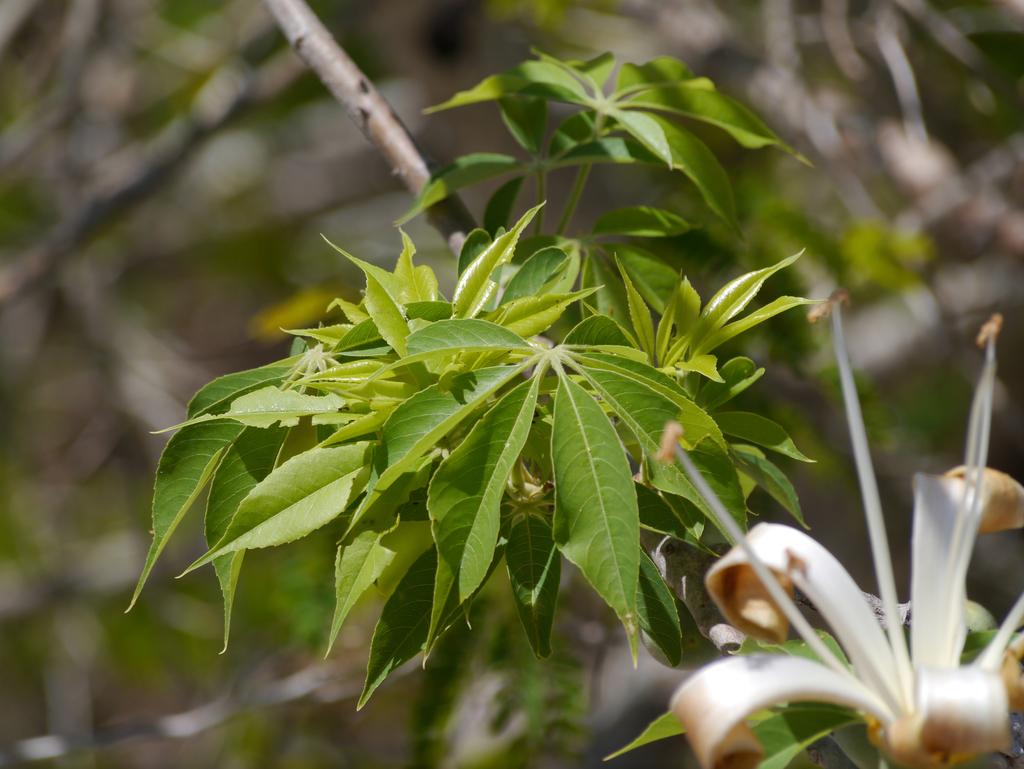
Pochote
Ceiba aesculifolia
Ceiba aesculifolia is a tree belonging to the Malvaceae family. It can reach up to 30 m (98 ft) in height and has a thick trunk. In its juvenile stages, the trunk is covered with large, conical thorns. The fruit is a giant capsule that encloses its seeds in a thick layer of soft, white, silky fiber. This fiber has been used to stuff mattresses. Handicrafts are made from the bark and thorns. The tree has medicinal properties. It is the sacred tree of the Mayans.
It is also known as ceiba and pochote.
From the article Ceiba aesculifolia on Wikipedia (CC BY-SA), quoted section by section
Description
Ceiba aesculifolia reaches a height of 30 m (98 ft), with a trunk densely covered with thorns. It has 5–7 foliolate leaves. Leaflets of range in shape from obovate to oblong-elliptic and are between 3–10 cm long and 1–4 cm wide. They can be acuminate, cuneate, serrated at least towards the apex, glabrous or densely pubescent. Solitary flowers appear in the axils of fallen leaves or somewhat grouped towards the apices of the branches, whitish turning brown inside; irregular and slightly lobed calyx, 1.5–3 cm (0.59–1.18 in) long. Petals are 8–16 cm (3.1–6.3 in) long, with dense yellowish-brown pubescence on the outside; filaments form a narrow, pubescent column approximately 1.5–2 cm (0.59–0.79 in) long. Fruits produced by the plant range from 12–15 cm (4.7–5.9 in) long and can be up to 8 cm (3.1 in) wide.
Range & habitat
C. aesculifolia is found in low, dry, deciduous forests, as well as north-central and Pacific zones, at altitudes ranging from 20–850 m (66–2,789 ft). It lives from Mexico to Costa Rica. It flowers January to April, and fruits May to June.
Wikipedia: “Distribution and habitat”
Where it lives
Recorded sightings
—
geo-referenced records in GBIF, from museums, herbaria and field observers.
Drag the globe to turn it. Dots are where records exist, not a range map; darker means more records.
In the stacks
Searching the stacks…
Every page naming Ceiba aesculifolia in the Biodiversity Heritage Library →
This page is assembled live from iNaturalist, GBIF, Wikipedia, the Source Library and the Internet Archive. It is not yet part of the hand-edited codex. iNaturalist taxon 209891.