- Animals
- ›Arthropods
- ›Hexapods
- ›Insects
- ›Winged and Once-winged Insects
- ›Butterflies and Moths
- ›Owlet Moths and Allies
- ›Underwing, Tiger, Tussock, and Allied Moths
- ›Tussock Moths
- ›Leucomini
- ›Leucoma
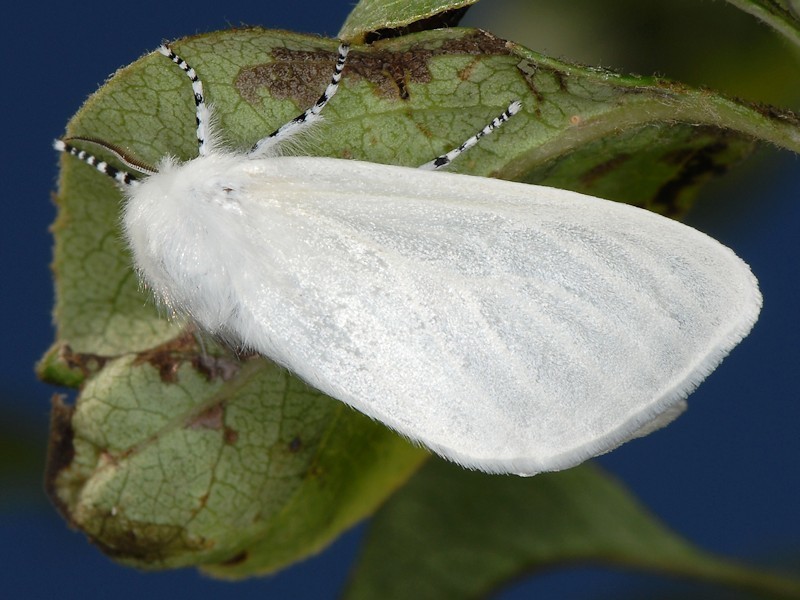
White Satin Moth
Leucoma salicis
Leucoma salicis, also known as the white satin moth or satin moth, is a moth of the family Erebidae. The species was first described by Carl Linnaeus in his 10th edition of Systema Naturae from 1758. It is found in Europe including the British Isles excluding the far north. In the east it is found across the Palearctic to Japan. The species was introduced to North America in the 1920s.
From the article Leucoma salicis on Wikipedia (CC BY-SA), quoted section by section
Range & habitat
Leucoma salicis eggs are usually laid on tree trunks in clusters covered with a paper-like substance. Larvae are black with a row of light dorsal spots and a yellow lateral line. Segments four and five have a pair of fleshy pointed tubercles. The larvae feed on Salix and Populus species. Pupation takes place in a loose cocoon between leaves. The pupa is glossy black with white spots and yellow tufts. Leucoma salicis is generally active in June, July and August. The males begin to fly shortly before dusk. Leucoma salicis prefers damp locations, such as forest edges and hedges, as well as alleys, parks and gardens in urban areas.
Wikipedia: “Life and habitat”
Listen
Looking for field recordings…
Where it lives
Recorded sightings
—
geo-referenced records in GBIF, from museums, herbaria and field observers.
Drag the globe to turn it. Dots are where records exist, not a range map; darker means more records.
In the stacks
Searching the stacks…
Every page naming Leucoma salicis in the Biodiversity Heritage Library →
This page is assembled live from iNaturalist, GBIF, Wikipedia, the Source Library and the Internet Archive. It is not yet part of the hand-edited codex. iNaturalist taxon 209787.