On eBird ↗
Yellow-legged Buttonquail
Live sightings near you, the range map, bar charts of when it is seen, and Macaulay Library photos and recordings.
Yellow-legged Buttonquail
Turnix tanki
The yellow-legged buttonquail (Turnix tanki) is a buttonquail, one of a small family of birds which resemble, but are unrelated to, the true quails. They are endemic to the Indian subcontinent, East Asia and Southeast Asia. There are two recognised subspecies; T. t. tanki is found in Pakistan, India and Nepal, and the Andaman and Nicobar Islands; and T. t. blanfordii is found in Myanmar, and Indochina, and eastwards to eastern China. It also migrates to...
From the article Yellow-legged buttonquail on Wikipedia (CC BY-SA), quoted section by section
Description
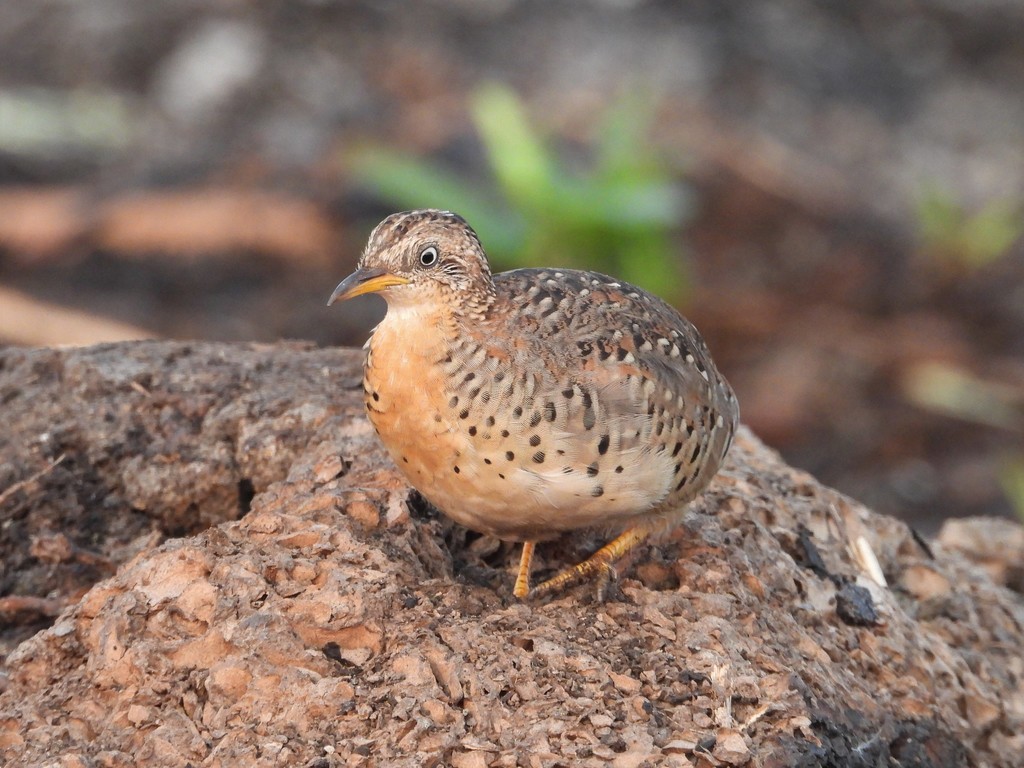
The yellow-legged buttonquail is a small quail growing to a length of 15 to 18 cm (6 to 7 in), the females being slightly larger and more brightly coloured than the males. The weight is 36 to 43 g (1.3 to 1.5 oz) for the subspecies Turnix tanki tanki, and 35 to 78 g (1.2 to 2.8 oz) for the male T. t. blanfordii, while the female of this subspecies is 93 to 113 g (3.3 to 4.0 oz). The tail is short and the wings have rounded ends. The adult male has a black crown with a buff margin, and sometimes a buff central streak. The front and side of the head are buff, the individual feathers having black tips. The throat is pale buff, darkening to reddish-buff at the edges and on the breast, and paling again on the belly, becoming white at the under tail coverts. The sides of the breast are scattered with round black spots. The nape and upper parts of the body and tail are greyish-brown, with reddish and dark brown vermiculations and spotting. The main wing feathers are blackish-brown with buff margins, and the wing coverts are buff with dark spots. The beak is dull yellow, the irises whitish, and the legs and feet deep yellow. The adult female differs from the male in being a richer colour and in having a broad, reddish-brown collar round the back of the neck. …
Range & habitat
The species is endemic to the Indian subcontinent, East Asia and Southeast Asia. There are two recognised subspecies; T. t. tanki is found in Pakistan, India and Nepal, and the Andaman and Nicobar Islands; and T. t. blanfordii is found in Myanmar, and Indochina, and eastwards to eastern China. It also migrates to and breeds in the Korea peninsular and the southernmost parts of southeast Russia. In most of its range it is a resident species, but it migrates to the drier parts of India in the wet season, and similarly to the southeastern part of Russia, making its journeys by night.
Wikipedia: “Distribution and habitat”
What it does
This species is ground-dwelling and usually runs away from danger rather than taking to the air. It is generally seen singly or in pairs.
Feeding. The diet includes green plant material, seeds, and a variety of insects including beetles, ants and grasshoppers.
Breeding. Breeding takes place between March and November, mostly in the wet season. Females have a bright rufous nape collar which is moulted during the non-breeding season. Females offer food to males during courtship and once the eggs are laid, the females leave incubation to the male. The eggs hatch after about 12 days (in captivity) and the chicks follow the male after hatching. The nest is a scoop in the ground lined with grasses and often roofed with bent-down plant stems, having an entrance at the side. A clutch of four greyish-white, blotched eggs is laid and these are incubated by the male alone; they hatch after twelve to sixteen days and the chicks are cared for by the male. After her eggs are laid, the female moves off and selects another mate, with whom she lays another clutch of eggs in a different nest.
Wikipedia: “Behaviour”
Listen
Looking for field recordings…
Where it lives
Recorded sightings
—
geo-referenced records in GBIF, from museums, herbaria and field observers.
Drag the globe to turn it. Dots are where records exist, not a range map; darker means more records.
In the stacks
Searching the stacks…
Every page naming Turnix tanki in the Biodiversity Heritage Library →
This page is assembled live from iNaturalist, GBIF, Wikipedia, the Source Library and the Internet Archive. It is not yet part of the hand-edited codex. iNaturalist taxon 20897.